Toolaby: Add Subscription Payments to Your Chrome Extension in Two Lines of Code

Toolaby lets Chrome extension developers monetize with two lines of code, routing payments straight to their own Stripe account.
Toolaby is a monetization infrastructure tool built for Chrome extension developers, designed to eliminate the backend burden of adding license validation, subscriptions, free trials, and paywalls. Its two core selling points are no server required and payments routed directly into the developer's own Stripe account rather than through a platform intermediary. Pricing comes in two tiers — 0.5% per sale or a flat $25/month Pro plan — with Pro becoming more economical above $5,000 in monthly sales. The product is also optimized for AI coding assistants, letting developers hand off integration to tools like Cursor or Copilot. It's currently early-stage, and the security of client-side license verification warrants scrutiny, but it offers a low-barrier path for developers looking to validate an extension's business model quickly.
The Shortest Path to Monetizing a Chrome Extension
Building a great Chrome extension isn't the hard part — making money from it is. Many indie developers finish their plugin only to get stuck on the most time-consuming piece: adding license validation, subscription management, free trials, and a paywall, then securely routing payments into their own account. These features sound straightforward, but in practice they require standing up a backend, handling payment webhooks, and managing user authorization state — no small burden for a solo developer.
Toolaby, which recently launched on Product Hunt, is aimed squarely at this pain point. Its pitch is almost provocatively blunt: "Charge for your Chrome extension in two lines of code." The product is currently ranked #19 on the leaderboard with 65 upvotes, built by maker Miltos Tave, and sits at the intersection of Chrome Extensions, Payments, and Developer Tools.
Core Capabilities: Licenses, Subscriptions, and Trials in One Place
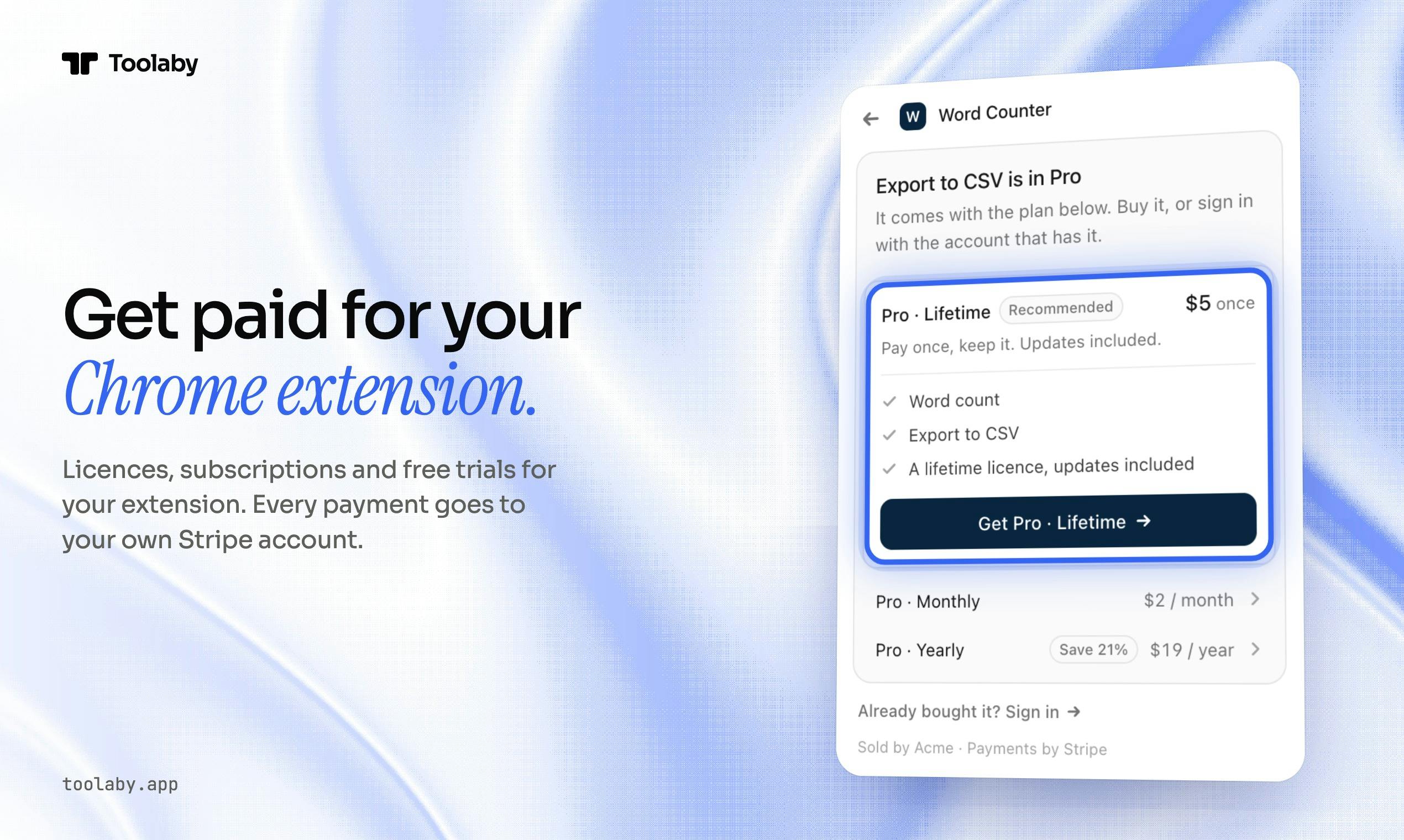
Toolaby packages the monetization infrastructure a Chrome extension needs into a single, ready-to-use solution. According to the official description, it adds four capabilities to your extension:
- Licences: Control who can access paid features
- Subscriptions: Support recurring billing models
- Free trials: Let users try before they buy to improve conversion
- Paywall: Gate key features behind a payment requirement
There are two ways to integrate: developers can run a single command to plug it in, or simply "let your coding Agent do it." That second option is an interesting detail — it implies that Toolaby's SDK and documentation are designed to be AI-agent-friendly, meaning developers don't even need to read the docs themselves; they can hand the task off to tools like Cursor or Copilot. This reflects an emerging product design philosophy: treating "can an AI agent integrate this smoothly" as a first-class metric of developer experience.
No Backend Required + Funds Go Directly to Your Stripe Account
The two most notable design decisions in Toolaby are no backend required and funds deposited directly into the developer's own Stripe account.
The first means developers don't need to worry about server hosting, the reliability of an authorization service, or its security posture — eliminating a significant amount of operational overhead and potential technical debt. The second addresses trust: money doesn't pass through a Toolaby intermediary account. It goes straight into the developer's own Stripe, reducing the risk of funds being held, platform failure, or settlement delays, and keeping the developer in full control of their revenue and customer data.
For indie developers who've grown wary of platforms with high take rates and slow payouts, the model of "I use the infrastructure, I keep my money" is genuinely appealing.
Stripe Connect is the underlying mechanism worth understanding here. Stripe offers a feature called Connect that allows a platform (like Toolaby) to process payments on behalf of third-party merchants (the extension developers), while routing funds directly to the merchant's own registered Stripe account. This means Toolaby technically acts as a "platform intermediary," but settlement rights and fund ownership remain entirely on the developer's side. This is fundamentally different from aggregated payment platforms that pool all funds into a master account before distributing to sellers — a model that carries pooled-funds risk. Through Stripe Connect, Toolaby can collect a service fee without ever holding user funds, which is also the technical foundation that makes its "0.5% cut" model work.
Pricing: 0.5% Per Transaction or $25/Month
Toolaby offers two billing plans with a clear logic:
- Pay-as-you-go: A 0.5% fee on each sale — suitable for developers just starting out with unpredictable sales volume
- Pro subscription: A flat $25/month with no per-transaction fee — better for projects with consistent revenue
A 0.5% rate is quite restrained for a payments tool — keep in mind this is on top of Stripe's own processing fees (typically around 2.9% + $0.30). There's a clear break-even point between the two tiers: once monthly sales exceed $5,000, the 0.5% cut exceeds $25, making Pro the smarter choice. This structure lets the product serve both side-project developers and projects that have already achieved meaningful scale.
A Brief Assessment
Toolaby addresses a real and persistent need: monetization infrastructure for extension developers. Similar ideas are well-established in the App Store and SaaS ecosystems (think RevenueCat or Lemon Squeezy), but the Chrome extension ecosystem has long lacked a purpose-built tool. Toolaby is filling that gap.
That said, the product is still early-stage — it has only 2 comments on Product Hunt. The stability of real-world integrations, the risk of license verification being bypassed (extension code runs client-side and is inherently easier to reverse-engineer), and support for non-Stripe payment methods all remain to be tested by time and a larger user base. For developers looking to quickly validate the business model of their extension, it's worth trying; but before betting your core revenue on it, assessing its long-term reliability is advisable.
Overall, Toolaby offers a low-friction new path to Chrome extension monetization through minimal integration effort and a developer-friendly fee structure.
Client-side license verification is a structural weakness in Chrome extension monetization that deserves its own callout. Chrome extensions are, at their core, JavaScript running in the user's browser. Users can inspect and tamper with the logic via DevTools, by unpacking the .crx file, or by modifying the Service Worker. If license validation runs entirely on the client, a sufficiently skilled user can bypass it and access paid features for free. A truly robust solution moves validation server-side — the extension makes a request to a backend to confirm authorization each time a paid feature is invoked, with the server holding the source of truth. Toolaby claims no backend is needed, which raises a legitimate question: at which layer does its license validation actually execute? If it's purely client-side, the security guarantees are limited. If Toolaby provides its own verification server, developers take on a dependency risk tied to that service's uptime. This is a technical detail worth investigating carefully before adopting the tool.
Related articles

Felix Rieseberg Personal Homepage
Felix Rieseberg's personal homepage sparks attention on Hacker News. This article covers the Slack engineer's technical background, the rise and fall of nativefier, and the value of a developer homepage as a tech calling card.

@ai-sdk/vue 3.0.306 Patch Release Syncs with [email protected] Update
@ai-sdk/vue 3.0.306 released, synced with [email protected]. A routine patch release for the Vercel AI SDK ecosystem with no public API changes; the Vue adapter layer stays version-aligned with the core package.

Gemini 4 Argon API Launches: The Era of Million-Token Output Begins
Google launches Gemini 4 Argon with sparse MoE architecture, up to 1M output tokens, and a 68.90% Vals Index score, available across API, AI Studio, and the Gemini app.