Top AI Coding Tools Compared: How to Choose the Right Programming Assistant

A practical comparison of four leading AI coding tools — international vs. domestic — with selection advice.
This article surveys the international and domestic Chinese camps of AI coding tools, covering GitHub Copilot, Cursor, Tongyi Lingma, and Trae. All four share core capabilities — code completion, chat Q&A, multimodal interaction, and Agent mode — but diverge on model support, pricing, and network accessibility. International tools integrate Claude, GPT, and Gemini for higher code quality at $10–$20/month, while domestic tools offer Qwen3, Doubao, and DeepSeek at lower or no cost with full compliance for China-based developers. The recommendation: use each tool's free tier before committing.
AI-assisted coding tools are rapidly becoming a staple in developers' daily workflows. From code completion to autonomously handling full development tasks, these tools have evolved from a "nice-to-have" into a productivity standard for many teams. Products on the market broadly fall into two camps — international and domestic Chinese — each with notable differences in model support, features, and pricing. This article, based on a systematic course overview of these tools, breaks down four representative products and offers practical selection advice.
International Tools: GitHub Copilot and Cursor
GitHub Copilot: A Joint Effort from Microsoft and GitHub
GitHub Copilot, developed jointly by Microsoft and GitHub, is installed as a plugin directly inside your IDE and is currently one of the most recognized AI coding assistants available. Its core capabilities span three areas: code completion, in-IDE chat Q&A, and the much-discussed Agent mode.
Agent mode can autonomously plan, write, and test code based on natural-language descriptions of requirements. It supports cross-file analysis and modification, enabling large-scale code changes. In practice, this means a developer can describe a need in plain language and let the tool break it down and execute it independently.
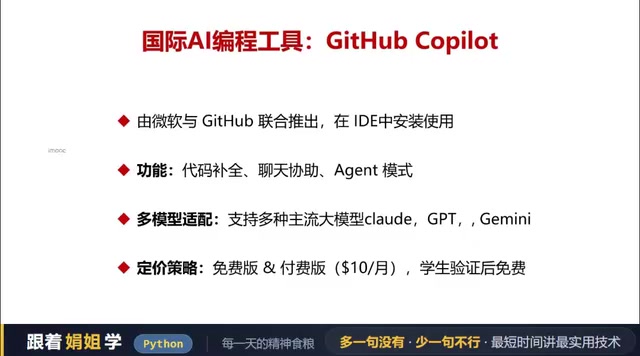
Model flexibility is another major advantage of Copilot. It integrates with a range of leading large language models, including Claude 3.7 / 4.0, Gemini 2.5, and the GPT series, giving developers more room to choose.
On pricing, Copilot offers both a free and a paid tier. The free tier provides 2,000 code completions and 50 Agent mode requests per month — suitable for personal learning and light use. The paid tier costs $10/month and unlocks unlimited Agent mode powered by GPT-4.1, plus code generation with more advanced models like Claude and Gemini. Verified students can also access discounted plans.
What is Agent Mode, really? Agent mode represents the latest evolution in AI coding tools — fundamentally different from traditional "line-by-line completion" or "single-turn Q&A." In traditional mode, AI passively responds to a developer's individual request. In Agent mode, the AI proactively breaks a complex goal into subtasks, sequentially calls tools (such as reading/writing files, running terminal commands, or searching the codebase), and dynamically adjusts its plan based on intermediate results — all until the overall goal is achieved. This "plan → execute → observe → re-plan" loop allows the AI to handle large changes spanning multiple files and modules, not just filling in a single function body. Understanding this distinction helps you assess how much actual work an advertised number of "Agent requests" really represents.
Cursor: An AI-Native Editor Built for Professional Developers
Cursor is an AI-driven code editor built around the core goal of boosting developer productivity, with a focus on intelligent, efficient experiences that align with how developers actually work. Its code completion is powered by context-aware prediction of the next edit, while its codebase understanding feature analyzes entire repositories to generate relevant answers.
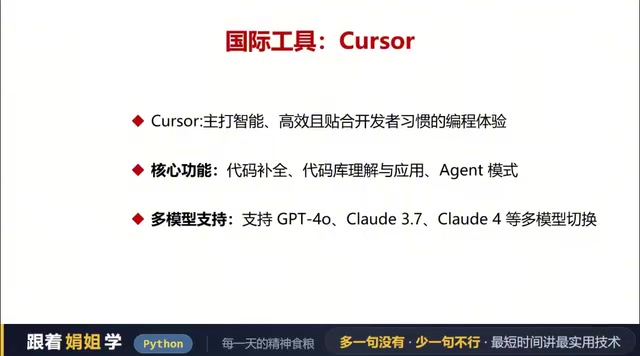
Cursor's most powerful feature is also Agent mode — it autonomously plans code modification logic, analyzes requirements, breaks them into steps, and executes development tasks incrementally to minimize manual intervention. On the model side, it supports switching between internationally leading models like GPT-4o and Claude 4.
In terms of pricing, Cursor offers a two-week free trial that includes limited Agent requests and code completions. The paid plan runs $20/month, with the primary difference being a higher number of Agent requests. Combined with advanced model access and an excellent developer experience, Cursor is best suited for professional developers.
Domestic Chinese Tools: Tongyi Lingma and Trae
Alibaba Cloud Tongyi Lingma: Powered by a Homegrown Open-Source Model
Tongyi Lingma runs on Qwen3, Alibaba's high-quality domestic open-source hybrid reasoning model. It's available both as a standalone IDE and as a VS Code plugin. One of its standout features is multimodal interaction — you can upload a UI design mockup and automatically generate frontend component code, which is particularly useful for frontend developers.
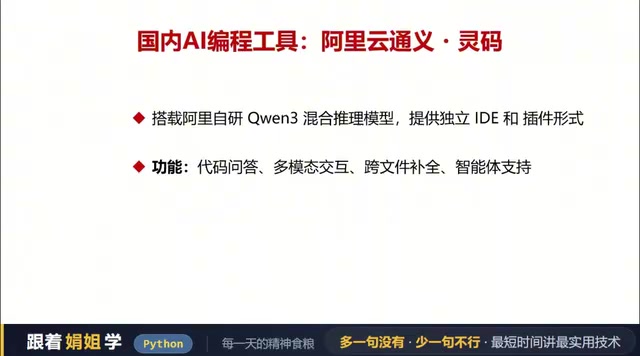
The cross-file completion feature analyzes the logical relationships between multiple files to generate coherent code, reducing the manual effort of bridging across files during development. Its most powerful feature — the "intelligent agent" mode — is functionally equivalent to the international Agent mode: it makes autonomous decisions, plans steps, calls tools to modify files, and ultimately completes complex coding tasks.
On pricing, the individual basic plan is free and includes basic coding assistance plus 50 intelligent agent conversations per month. The individual professional plan costs ¥59/month and includes additional agent conversation quota.
What is Qwen3? Qwen3 is the third-generation Tongyi Qianwen large language model series released by Alibaba Cloud in 2025. Its "hybrid reasoning" capability means the model can dynamically switch between a fast response mode (generating answers directly) and a deep thinking mode (performing chain-of-thought reasoning before output) to balance speed and quality. For code generation specifically, deep thinking mode excels at algorithm design and debugging complex bugs, while simple code completions benefit from the lower latency of fast mode. Qwen3 is released as open source, meaning enterprises can deploy it in private environments — an additional draw for teams with strict data security requirements.
ByteDance Trae: A Dual-Version Strategy for an AI-Native IDE
Trae is an AI-native IDE developed by ByteDance, offered in two versions: a domestic Chinese version and an international version. The core difference lies in model support: the domestic version supports leading Chinese models like Doubao and DeepSeekAd, while the international version supports GPT, Claude, Gemini, and other global models.
Feature-wise, Trae provides code completion, intelligent Q&A, and MCP service support — using the MCP protocol to connect with a wide range of external tools to assist with project development. Its intelligent agent feature can help developers build projects from scratch, covering everything from initial setup to iterative development.
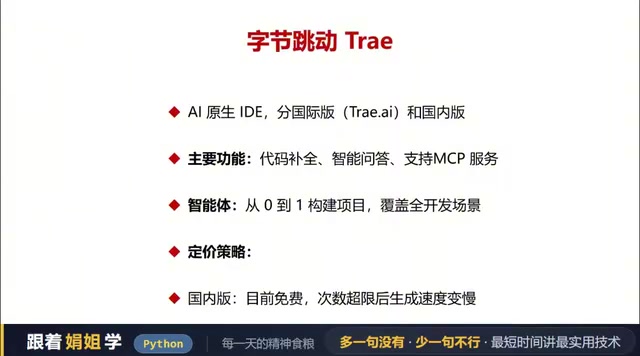
On pricing, the domestic version is currently free, though code generation speed slows down once the agent mode usage limit is exceeded. The international version costs $3 for the first month and $10/month thereafter.
What is MCP? MCP (Model Context Protocol) is a standardized protocol proposed and open-sourced by Anthropic in late 2024, designed to unify how AI models connect to external tools and data sources. Before MCP, every AI tool that wanted to integrate with external resources — code runners, databases, browsers — had to build proprietary integration logic, which was costly to maintain and incompatible across tools. MCP essentially defines a universal "socket standard" for AI tools: as long as an external tool implements the MCP server-side spec, any MCP-compatible AI client can call it directly. Trae's MCP support means it can cheaply tap into the large ecosystem of community-built MCP Servers — including file system operations, GitHub APIs, database queries, and more — continuously expanding the agent's tool-calling capabilities without modifying the IDE's core code.
International vs. Domestic: How to Choose
Looking across all four tools, their core capabilities are strikingly similar: code completion, chat Q&A, multimodal interaction, and Agent/intelligent agent mode are virtually standard across the board. The real differentiators are model quality, regulatory compliance, and price.
International tools support leading global large language models, generally delivering higher code generation quality — but they come with higher price tags and require access to international networks. For developers who prioritize code quality and can meet the compliance requirements, these are worth considering first.
Domestic Chinese tools support models that comply with Chinese regulatory requirements, are priced lower or even free, and work directly on domestic networks — making them far more accessible for developers in China. The tradeoff is the absence of leading international models, and code generation quality still lags behind the best global models.
A practical recommendation: both international and domestic tools offer free usage tiers. Try them out first at no cost, assess the real-world results, and then decide whether to pay based on your actual usage depth. There's no universal right answer — the key is matching your choice to your network environment, budget, and code quality requirements.
Related articles

How Big Can Stars Really Get? The Physical Limits of the Largest Stars
Red supergiants are the largest stars by volume, with radii up to 2,000 times the Sun, engulfing the inner solar system. But there is no precise upper limit on stellar size—models predict up to 15,000 solar radii. The most massive blue stars are far smaller than red supergiants—biggest and heaviest are two different things.

Apple HomeView Smart Display Full Feature Breakdown: Wall-Mount or Desktop, $299
Apple launches HomeView, a $299 smart display with wall-mount and desktop options, 12MP camera for facial recognition, smart home control, music playback, and recipe step-by-step cooking. Full breakdown of watch faces, apps, privacy, and cooking integration.

Where Did the Promised New Studio Go? Craft Computing Answers After Five Years
Craft Computing's host responds to viewer questions: the new studio promised five years ago was shelved as construction costs soared from $30,000 to $75,000, and was replaced by a 168-square-foot garage conversion.