Top AI Conferences Plagued by "Desk Rejects": ICLR Submission Chaos and the Peer Review Dilemma

Desk rejects are increasingly common at top AI conferences, reflecting the deep contradiction between surging submissions and limited review resources.
Starting from a Reddit post about ICLR desk rejects, this article examines the phenomenon where papers are rejected before peer review, wasting reviewers' efforts and leaving authors without feedback. It analyzes common triggers, highlights the gray practice of using multiple accounts to bypass submission limits, and argues the root cause is exploding submissions outpacing reviewer capacity.
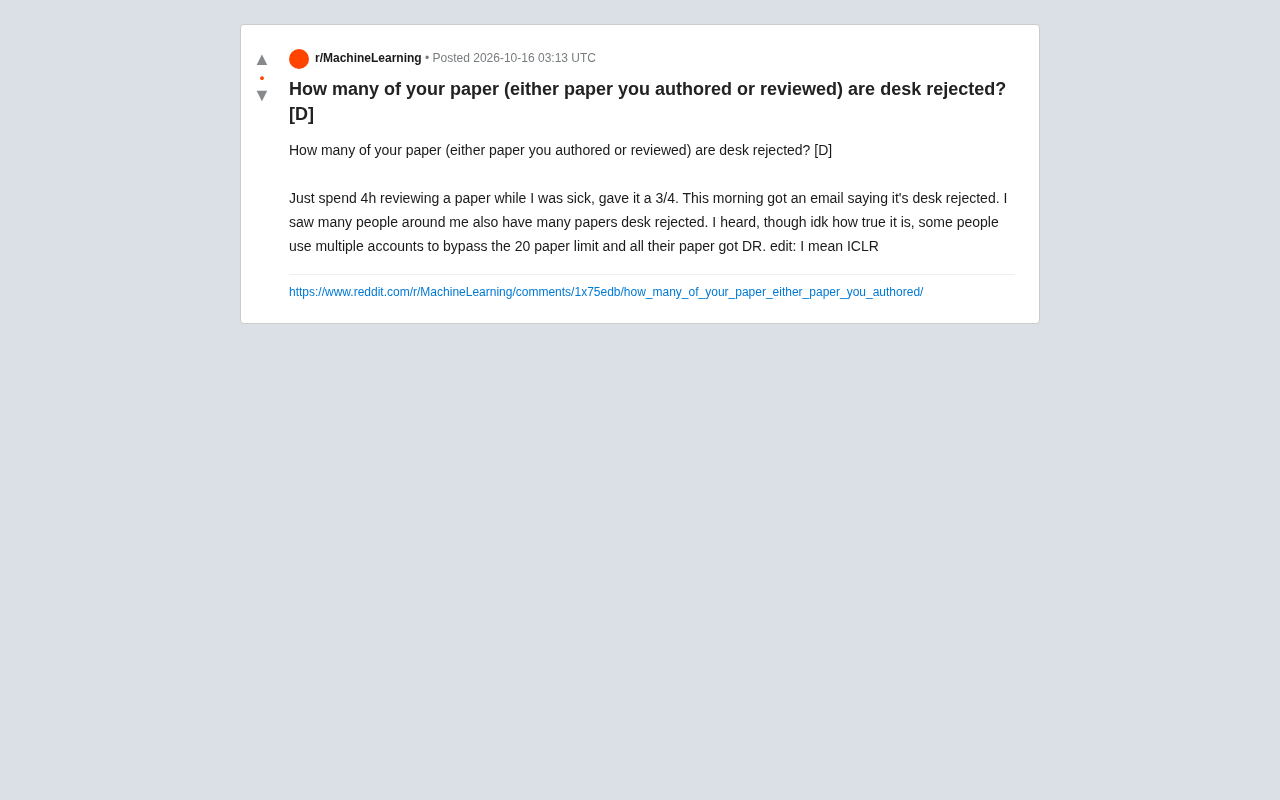
In academia, especially when submitting to top AI conferences, there's a type of rejection that's more disheartening than being rejected after receiving reviewer feedback — Desk Reject. It means the paper was returned directly by an Area Chair or Program Committee before even entering the peer review process. Recently, a Reddit discussion about ICLR struck a chord with many researchers: a reviewer spent 4 hours reviewing a paper while sick, gave it a score of 3/4, only to receive an email the next morning notifying them that the paper had been desk rejected. This isn't just one person's experience — the flood of replies below the post shows that desk rejection is becoming a widespread phenomenon in top conference submissions.
What Is a Desk Reject and Why Is It So Frustrating
A desk reject occurs when a paper is rejected by an editor, Area Chair (AC), or Program Committee before entering formal peer review. Unlike regular rejections, desk rejects typically come without detailed reviewer comments — authors often receive only a brief email and don't even know the specific reason their paper was rejected.
At conferences like ICLR that use the OpenReview platform, common triggers for desk rejection include: formatting violations, exceeding page limits, double-blind policy violations, duplicate submissions, and — increasingly in recent years — "mass submissions." For authors, the most direct cost is time — submission cycles often last months, and a desk reject means all that preparation yielded no valuable feedback whatsoever.
For reviewers, desk rejects are equally frustrating. The original poster mentioned spending 4 hours reviewing a paper and giving it a positive score, only to find out it never entered the decision-making process at all. This "reviewing for nothing" experience is draining reviewers' motivation.
OpenReview is an open peer review platform widely adopted by top AI conferences. ICLR has used it fully since 2018, and conferences like NeurIPS and ICML have gradually followed suit. Unlike traditional review systems, OpenReview allows papers, reviews, and author responses to be publicly displayed during or after the review period (some conferences use anonymization or delayed disclosure strategies), with all discussions leaving traceable records. This mechanism enhances review transparency and makes desk reject behavior easier for the community to observe and discuss. Additionally, OpenReview's account system is tied to author identities and institutional emails, providing the technical foundation for conferences to identify linked accounts — which is one of the prerequisites enabling the cross-account detection mentioned later.
Double-blind policy is an institutional design adopted by conferences to ensure review fairness, requiring reviewers not to know author identities and authors not to know reviewer identities. During submission, authors must anonymize names, institutions, acknowledgments, project links, and other information in their papers. Violating the double-blind policy (such as promoting a paper prominently on preprint platforms in advance or leaving identifiable information in the paper) is one of the common triggers for desk rejection. However, the boundaries of double-blind policy enforcement are controversial in practice: whether arXiv preprints count as violations, how to anonymize GitHub code repositories — regulations vary across conferences, and authors can easily cross the line with a single misstep.
Multiple Accounts Bypassing Submission Limits: A Hotly Debated Gray Area
The post mentioned a noteworthy detail: someone used multiple accounts to bypass the 20-paper submission limit. Conferences like ICLR typically impose a cap on submissions per account to prevent mass flooding. But by registering multiple accounts, some researchers can submit far more papers than the limit allows.
The original poster expressed uncertainty about the authenticity of this claim but added that "I heard all those papers got desk rejected." If this claim is true, it suggests that conference organizers may have already established cross-account detection mechanisms, such as linking identities through author names, institutional emails, ORCID, and other information.
Behind this phenomenon lies the systemic pressure from the surge in conference submissions. When the number of submissions far exceeds what reviewers can handle, the Program Committee has to adopt more aggressive measures to screen papers — desk rejection being one of them.
ORCID (Open Researcher and Contributor ID) is a globally universal unique researcher identifier in academia, consisting of a 16-digit number that can link a researcher's papers, grants, institutions, and other information. Unlike names that are prone to duplication and emails that can be changed, ORCID is unique and persistent. In conference submission systems, ORCID is often used as an auxiliary identity verification tool. When organizers suspect multi-account mass submissions, comparing signals such as ORCID behind different accounts, institutional email domains, and author list overlaps can effectively identify linked accounts. However, ORCID is not mandatory to bind, and researchers can still evade detection by using different emails and avoiding ORCID — so cross-account identification is essentially an ongoing technological game.
The Program Committee (PC) is the core organization for conference review work, composed of Area Chairs (ACs) and a large number of reviewers. ACs are responsible for coordinating review assignments, quality control, and final decisions within a specific sub-field, while Program Chairs are responsible for overall process design. Against the backdrop of surging submissions, ACs have been given the authority to screen and eliminate papers before the review process begins — desk rejection is a product of this authority. Therefore, fluctuations in desk rejection rates largely depend on individual AC judgment standards and conference policy direction, which is the institutional root of why its standards are often criticized for lack of transparency.
Why Are Desk Rejects Increasingly Common? The Imbalance Between Submissions and Review Resources
Submissions to top AI conferences have experienced explosive growth over the past few years. The number of submissions to ICLR, NeurIPS, ICML, and other conferences has ballooned from thousands to tens of thousands, while the number of reviewers has not grown in tandem. Each reviewer is responsible for an increasing number of papers, and review quality consequently suffers.
Against this backdrop, desk rejection becomes a valve for the Program Committee to control workload. By setting stricter format reviews, clearer topic matching requirements, and screening for suspicious submission behavior, ACs can filter out a portion of papers before they enter the review pool.
But this approach has also sparked controversy. Some researchers argue that desk rejection standards are not transparent enough, authors often cannot learn the specific reasons, and it's difficult to improve their papers accordingly. Others worry that desk rejection may be abused as a means for certain ACs to quickly reduce their workload.
Review incentives are key to understanding the review system's predicament. The vast majority of reviewers at top AI conferences are senior researchers, postdocs, and graduate students participating voluntarily without compensation. Conferences typically require "submit one paper, review several" as a qualification for submission, but this mandatory linkage also brings problems: some reviewers lack motivation to review carefully, or review burdens are so heavy that quality declines. In contrast, the journal system has dedicated editors overseeing quality, while the conference system relies heavily on community self-governance. When submission volumes swell beyond what review resources can match, the Program Committee can only tighten screening at the entry point, and desk rejection becomes a "pressure relief valve" for systemic overload. Some researchers have proposed introducing review compensation, AI-assisted preliminary screening, and tiered review, but these measures remain controversial in terms of implementation cost and fairness.
The Impact of Desk Rejects on the Academic Ecosystem
The widespread normalization of desk rejects is changing researchers' submission strategies. Some are beginning to pay more attention to format compliance and topic matching to reduce the risk of desk rejection. Others are choosing to submit to conferences or journals with shorter review cycles and lower desk rejection rates.
From a broader perspective, desk rejects reflect a deep-seated contradiction in the current academic publishing system: the growth rate of submissions exceeds the carrying capacity of the review system. If this trend continues, conference organizers may need to make greater adjustments in submission thresholds, review incentives, and review process automation.
The original poster's experience is not an isolated case. In the Reddit discussion, many researchers shared experiences of desk rejection — their own or those around them. Some said "many people around me have had papers desk rejected," while others questioned whether conference screening standards are fair. These discussions point to a common problem: against the backdrop of continuously swelling submission volumes, how to establish an efficient yet fair paper screening mechanism is one of the core challenges facing top conferences.
One-line Summary
Desk rejects are increasingly common at top AI conferences, reflecting the deep-seated contradiction between surging submissions and imbalanced review resources.
Paragraph Summary
Starting from a Reddit discussion post about ICLR desk rejects, this article systematically examines the phenomenon. Desk rejection means a paper is rejected directly by an Area Chair or Program Committee before entering peer review, with authors often receiving no specific reason and reviewers' efforts going to waste. The article analyzes common triggers for desk rejection (format violations, double-blind violations, mass submissions, etc.) and pays special attention to the gray-area practice of someone using multiple accounts to bypass the 20-paper submission limit — only to have all papers desk rejected anyway. The article points out that the fundamental reason for the prevalence of desk rejects is that top AI conference submissions have ballooned from thousands to tens of thousands, while the number of reviewers has not grown in tandem, forcing the Program Committee to use desk rejection to control workload. The lack of transparency in desk rejection standards has also sparked controversy and is changing researchers' submission strategies, exposing the deep contradiction between the carrying capacity of the academic review system and the scale of submissions.
Related articles

Understanding DeepSeek in 3 Minutes: The Rise from a Quant Hedge Fund to an Open-Source AI Leader
DeepSeek's history in 3 minutes: from High-Flyer Quant's compute build-up to V2's MLA inference cost cuts, V3's $5.576M training bill, R1's open-source global shock, and V4 with a $7B Series A.

Local Creative Writing Model Showdown: Fine-tuned Qwen3.8 27B Wins, DeepSeek v4.1 Underwhelms
Bilibili creator tests seven local creative writing models: Hemingway and HumanLike Chat based on Qwen3.8 27B perform best, DeepSeek v4.1 is plain, Dongfang Shuo ranks last with confused characters. Includes three test prompts, scores, and usage advice.

Liang Wenfeng's Three Big Bets: Why Did DeepSeek Open-Source Its 82% Gross Margin?
Why did DeepSeek open-source DeepInfer, its 82% gross margin inference framework, and then launch a hundred-billion funding round? An analysis of Liang Wenfeng's three big bets and the open-source strategy.