Top Conference Paper Flood: AI Ghostwriting Is Eroding Academic Trust

Reddit exposé of AI top conference chaos calls for rejecting AI-generated papers to rebuild academic trust.
A researcher posted on Reddit calling on AI top conferences to take stricter measures to reject AI-generated papers, sparking widespread resonance. The post described absurd scenes at top conferences: authors unable to explain basic concepts in their papers, even reading answers from ChatGPT on the spot; the same paper accepted at two conferences simultaneously, with LLM prompts left in the code repository and all data fabricated. The poster noted that this harms honest researchers and pollutes the literature pool, shifting researchers' mindset from "presumed credible" to "presumed suspect." Existing peer review struggles to identify such papers due to time and means constraints. The way out lies in in-depth defenses, code reproducibility requirements, strict duplicate checking, and rebuilding a culture of academic integrity—not relying solely on detection tools.
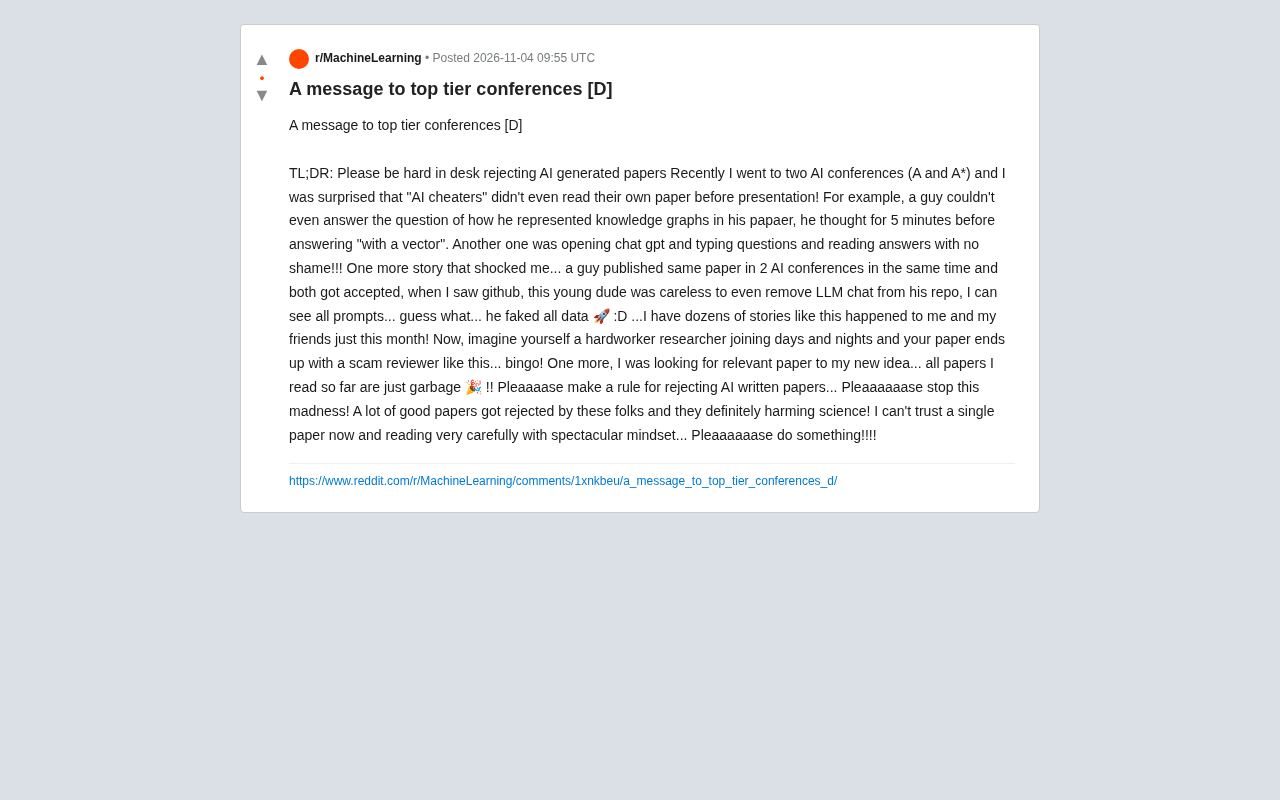
A researcher posted on Reddit calling on top tier conferences to take stricter measures to reject AI-generated papers. The post quickly resonated because it struck a growing anxiety: when AI can easily generate seemingly complete papers, can academic conferences still hold the quality line?
On-Site Observations: Even Authors Don't Understand Their Own Papers
The poster described what he witnessed at two recent AI top conferences (A and A*). One presenter, when asked how knowledge graphs are represented in the paper, thought for five minutes before answering "with vectors." Another unabashedly opened ChatGPT on the spot, typed in the question, and read the answer aloud. Even more shocking, someone submitted the same paper to two AI conferences simultaneously, both were accepted, and the GitHub repository still had the prompts used to converse with the LLM uncleaned—all the data was fabricated.
These are not isolated cases. The poster said that within just one month, he and his friends had accumulated dozens of similar stories.
The Plight of Diligent Researchers and the Crisis of Trust in Science
The poster pointed to the systemic consequences: honest researchers who work late into the night writing papers may see their efforts come to nothing because of "fraudulent reviewers." When he searched the literature for related work on new ideas, he found that "all the papers I read were garbage." This feeling is not isolated—when AI-generated content floods in, reviewers need to spend more effort to discern quality, and the passage of low-quality papers further pollutes the literature pool.
The core concern is the collapse of trust. "I can't trust any paper now," the poster wrote, saying he has to read word by word with extreme caution. This shift from "presumed credible" to "presumed suspect" is precisely a signal that the ecosystem of academic communication is being eroded.
Why Is Existing Peer Review Struggling to Cope?
Peer review relies on reviewers' professional judgment, but AI-generated papers are often formally complete, logically coherent, and can even cite real literature. The problem is that reviewers usually lack the time or means to verify data authenticity, code reproducibility, and the author's actual depth of understanding of the content. When authors themselves cannot explain basic concepts, the review process should act as a filter, but the reality is that these papers have already passed review.
The poster called on top conferences to establish clear rules to reject AI-generated papers. This is not opposition to AI-assisted writing, but a demand that authors have substantive mastery of the paper's content. If someone cannot even answer how knowledge graphs are represented, the originality and authenticity of the paper are questionable.
Peer Review is the core quality assurance mechanism of academic publishing: after authors submit, experts in the same field (usually 2-4) review anonymously or openly, assessing the paper's novelty, methodological rigor, and clarity of presentation, and giving recommendations to accept, revise, or reject. It relies on reviewers' professional judgment and the credibility of the academic community, not on formal checks. Precisely for this reason, it lacks immunity to content that is "formally complete but substantively hollow"—AI-generated papers often have standardized structure and reasonable terminology stacking, exactly able to pass initial screening. In addition, review is mostly unpaid labor with limited time, making it difficult for reviewers to verify data and code one by one; this mechanism becomes even more fragile when submission volumes surge.
Possible Ways Out: From Rules to Culture
Relying solely on detection tools is unreliable; AI-generated text detection itself has a high false-positive rate. More feasible directions include: strengthening in-depth questioning during defense sessions, requiring code and data to be openly reproducible, strictly checking for duplicate submissions of the same paper, and adding assessments of authors' understanding during review.
But technical means can only solve part of the problem. Behind the poster's anger is concern that the culture of academic integrity is being diluted. When "publication" becomes the goal rather than "contributing knowledge," AI merely accelerates this alienation. What top conferences need is not just a rejection rule, but a reaffirmation of the basic contract of the academic community: authors must be responsible for every word they write.
For individual researchers, this post is also a reminder: in an era when AI tools are readily available, true competitiveness still lies in deep understanding of problems and honest work. Those who read answers from ChatGPT will eventually be exposed when faced with a certain question.
AI-generated text detection currently relies mainly on statistical features (such as word frequency distribution, perplexity) or watermarking technology, but when faced with rewritten, polished, or human-machine collaborative text, both false-positive and false-negative rates are high. The more fundamental problem is that detection tools can only judge "whether it looks AI-written," not "whether the author understands the content," and the latter is the essence of academic integrity. Therefore, the industry is gradually turning to process-based verification: requiring code and data to be public, setting reproducibility checks, and probing methodological details during defenses. These methods do not depend on the accuracy of detectors, but constrain authors through a verifiable evidence chain—which is also why the rule direction called for by the poster is more feasible.
One-line Summary
Reddit exposé of AI top conference chaos calls for rejecting AI-generated papers to rebuild academic trust.
Paragraph Summary
A researcher posted on Reddit calling on AI top conferences to take stricter measures to reject AI-generated papers, sparking widespread resonance. The post described absurd scenes at top conferences: authors unable to explain basic concepts in their papers, even reading answers from ChatGPT on the spot; the same paper accepted at two conferences simultaneously, with LLM prompts left in the code repository and all data fabricated. The poster noted that this harms honest researchers and pollutes the literature pool, shifting researchers' mindset from "presumed credible" to "presumed suspect." Existing peer review struggles to identify such papers due to time and means constraints. The way out lies in in-depth defenses, code reproducibility requirements, strict duplicate checking, and rebuilding a culture of academic integrity—not relying solely on detection tools.
Related articles
 Tech Frontiers
How Do You Stop AI Agent Emails From Sounding Like AI? One Developer's Solution
AI agent emails always sound like AI? A developer shares reright: a rewrite step that validates numbers, names, and links, preventing humanizers from tampering with key info. Test data and integration details inside.
 Tech Frontiers
Starlink Mobile: SpaceX's Carrier Ambitions and the 5G Deployment Challenge
SpaceX plans to make Starlink Mobile a mainstream carrier, deploying thousands of direct-to-cell satellites and building a terrestrial 5G network to challenge AT&T, Verizon, and T-Mobile. This article analyzes its dual-track strategy, 5G deployment challenges, and the competitive landscape.
 Tech Frontiers
OpenAI Raises Another $11 Billion, Valuation Hits $1.25 Trillion
OpenAI has raised an additional $11 billion in a new funding round at a valuation of $1.25 trillion. The deal is not yet closed and is expected to be completed in the coming weeks, further consolidating its leading position in AI.