Touchy: A Deep Dive into the iOS AI Assistant Built Around Context Awareness and Low-Interruption Design
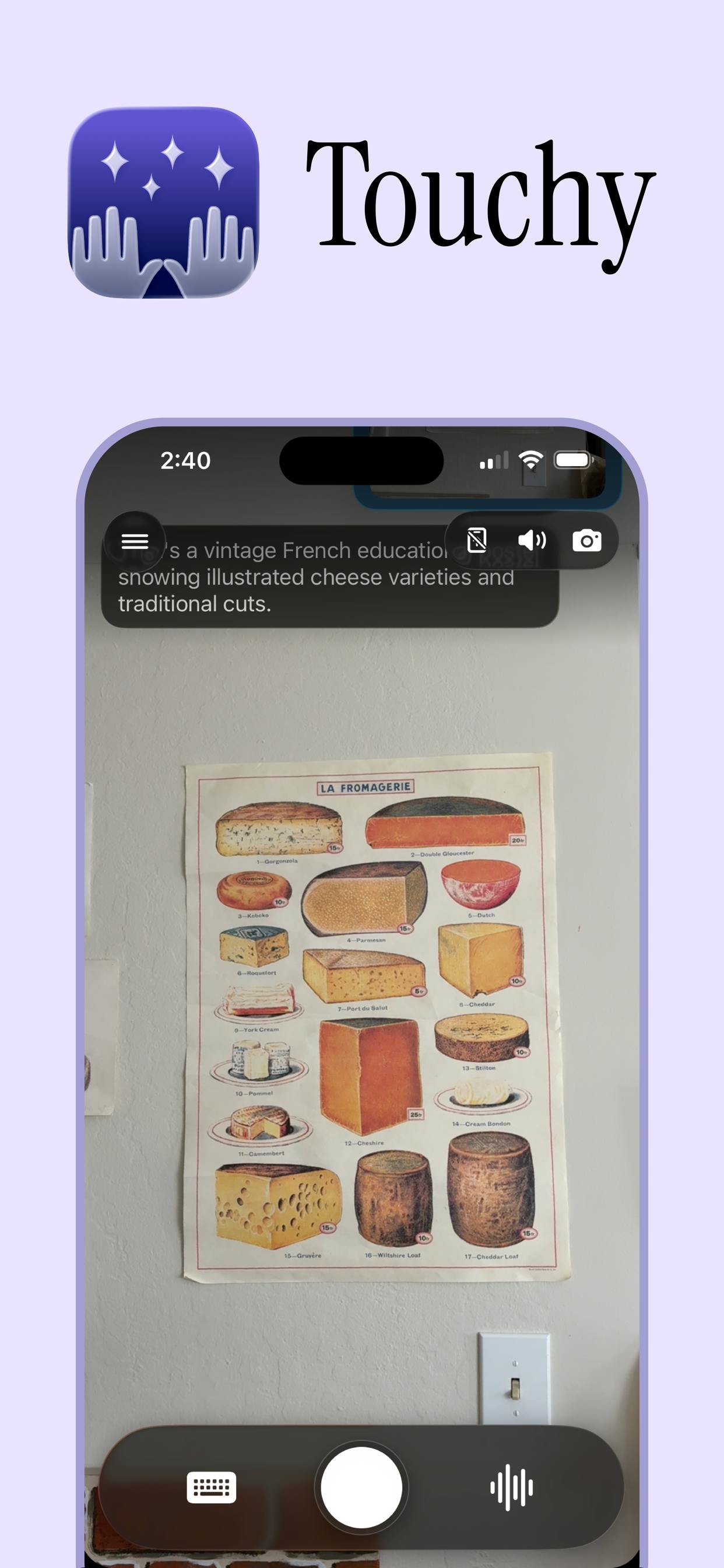
Touchy is an iOS AI assistant that uses context awareness and low-interruption design to let users ask and go.
Touchy is an iOS AI assistant that differentiates itself through environmental context awareness and a low-interruption "use-and-go" interaction philosophy. Rather than keeping users engaged in long conversations, it leverages device sensors and multimodal signals to proactively understand user context, enabling quick queries and minimal screen time. While its approach aligns with growing demand for digital wellness, the product faces challenges around privacy, sensor permissions, and sustaining differentiation in a market crowded with GPT wrapper apps.
What Is Touchy: An iOS AI Assistant Built on Environmental Understanding
In a landscape overflowing with AI assistants, Touchy made its debut on Product Hunt with the tagline "An iOS assistant that understands the world around you," earning 85 upvotes and landing at #15 for the day. It's categorized under Productivity, User Experience, and Artificial Intelligence, and was built by a team that includes Andrew Liu.
The product's core selling point isn't "more powerful conversations" — it's a more restrained, everyday-friendly interaction philosophy: let AI quietly handle tasks in the background while users ask a quick question, then put their phone back in their pocket and stay focused on the present moment.
Context Awareness: Touchy's Core Differentiator
The most telling line in Touchy's official description is: "The AI assistant that handles it quietly, so you can stay in the moment." This reveals two important design intentions.
From Conversational Interaction to Contextual Interaction
Traditional AI assistants typically require users to explicitly provide full context — where you are, what you want to do, what information is involved. Touchy's emphasis on "understands the world around you" suggests it attempts to proactively infer the user's situation through device sensors, location, time, and even camera feeds — multimodal signals that reduce the amount of information users need to manually provide.
This kind of context awareness represents a major convergence point between on-device AI and multimodal models. The concept of Context-Aware Computing dates back to research at MIT's Media Lab in the 1990s, but it's only in recent years — thanks to the maturation of on-device AI chips (like Apple's Neural Engine and Qualcomm's Hexagon NPU) and multimodal large language models — that consumer-grade productization has become feasible. "Multimodal" refers to AI models that can simultaneously process text, images, audio, sensor data, and other input types — a capability already demonstrated by models like GPT-4V and Gemini. On mobile devices, accelerometers, gyroscopes, barometers, GPS, Bluetooth beacons, ambient light sensors, and even real-time camera feeds together form a rich contextual signal matrix. By combining these signals with a language model's reasoning capabilities, an AI assistant can evolve from "passive responder" to "active understander" — precisely the technical position Touchy aims to occupy.
When an assistant can automatically understand that "you're standing in front of a supermarket shelf" or "you just received an email," its responses become more precise and effortless.
Low-Interruption Design: An Interaction Rhythm of Use-and-Go
"Ask a quick question, then put your phone back away" — this line reveals Touchy's ambition regarding interaction rhythm: it wants to be a use-and-go tool, not yet another app designed to keep users glued to their screens.
At a time when the "attention economy" faces growing criticism, this contrarian product philosophy actually carries differentiation value — it positions "using your phone less" as a selling point, rather than "using the app more." The Attention Economy concept was first sketched by Herbert Simon in 1971 and later systematically articulated by Tim Wu in The Attention Merchants. Its core logic: when information is abundant, human attention becomes the scarce resource, and apps and platforms monetize by maximizing user session duration. This model gave rise to design patterns like infinite scroll, push notifications, and badge alerts, while also drawing heavy criticism around digital addiction. In recent years, the "digital wellness" movement has gained momentum — Apple introduced Screen Time, Android launched its Digital Wellbeing dashboard, and the design community has renewed its interest in Calm Technology. Touchy's "use-and-go" philosophy directly echoes this counter-trend — rather than optimizing for DAU (Daily Active Users) or session length, it attempts to measure product value by "solving problems with minimal interaction cost."
Touchy's Product Positioning and Design Logic
Precisely Targeting Fragmented Query Scenarios
Touchy is categorized as a productivity tool, but it doesn't aspire to be a processing center for complex tasks. Instead, it targets high-frequency, lightweight, real-time query scenarios: looking up a piece of information, making a quick decision, confirming a small detail. These scenarios account for a significant share of daily life, yet they're often bogged down by the cumbersome workflows of heavyweight assistants.
According to multiple user behavior studies, smartphone users unlock their phones 80–150 times per day, with a large portion of these interactions lasting less than 30 seconds. These "micro-interactions" often involve checking the weather, converting units, verifying a fact, or quickly translating a word — lightweight needs. Traditional AI assistants (such as the ChatGPT app) typically require opening the app, waiting for it to load, typing a question, and waiting for generation — a multi-step process that can easily exceed 15 seconds, creating noticeable friction against the "ask-and-go" rhythm of fragmented needs. iOS features like Lock Screen Widgets, Live Activities, Action Button, and the Shortcuts framework provide the technical infrastructure for system-level quick access. If Touchy can compress the full chain of reach → ask → receive answer to under 5 seconds, it has a real opportunity to build user habits within this high-frequency scenario.
By lowering the cost of each individual interaction, Touchy aims to make "casually asking AI" a natural muscle memory, rather than a deliberate action that involves opening an app, formulating a query, and waiting for a response.
User Experience Over Feature Bloat
Interestingly, Touchy explicitly includes "User Experience" among its three categories. This signals that the team places experience design on equal footing with AI capability. For an AI assistant that prides itself on quiet processing, interface simplicity, response speed, and a sense of restraint in not disturbing the user are themselves core competitive advantages.
A Clear-Eyed Assessment: Opportunities and Challenges Facing Touchy
Privacy Is an Unavoidable Hurdle
"Understanding the world around you" is a double-edged sword. Greater environmental awareness typically requires more sensor permissions and data collection. On the iOS platform, Apple's strict privacy framework serves as both a constraint and an endorsement — how Touchy satisfies its sensing needs while respecting user privacy will directly determine whether it can earn user trust.
Since iOS 14, Apple has significantly strengthened its privacy protections, including precise/approximate location toggles, the App Tracking Transparency (ATT) framework, indicator lights when the camera or microphone is in use, and periodic pop-up reminders for background location access. iOS 17 further tightened the permission granularity of sensor APIs. For an app like Touchy that requires extensive environmental signals, this means every sensing capability requires explicit user authorization, and the system will continuously remind users that their data is being accessed. Apple's On-Device Processing strategy offers a viable path — sensitive data stays on the device, inference happens locally, and only results are presented to the user. The Core ML framework and Apple Intelligence's on-device inference capabilities provide the infrastructure for this approach. How to technically achieve "sensing without snooping" is the core trust question Touchy must answer.
Can Its Differentiation Hold Up Over Time?
Touchy's current tally of two comments and 85 upvotes shows it has attracted some attention, but it hasn't yet achieved validated scale. In a market surrounded by Siri, Google Assistant, and countless GPT wrapper apps, whether "environmental understanding" and "low interruption" can build a real moat remains a question that only the actual product experience can answer.
Since the ChatGPT API opened up in 2023, thousands of "GPT Wrapper" apps have flooded the App Store — apps that call OpenAI or other LLM APIs at their core, layered with different UI skins and scenario packaging. Most of these lack technical barriers, compete in a highly homogenized space, and suffer from generally low user retention. In this red ocean, products that achieve true differentiation typically need to establish an advantage along at least one of three dimensions: a unique data source (such as personal knowledge base integration), a unique interaction method (such as voice-first or gesture-driven), or unique scenario binding (such as specialized professional tools). Touchy has chosen dual differentiation through interaction method and scenario binding, using context awareness + low interruption as its moat. In theory, this is harder to replicate than pure UI differentiation, but it also demands higher standards for engineering execution and product polish.
Conclusion: Quiet Intelligence May Be the Next Direction for AI Assistants
Touchy represents a thought-provoking direction in AI assistant evolution: not chasing more power or omnipotence, but pursuing deeper contextual understanding and less interruption. Its product philosophy of "help you solve it quickly, then disappear" attempts to play a restrained role in the relationship between people and their phones.
For users tired of having their attention constantly fought over by apps, this kind of quiet intelligence may be a long-overdue solution. Whether it can truly deliver on its promise to "understand the world around you" will depend on finding that delicate balance between privacy, experience, and utility.
Related articles

DeepCell: One-Click AI Generation of Documents, Spreadsheets, and Slides
DeepCell tops Product Hunt with one-click generation of documents, spreadsheets, and slides, using the .deepcell format for linked updates, designed for System 2 tasks like modeling and sales reviews.

Doneas: 15-Minute Daily Accountability Calls That Keep Indie Developers From Procrastinating
Doneas is a daily accountability tool for indie developers: plan tasks on Monday, join a 15-minute call with five builders each day, and log deliveries on a public progress page. This article analyzes its core mechanics, effectiveness, and potential issues around retention and matching.

Fastlane 2.0: Fully Automated AI Ad Campaigns, From Creative to Optimization
Fastlane 2.0 is an AI ad automation tool: enter your website and it learns your brand, generates video and image ads, and runs and optimizes them on Meta, TikTok, Instagram, and YouTube.