TowerBridge: Weight-Space Programming Bridges the CLIP Modality Gap

TowerBridge precisely attenuates harmful directions via weight-space programming, boosting CLIP retrieval without hurting zero-shot ability.
TowerBridge solves the CLIP dual-encoder modality gap. Post-hoc gap removal hurts retrieval since the gap contains beneficial alignment structure. Using a paired statistic, it identifies directions where the model is over-consistent on hard negatives and slightly attenuates them. An LLM agent performs weight-space programming to auto-edit weights, distilling a closed-form recipe computed in seconds from 25,000 pairs—no architecture change or inference cost. On 21 CLIP checkpoints, it improves COCO retrieval by 16.8 RSUM and Flickr30k by 6.6, with ≤0.5-point zero-shot drop and reduced hubness.
Title
TowerBridge: Weight-Space Programming Bridges the CLIP Modality Gap
Meta Description
TowerBridge bridges the CLIP dual-encoder modality gap via weight-space programming, improving COCO retrieval by 16.8 RSUM on average across 21 checkpoints while dropping zero-shot accuracy by only 0.5 points—with no added inference cost.
Article Content
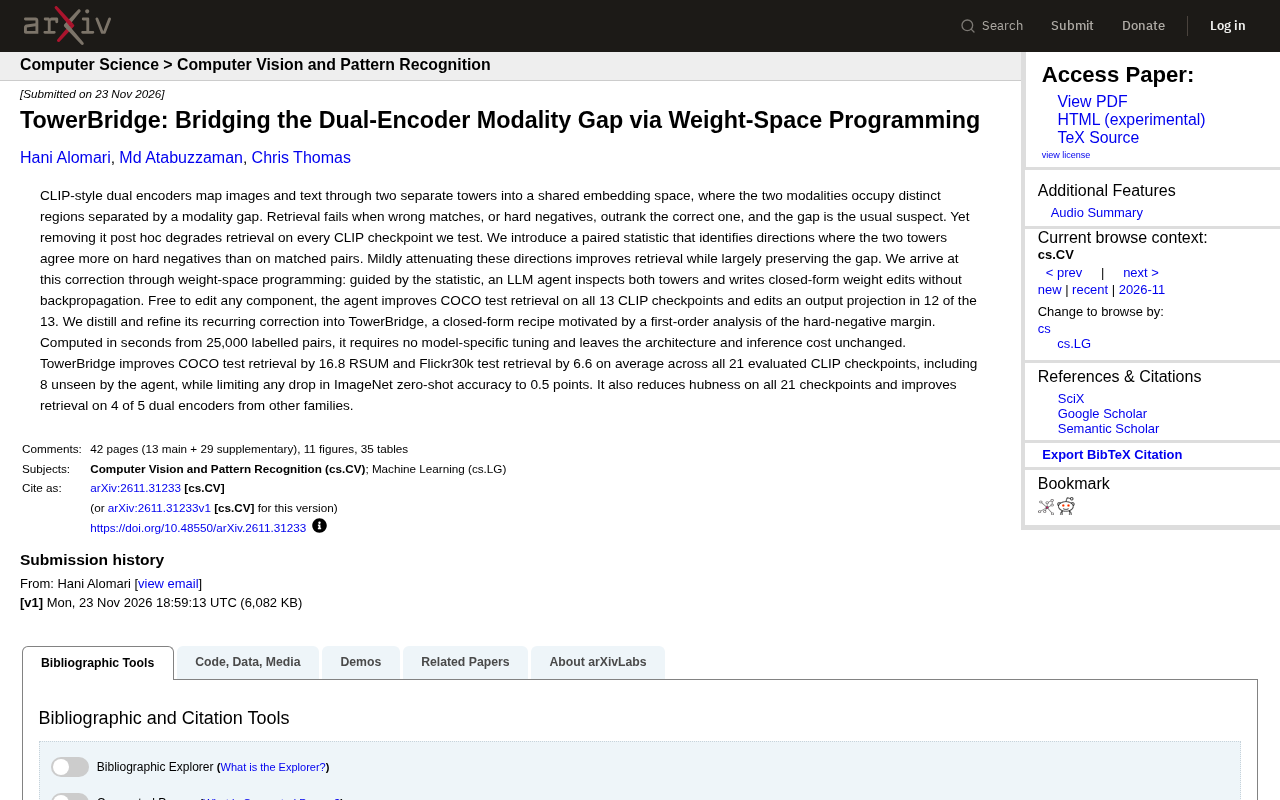
CLIP-style dual encoders map images and text into a shared embedding space, but the two modalities occupy different regions, creating a modality gap. During retrieval, mismatches (hard negatives) often rank above correct matches, and the modality gap is blamed. However, post-hoc removal of the gap actually degrades retrieval performance on every CLIP checkpoint tested. TowerBridge proposes a new method that uses weight-space programming to significantly improve retrieval performance without changing the architecture or inference cost.
The Modality Gap Dilemma: Removing It Makes Things Worse
Dual-encoder models like CLIP encode images and text through two separate towers and align them in a shared space. But embeddings from the two modalities often occupy different regions, forming the so-called "modality gap." Intuitively, the gap causes hard negatives (samples similar to the query but incorrect) to be closer to the query than correct matches in cross-modal retrieval, thus hurting retrieval performance.
But the research team found that directly removing the gap post-hoc (e.g., via centering or projection) degrades retrieval performance on every CLIP checkpoint they tested. This suggests the gap is not purely a defect; naively eliminating it destroys the alignment structure the model has already learned.
Hard negatives are a core concept in cross-modal retrieval. In contrastive learning or retrieval tasks, negatives are samples that do not match the query. Hard negatives are those that are very close to the query in embedding space and easily mistaken by the model for correct matches. For example, in image-text retrieval, for an image of "a dog running on the grass," the correct text might be "a dog running outdoors," while a hard negative could be "a cat running on the grass"—semantically similar but with a different subject. Hard negatives are "hard" because they share many visual or semantic features with the query, making them difficult for the model to distinguish. In dual encoders like CLIP, the modality gap exacerbates the hard-negative problem: because image and text embeddings are distributed in different regions, some hard negatives may be closer to the query than correct matches, thus ranking higher. Therefore, effectively handling hard negatives is key to improving retrieval performance, and TowerBridge mitigates this problem precisely by identifying and attenuating directions in which the model is over-consistent on hard negatives.
Paired Statistics: Identifying Harmful Directions
To handle the gap more precisely, the researchers introduced a paired statistic to identify directions where the two towers are more consistent on hard negatives than on matched pairs. In other words, these directions are the "culprits" behind the model confusing hard negatives with correct matches.
By slightly attenuating these directions, retrieval can be improved while largely preserving the gap. This finding overturns the intuition that "the gap must be eliminated" and adopts a gentler intervention strategy.
Weight-Space Programming: An LLM Agent Automatically Edits Weights
How do you find these directions and adjust them? The research team adopted weight-space programming. They let an LLM agent, guided by the statistic, inspect both towers and write closed-form weight edits without backpropagation.
The agent can freely edit any component, and the result improved COCO test retrieval performance on all 13 CLIP checkpoints, editing the output projection layer on 12 of them. This indicates that the output projection layer is the key place to adjust.
Weight-space programming is an emerging model-editing paradigm whose core idea is to directly modify model weights to change model behavior, rather than through traditional fine-tuning or prompt engineering. Unlike gradient-descent fine-tuning, weight-space programming typically uses closed-form solutions or regularized weight updates without backpropagation, making it extremely computationally efficient. In this paradigm, an LLM agent can play the role of "programmer": it receives guidance about the model's internal state (such as statistics), analyzes it, and decides how to edit the weights—for example, adjusting scaling factors or biases of specific layers. The agent can freely choose which components to edit (such as the output projection layer) and generate specific weight modification plans. The advantages of this approach are: it does not change the model architecture, does not increase inference cost, and the editing process is interpretable and reproducible. TowerBridge uses an LLM agent to automatically search for effective editing strategies in weight space, ultimately distilling a general closed-form recipe.
TowerBridge: The Distilled Closed-Form Recipe
The researchers distilled the correction method repeatedly used by the agent into a closed-form recipe called TowerBridge. The recipe is based on a first-order analysis of the hard-negative boundary, computed from 25,000 labeled pairs in just seconds, requires no model-specific tuning, and does not change the architecture or inference cost.
On 21 evaluated CLIP checkpoints (including 8 unseen by the agent), TowerBridge improves COCO test retrieval performance by an average of 16.8 RSUM and Flickr30k test retrieval by 6.6, while limiting the maximum drop in ImageNet zero-shot accuracy to 0.5 percentage points. In addition, it reduces hubness on all 21 checkpoints and improves retrieval performance on 4 of 5 dual encoders from other families.
RSUM (Recall Sum) is a commonly used comprehensive evaluation metric in information retrieval, usually referring to the sum of multiple recall rates (Recall@K). For example, in cross-modal retrieval, Recall@1, Recall@5, Recall@10, etc. are often computed, and RSUM is the sum (or weighted sum) of these values, measuring the model's overall retrieval capability at different ranking thresholds. The higher the RSUM, the higher the correct matches rank in retrieval results. TowerBridge's average improvement of 16.8 RSUM on the COCO test set means significant improvements across multiple recall metrics. The hubness phenomenon is a common phenomenon in high-dimensional spaces: certain points (called "hubs") become the nearest neighbors of many other points, causing retrieval results to favor these hub points, reducing diversity and hurting retrieval performance. In cross-modal retrieval, hubness causes some samples to be over-retrieved while other relevant samples are ignored. TowerBridge reduces hubness on all 21 checkpoints, indicating that it not only improves average performance but also improves the distributional balance of retrieval results.
Multi-Source Validation and Significance
According to analyses by Bilibili creators and YouTube channels, TowerBridge represents a new direction in the field of model editing: using LLMs for weight-space programming rather than traditional fine-tuning or post-hoc processing. The method is not only effective but also efficient, providing a new tool for optimizing multimodal retrieval systems.
Compared with prior work, TowerBridge's uniqueness lies in that it does not try to eliminate the modality gap but instead precisely attenuates harmful directions, preserving the beneficial part of the gap. This fine-grained intervention greatly improves retrieval performance while leaving zero-shot classification ability almost unaffected.
Conclusion
Through weight-space programming and paired statistics, TowerBridge cleverly solves the modality gap problem of CLIP dual encoders. Its closed-form recipe is simple and efficient, validated on multiple checkpoints and datasets, opening a new path for improving multimodal retrieval performance. In the future, this method is expected to extend to more dual-encoder architectures and tasks.
One-line Summary
TowerBridge precisely attenuates harmful directions via weight-space programming, significantly improving CLIP retrieval performance without harming zero-shot ability.
Paragraph Summary
TowerBridge proposes a new method to solve the modality gap problem in CLIP dual encoders. The study finds that post-hoc removal of the gap actually degrades retrieval performance, because the gap itself contains beneficial alignment structure. By introducing a paired statistic, the researchers identify directions where the model is more consistent on hard negatives than on correct matches, and slightly attenuate these directions to improve retrieval. The method uses weight-space programming, letting an LLM agent automatically edit weights guided by the statistic, without backpropagation. The final distilled closed-form recipe, TowerBridge, is computed in seconds from 25,000 labeled pairs, without changing architecture or inference cost. On 21 CLIP checkpoints, TowerBridge improves COCO retrieval by an average of 16.8 RSUM and Flickr30k retrieval by 6.6, limits the ImageNet zero-shot accuracy drop to no more than 0.5 percentage points, and reduces hubness.
Related articles

GPT-6 Designs Proteins, Claude Creations Become Apps with One Click, DeepMind Releases New Benchmark
OpenAI says GPT-6 can design protein 3D structures, Anthropic lets Claude creations install as desktop apps, DeepMind's HIP benchmark tests stability on simple questions, Google Workspace opens agent MCP interfaces.

OpenAI Weekly Roundup: GPT-6.2 Rolls Out to ChatGPT, GPT-6 Designs Proteins
OpenAI's week: GPT-6.2 rolls out to ChatGPT, GPT-6 claims independent protein design, agent research share surges, perplexity proposed as a shared metric, and internal safety concerns surface.

Is the Crypto Industry About to "Turn Blue"? The Truth Behind Tech and Politics' Shifting Allegiances
Vergecast discusses whether the crypto industry will shift from the right to the Democrats, revealing the pragmatic nature of tech's politics and the costs of a crypto pivot.