Toyota Revives Scion Brand: The First Model Is Surprisingly an American-Made 25mph Kei Truck
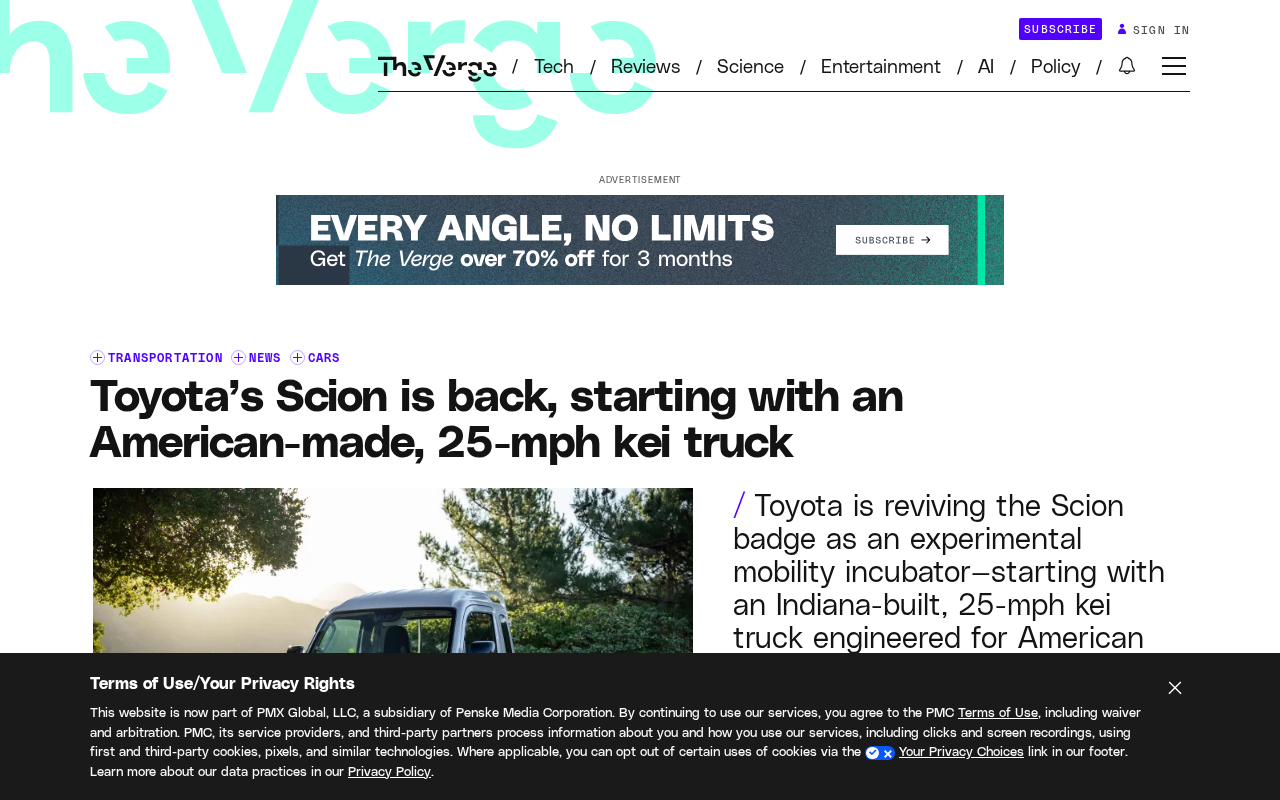
Toyota revives Scion to test the low-speed micro mobility market with an American-made kei truck.
Toyota is restarting Scion as an "experimental mobility incubator" rather than a youth compact car brand. Its first product is a Japanese-style kei truck made in Indiana, capped at 25mph—likely classified as a Low-Speed Vehicle to bypass strict crash rules. US production avoids tariffs and tests flexible manufacturing, letting Toyota gauge demand for micro commercial vehicles at low risk.
Toyota is restarting the Scion brand, but this time it's not aiming at the youth market with hatchbacks—instead, it's positioning the brand as an "experimental mobility incubator." According to an RSS source report, the first model from Scion by Toyota will be an authentic Japanese-style kei truck, manufactured in Indiana, USA. This move marks Toyota's new attempt at mobility innovation.

The Rebirth of the Scion Brand: From Youth-Oriented to Experimental Incubator
Scion was originally a brand established by Toyota to attract young consumers, known for personalized compact cars. But with this revival, Scion's mission has undergone a fundamental shift. According to the original report, the new Scion will serve as an "experimental mobility incubator," focusing on exploring new mobility solutions rather than the traditional passenger car market. This means Toyota may use the Scion brand to test new vehicle forms, business models, or services. The kei truck as the first product is clearly not a mainstream passenger car choice, but rather an experimental endeavor.
This strategic adjustment reflects Toyota's emphasis on diversification in the mobility sector. The incubator model allows Toyota to test new concepts at lower risk, while Scion's brand recognition can provide it with a certain level of attention.
Why a Kei Truck?
Kei trucks are a product of Japan's light vehicle regulations, known for being compact, practical, and economical. These vehicles have stable demand in the Japanese market, often used for urban logistics, agriculture, and small businesses. The report notes that kei vehicles are enjoying something of a revival (the original text ends with an ellipsis, suggesting rising popularity). Bringing the kei truck to the US market and localizing production is an interesting experiment.
The US market's preference for large pickups and SUVs is well known, and the kei truck's size and performance (top speed of 25 mph) are clearly not suited to mainstream road scenarios. But it may find use in specific settings—such as closed campuses, school grounds, construction sites, and agricultural communities. By launching this vehicle through the Scion brand, Toyota may be testing American market acceptance of micro commercial vehicles.
Kei truck (軽トラック) is a sub-category under Japan's "light motor vehicle" (軽自動車, keijidōsha) regulatory framework. The regulations set strict upper limits on body dimensions (length ≤ 3.4 m, width ≤ 1.48 m, height ≤ 2.0 m) and engine displacement (≤ 660cc), while enjoying lower taxes, insurance, and inspection costs. Kei trucks typically use a mid-engine rear-wheel-drive layout with a cab-over design, a flat bed with three-way fold-down sides, and a payload of about 350 kg.
It is precisely the absence of this regulatory advantage that makes it nearly impossible to replicate the kei truck at the same cost in overseas markets. The US has no corresponding light vehicle category, and importing kei trucks is restricted by the "25-year rule" (vehicles less than 25 years old are difficult to legally register). Therefore, Toyota's choice to localize production in Indiana is both a means of avoiding regulatory barriers and implies that the vehicle must redefine its regulatory identity—Low-Speed Vehicle (LSV) is one possible path.
Made in America: The Role of the Indiana Plant
The report explicitly states that this kei truck will be manufactured in Indiana, USA. This has two implications: first, avoiding import tariffs and logistics costs; second, demonstrating Toyota's commitment to American domestic manufacturing. The kei truck was originally a vehicle category unique to Japan, and producing it in the US means Toyota needs to adjust its supply chain and production processes—which is itself an experiment.
The Indiana plant is an important production base for Toyota in North America, previously mainly producing large vehicles. Introducing a niche product like the kei truck may leverage the flexibility of existing capacity while accumulating experience for more compact and electrified models in the future.
The US has long imposed a 25% "chicken tax" on imported light trucks, in effect since 1964, covering pickups and certain commercial van categories. If the kei truck is classified as a light truck, direct import from Japan would face high tariffs, while domestic assembly can effectively avoid them. This is also why many overseas automakers choose to produce pickups in the US.
Toyota Indiana (located in Princeton) is one of its largest vehicle plants in North America, mainly producing mid-to-large SUVs such as the Highlander and Grand Highlander, with annual capacity exceeding 400,000 vehicles. Introducing a niche product like the kei truck—with entirely different dimensions, processes, and supply chains—requires adjusting welding fixtures, assembly line takt times, and parts logistics systems. This "big plant builds small car" arrangement is itself a stress test of Toyota's flexible manufacturing capabilities, and also accumulates line modification experience for introducing more compact and electrified models in the future.
The Positioning Behind the 25mph Speed Limit
The first model's top speed is limited to 25 mph, clearly below the requirements for normal US road driving. A 25mph speed limit typically applies to low-speed environments such as community roads, campuses, and golf courses. This suggests the vehicle may be classified as a Low-Speed Vehicle (LSV), thereby avoiding strict crash safety regulations and reducing development costs and market entry barriers.
This positioning is consistent with Scion's incubator role: first validate the product in a controlled scenario, then consider expansion. If market feedback is positive, Toyota may launch higher-speed, more fully featured versions; conversely, the experiment can be quickly terminated without affecting the main brand.
Low-Speed Vehicle (LSV) is a class of motor vehicle explicitly defined by US federal regulations: according to NHTSA's FMVSS 500 standard, an LSV must have a maximum design speed between 20 and 25 mph and be equipped with basic safety devices such as headlights, turn signals, mirrors, seat belts, and parking brakes. Unlike conventional passenger cars, LSVs can be exempted from strict passive safety tests such as frontal and side impact, which is precisely why their development costs are significantly lower.
State permissions for LSV road use vary considerably: some states only allow them on roads with speed limits below 35mph, while others allow up to 45mph. In addition, LSVs in most states do not need to meet full emissions certification processes (especially electric versions). This explains the regulatory meaning of the 25mph figure—it is not a performance compromise, but a "compliance pass" into specific markets, and it also determines that the vehicle can only serve low-speed scenarios such as communities, industrial parks, and campuses.
Industry Impact and Implications
Toyota's move may prompt other manufacturers to re-examine micro mobility tools. As urban congestion worsens and last-mile logistics demand grows, small, low-speed, specialized vehicles may find new niche markets. The US localization of the kei truck also shows that global automakers are trying to introduce regionally distinctive products to other markets and reduce trial-and-error costs through brand innovation.
However, whether the Scion brand can successfully transform depends on how Toyota balances experimentation with commercialization. The incubator model requires sufficient resource investment and patience, and the US policy environment for low-speed vehicles remains unclear. The market performance of this kei truck will be an important window for observation.
One-line Summary
Toyota revives the Scion brand, testing the low-speed micro mobility market with an American-made kei truck.
Paragraph Summary
Toyota is restarting the Scion brand but repositioning it as an "experimental mobility incubator" rather than its former youth-oriented compact car brand. The first product is a Japanese-style kei truck, planned for local manufacturing in Indiana with a top speed limited to 25 mph. This speed limit suggests the vehicle may use Low-Speed Vehicle (LSV) status to avoid strict crash safety regulations, targeting specific scenarios such as communities, campuses, industrial parks, and agriculture. US domestic production both avoids import tariffs and logistics costs and serves as an experiment in supply chain and flexible manufacturing. The incubator model allows Toyota to validate American market acceptance of micro commercial vehicles at low risk, and its performance will be an important window into industry trends.
Related articles
Claude Code in Practice: Filling in Tests with Boundary Cases, Coverage, and Assertions
A practical guide to using Claude Code for unit tests: generating boundary cases with global context, locating uncovered branches to boost coverage, and writing effective assertions. Compares Cursor and Trae.
Test Report in Three Minutes? Lemon Test Report Skill Hands-On: No Fabrication, Fully Auditable
A Bilibili creator shares Lemon Test Report Skill: an AI reporting tool for testers with three modes—test summary, regression verification, and release acceptance. It flags missing data as 'to be confirmed,' catches manual data conflicts on the spot, and outputs an editable draft, a web report, and a verification data package.

Giving a Toilet an IP Address with a Raspberry Pi: An Absurd Yet Hardcore IT Experiment
An IT blogger assigned an IP address to his toilet using a Raspberry Pi and float switch, monitoring flushes via GPIO and correlating with network disconnection logs. This article breaks down the hardware wiring, pull-up resistor principles, 0.1-second polling logic, and installation process, extending to similar approaches in AI Agent security monitoring.