Tracing Agent Execution Paths with NVIDIA NeMo Relay: Making Efficiency Visible

NVIDIA NeMo Relay shifts agent evaluation from outcome-focused to process-focused by tracing execution paths.
Even when AI agents complete tasks successfully, their execution paths can be riddled with hidden inefficiencies — failed retries, truncated reads causing repeated operations, and context bloat — none of which appear in a simple success/failure label. NVIDIA's NeMo Relay addresses this observability gap by performing fine-grained tracing of Agent Harness behavior, giving developers full visibility into how tasks are executed, not just whether they succeed. This enables identification of inefficiency patterns, comparison across configurations, and quantifiable iterative optimization — reflecting a broader industry shift toward observability as essential infrastructure for production Agent systems.
Task Completion Doesn't Mean the Right Path Was Taken
An AI agent can successfully complete a task while taking an extremely inefficient path to get there. A failed search triggers another search; a truncated file read leads to repeated commands fetching the same content — and in the end, the task gets marked as "success," even as a trail of redundant steps and wasted resources hides beneath the surface.
This is a core pain point for Agent developers today: outcome-oriented evaluation masks the true quality of the process. Traditional task success rate metrics only care about whether something got done, not how well it was done. NVIDIA's NeMo Relay tool is designed to close exactly this observability gap, helping developers trace the behavioral trajectory of Agent Harness execution frameworks.
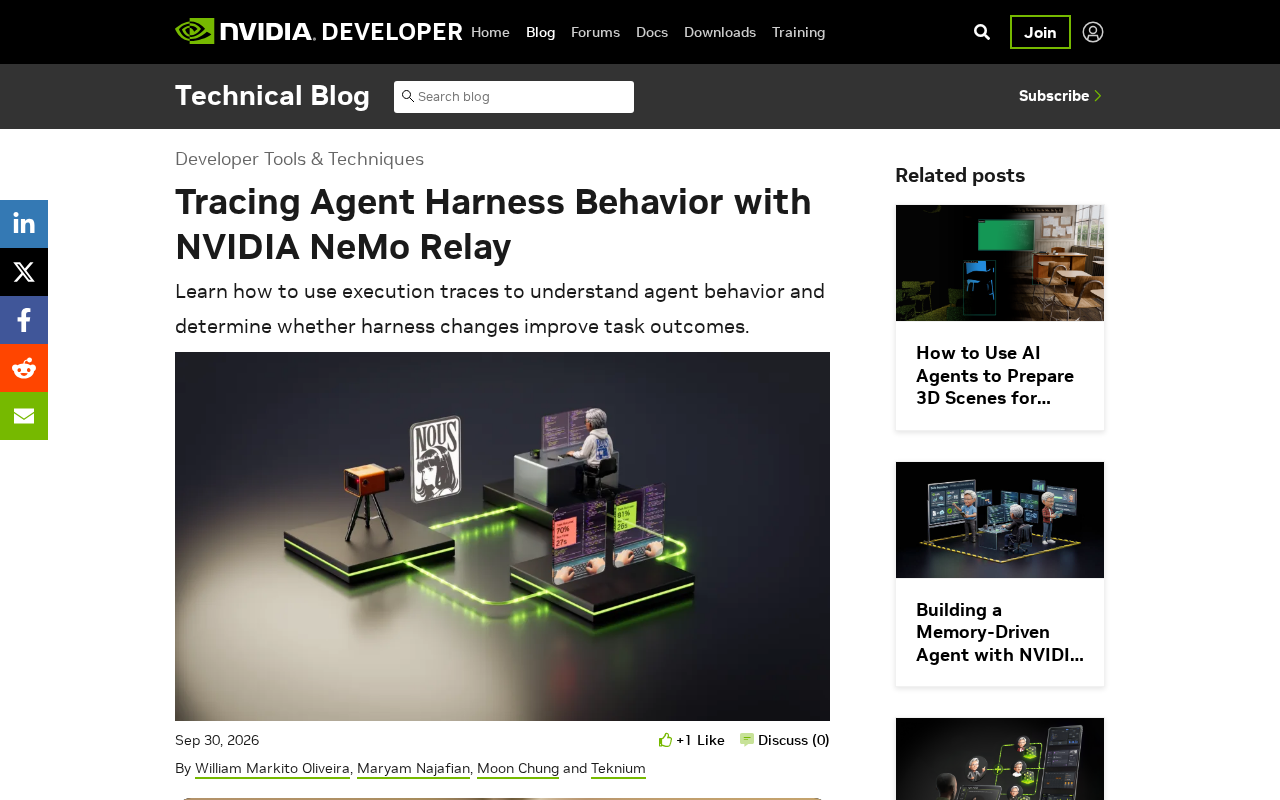
As shown in the screenshot, two task success rate panels display 70% and 81% respectively — a numeric difference that rarely tells the whole story. Two seemingly close success rates can correspond to wildly different execution efficiencies and resource consumption patterns.
Why Agent Harness Behavior Needs to Be Traced
An Agent Harness refers to the execution framework that drives an agent's operation — it orchestrates the entire flow of model calls, tool usage, context management, and multi-step reasoning. When an agent runs in a real environment, it traverses a chain of decisions: invoke a search, read a file, execute a command, process the returned result, then decide the next step.
The problem is that every link in this decision chain can harbor "hidden inefficiencies":
- Cascading retry failures: A failed search triggers a new search, potentially spiraling into a low-value loop
- Repeated operations from truncated information: When a file read is cut off, the agent is forced to issue additional commands to retrieve the missing content
- Context bloat: Redundant intermediate steps accumulate in the context window, increasing token costs and potentially interfering with subsequent reasoning
None of these issues surface in a final success/failure label, yet they concretely impact latency, cost, and user experience. In production Agent systems, these hidden costs scale with call volume into a burden that can no longer be ignored.
The concept of Agent Harness deserves further explanation. In mainstream Agent development frameworks (such as LangChain, AutoGen, and LlamaIndex), the Harness specifically refers to the glue layer that assembles a large language model together with external tools, memory modules, and execution loops. It determines: how tool-calling instructions are parsed from model output, how tool results are formatted and fed back to the model, and when multi-turn loops terminate. Harness implementations vary significantly across frameworks — some follow the ReAct (Reasoning + Acting) paradigm, some use a Plan-and-Execute structure, and some support parallel tool calls. Because the Harness is the "operational skeleton" of agent intelligence rather than the model itself, the same underlying model can exhibit drastically different execution efficiency under different Harnesses. This is precisely why tracing Harness behavior — rather than just model outputs — matters so much.
The Core Problem NeMo Relay Solves
NeMo Relay's approach is to transform an agent's execution process from a "black box" into something traceable. By performing fine-grained tracing of Agent Harness behavior, developers can see the complete path an agent takes to complete a task — not just the destination.
This observability capability delivers value across several dimensions:
From Outcome Evaluation to Process Evaluation
Task success rate alone is a lagging and coarse-grained metric. When you see two numbers like 70% and 81%, you have no way to judge whether the underlying execution paths were lean or bloated. By tracing execution trajectories, developers can compare actual behavioral differences across different configurations, models, and prompt strategies — and identify the factors that genuinely affect efficiency.
Identifying Inefficiency Patterns
Tracing surfaces the cases that "completed but took the long way around." For instance, a particular tool call that always fails before retrying, or a class of tasks that repeatedly triggers useless searches — once these patterns are identified, the Harness logic or tool design can be targeted for improvement.
Supporting Iterative Optimization
For continuously evolving Agent systems, behavior tracing provides a quantifiable comparison baseline. Each time the framework or model is adjusted, developers can observe whether execution paths have become more efficient, rather than fixating on a success rate number that may be misleading.
Implications for Agent Development Practice
NeMo Relay reflects a maturing trend: as agents move from demos to production, observability is becoming foundational infrastructure for Agent engineering. Just like logs, monitoring, and distributed tracing in traditional software engineering, Agent systems require an equally comprehensive behavior observation stack.
This demands a new mindset from developers. Evaluating an agent can't stop at whether it completes a task. You also need to ask:
- How many steps did it take to complete the task?
- How many of those steps were redundant or avoidable?
- What is the failure-and-retry rate?
- Is context utilization efficient?
These dimensions together form an agent's "execution quality profile." The fact that NVIDIA is integrating this kind of tooling into the NeMo ecosystem signals that major players are treating process quality as a strategic focus for Agent systems.
The concept of Observability originates from classical control theory and was later adopted in distributed systems engineering, where it is typically built on three pillars: Logs, Metrics, and Traces. For traditional microservices, distributed tracing tools (such as Jaeger and Zipkin) can visualize the full latency and call relationships of a request as it traverses multiple service nodes. The observability challenge for Agent systems is that execution paths are dynamically generated — the number and order of steps are non-deterministic, and a single "request" may span dozens of LLM calls and tool invocations. Tools like NeMo Relay represent the migration of distributed systems' Trace concepts onto non-deterministic AI workflows. They need to capture not just latency and status codes, but also intermediate reasoning states, token consumption, and the semantics of tool calls.
Conclusion
"Task success" is the starting point of Agent evaluation, not the finish line. By tracing Agent Harness behavior, NeMo Relay exposes the inefficient paths hidden within an agent's execution, enabling developers to shift from outcome-oriented to process-oriented optimization. For any team looking to deploy Agent systems in production, this kind of fine-grained behavioral observability may well be the critical step between an agent that merely "works" and one that works well.
Related articles

Chain of Thought Isn't Just for AI: How Humans Can Use CoT to Improve Thinking Quality
Chain of Thought isn't just a prompt trick for large models. Starting from a Hacker News discussion, this article analyzes why CoT works for human thinking too, breaks down actionable ways to transfer it, and highlights the key differences between human CoT and machine CoT.
Cloudflare Teams Up with OpenAI: Closi…
Cloudflare Teams Up with OpenAI: Closing the Loop from Vulnerability Discovery to Defense with AI
Cloudflare uses OpenAI Daybreak to investigate security vulnerabilities and generate reviewable remediation plans, while developers use Codex to boost coding efficiency and quality.

Orca Multi-Agent Orchestration in Practice: A Guide to Parallel Collaboration with Claude and Codex
Orca is Stable AI's free open-source agent workbench supporting 34 agents like Claude Code and Codex in parallel. Learn its Git worktree isolation, multi-model orchestration, and mobile management.