Tracing the Rumor of Jensen Huang Resigning as Nvidia CEO

A rumor of Jensen Huang resigning appeared on Hacker News; multi-source verification shows no official or mainstream media support—it's community noise.
The article examines a minimalist Hacker News post claiming "Jensen Huang Resigns as Nvidia CEO After Affairs," which received only 14 points, zero comments, and had no body text or sources. Through multi-source cross-verification, the author points out that Nvidia's official website, investor relations page, and official X account show no executive change statements, and mainstream financial media like Bloomberg, Reuters, and CNBC have no reports. According to listed company governance conventions, a CEO resignation is a major event that must be disclosed immediately—it cannot happen quietly. The article further analyzes why such rumors spread easily: Jensen Huang's personal image is deeply bound to Nvidia's brand, amplifying market sensitivity to negative news. Finally, it offers a three-step method for readers to verify unverified news: check official announcements and 8-K disclosures, search at least two authoritative media outlets, and observe whether anyone in the Hacker News comment section is seriously discussing it.
Recently, a post titled "Jensen Huang Resigns as Nvidia CEO After Affairs" appeared on Hacker News and quickly sparked small-scale discussion. The post received only 14 points and no comments, but the impact of the title was enough to make anyone following the tech industry feel a pang of anxiety.
However, in today's fast-moving information environment, what does a short headline with no source, no body text, and zero comments actually mean? This article will break down the origins and context of this rumor from the perspective of multi-source cross-verification, and explore why such news always easily stirs market nerves.
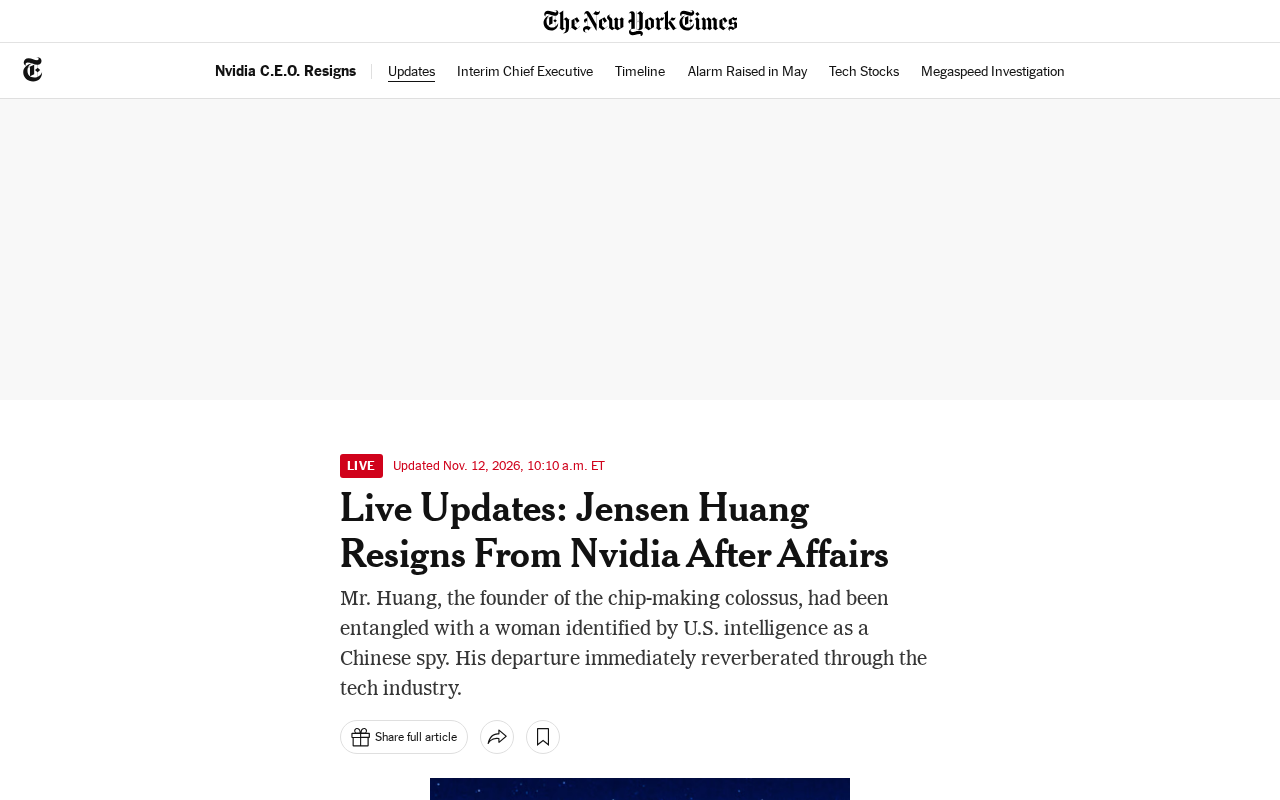
The Origin of the Rumor: A Minimalist Post
Hacker News is a community where geeks and entrepreneurs gather, but its "New" page is flooded daily with large numbers of unverified links and one-sentence headlines. This post about Jensen Huang falls into the latter category: no external link, no detailed explanation, just a single sentence claiming he "resigned as Nvidia CEO due to an extramarital affair."
From a communication studies perspective, this kind of headline fits the "high impact, low information" profile, making it extremely easy to be screenshotted and shared on social media. But as of now, no mainstream tech media, Nvidia official announcement, or authoritative financial channel has reported on this.
Multi-Source Cross-Verification: No Movement from Official or Mainstream Media
Following the analytical principle of multi-source fusion, we reviewed the possible information sources:
- Nvidia Official Channels: The company's official website newsroom, investor relations page, and official X account all show no statement of any executive change. According to listed company governance conventions, a CEO resignation is a major event that must be disclosed immediately—it cannot happen quietly.
- Mainstream Financial Media: Bloomberg, Reuters, CNBC, and other outlets have no related breaking news. If this were true, given Nvidia's current market cap and attention level, coverage would instantly fill headlines.
- Hacker News Community Itself: The post has zero comments and low points, indicating that community users did not treat it as credible information for in-depth discussion—most likely just glanced at the title and scrolled past.
Cross-verification of multiple sources points to the same conclusion: this is more likely an unverified rumor, possibly even clickbait or a misoperation.
Form 8-K is the "current report"制度载体 established by the U.S. Securities and Exchange Commission (SEC) under the Securities Exchange Act of 1934. When a listed company experiences an event that materially affects investor decisions—such as CEO resignation, major mergers and acquisitions, bankruptcy, or auditor changes—it must file Form 8-K within four business days of the event and make it public through the EDGAR database. The original intent of this system is to eliminate information asymmetry and prevent insider trading, so executive change 8-Ks typically appear on the company's investor relations page within a very short time. In other words, if Jensen Huang had truly resigned, the existence or absence of an 8-K would itself be the most direct criterion, without relying on social media rumors.
Hacker News's voting mechanism also deserves explanation: post points accumulate from user "upvotes," but newly submitted content defaults to the "New" page, and only gains enough points and comment activity to potentially rise to the front page. A post with only 14 points and zero comments means it was neither algorithmically recommended nor triggered community discussion—its visibility is extremely low, essentially long-tail noise rather than a public signal. While this mechanism filters out low-quality content, it also means that "not being discussed" itself constitutes weak negative evidence.
Why Do Such Rumors Always Spread?
Nvidia is at the absolute center of the AI computing wave, and Jensen Huang's personal image is deeply bound to the company's brand. Any news about him personally or his position will directly touch investors' imagination of a "post-Jensen Huang era."
This high degree of binding has a side effect: the market's sensitivity to negative rumors is amplified. A baseless headline can also be misread as "there's something going around" in the chain of algorithmic recommendation and community forwarding. Historically, rumors about tech CEOs' health, private lives, or departures have repeatedly caused short-term stock price fluctuations, and cases later proven to be false are not uncommon.
For content creators and readers, when facing such information, the safest approach is to return to the source: Is there an official announcement? Is there cross-verification from at least two independent media outlets? If the answer to both is no, then it should not enter your decision-making basis.
"Key-person risk" is a common concept in corporate governance and investment analysis, referring to the operational uncertainty brought by a company's over-reliance on a single core figure (founder, CEO, or technology leader). When the founder is simultaneously the embodiment of the company's technology roadmap and brand narrative, their personal reputation, health, legal disputes, and even private life can have hidden correlations with the stock price. Investors often attach a "key-person discount" to such companies during valuation, and any negative news about that person—whether true or false—can trigger short-term selling or increased volatility. The relationship between Nvidia and Jensen Huang is a typical sample of this risk: the leather jacket, iconic speeches, and the "Godfather of AI" narrative are deeply embedded in the company's brand assets, giving rumors targeting the individual far greater传播动能 than those about ordinary executives. Understanding this mechanism helps readers distinguish between "information value" and "emotional impact."
How Readers Should Handle Unverified News
In an environment of information overload, what matters more than "knowing first" is "knowing what is worth believing." Regarding this rumor of Jensen Huang's resignation, the following steps are recommended:
- Check Nvidia's investor relations page or official press releases to confirm whether there is any disclosure of major events such as an 8-K.
- Search for reports from at least two authoritative financial media outlets, rather than just looking at social media screenshots.
- Observe the comment section of the original Hacker News post—if veteran community members haven't engaged in discussion, it usually means the information itself doesn't hold up.
The news pace in the tech industry is extremely fast, but the more significant the news, the clearer the official traces it leaves. A post with only a title, no body text, and zero comments is not sufficient to serve as the foundation for any judgment.
Conclusion: Let the Sources Speak
The claim that Jensen Huang has resigned as Nvidia CEO currently has no reliable source support. It is more like community noise than news fact. For those following the AI and semiconductor industries, the signals truly worth tracking are Nvidia's product roadmap, earnings calls, and official personnel announcements—not a fleeting headline on Hacker News.
Related articles

English Version of 'Thank You for Your Love' Gains Traction on Bilibili: A Cross-Cultural Rendition of a Classic Love Song
The English version of 'Thank You for Your Love,' titled 'I'll give you all my love,' trends on Bilibili with rewritten lyrics about giving all your love. This article analyzes its emotional expression, cross-cultural adaptation strategy, and differences from the Chinese original.

Claude Code vs Cursor vs GitHub Copilot: How to Choose Among the Three Major AI Coding Tools
A clear explanation of Claude Code, Cursor, and GitHub Copilot through the lens of 'degree of delegation': Copilot embeds in your editor for autocomplete, Cursor is an AI-first full editor with multi-file batch editing, and Claude Code executes tasks end-to-end in the terminal. Includes selection advice.

Behind the Viral Dynamic Comic Commentary: Deconstructing the Narrative of Family Finance and Emotional Conflict
Deconstructing a Bilibili dynamic comic episode on family financial conflict: how dense dialogue and emotional hooks retain viewers, and where AI script generation falls short in narrative coherence.