Tracking Diseases Cured by AI: The Leap from Prediction to Personalized Medicine
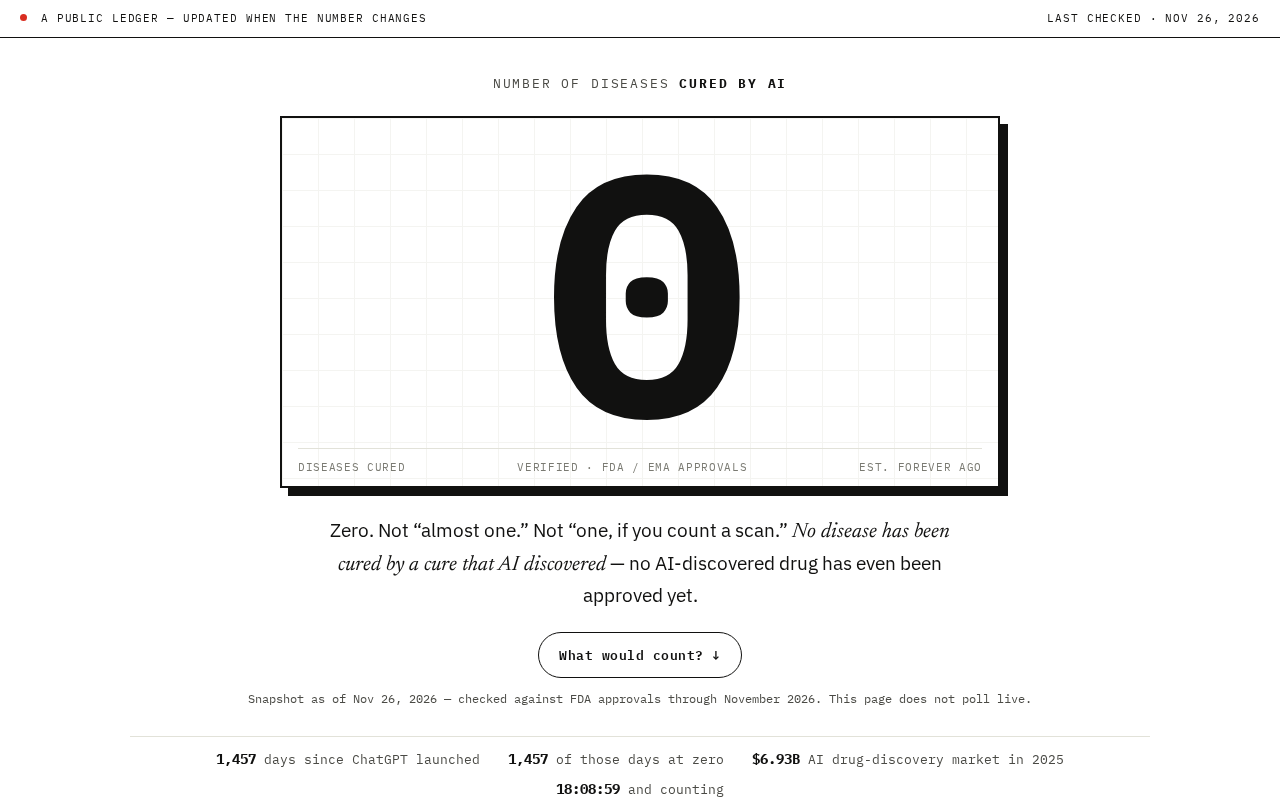
AI is moving from diagnostic aid to the core of disease cure, but tracking its efficacy still faces challenges in definition, data, and transparency.
Based on a Hacker News discussion, the article outlines the trend of AI's shifting role in disease cure. AI does not complete treatment independently but advances the cure process by accelerating drug development, personalized medicine, surgical robots, and rehabilitation monitoring. However, tracking diseases cured by AI faces multiple obstacles: subjective definitions of cure, tension between long-term follow-up data and privacy protection, and insufficient model transparency that makes efficacy attribution difficult, with the lack of a unified evaluation framework being the main bottleneck. The article proposes that medical institutions, AI developers, and regulators should collaborate to set standards, build open data platforms, and protect privacy to construct a transparent and trustworthy tracking system.
Introduction: The Shifting Role of AI in Disease Cure
In the past, AI applications in healthcare were mostly concentrated in image recognition and diagnostic assistance. Today, more and more research is focusing on AI's direct role in curing diseases. A discussion on Hacker News titled "Tracking Diseases Cured by AI" has drawn community attention to tracking diseases cured by AI. Although the discussion itself was brief, it reflects an important trend: AI is transforming from an auxiliary tool into the core driving force of treatment.
How AI Participates in Disease Cure
AI curing diseases does not mean AI independently completes treatment, but rather accelerates the cure process through multiple means. For example, in drug development, AI can rapidly screen compounds and predict drug targets, significantly shortening R&D cycles. In personalized medicine, AI analyzes patient genomic data to recommend the most suitable treatment plans. In addition, AI plays a key role in surgical robots, rehabilitation monitoring, and other areas. Together, these applications form the ecosystem of AI-driven disease cure.
Drug targets are specific molecular structures in the body through which drugs exert their effects, typically proteins or nucleic acids. The first step in modern drug development is often to identify disease-related targets, then screen for compounds that can bind to them and modulate their function. Traditional target discovery relies on extensive experimental validation, which is time-consuming and costly. AI can analyze genomics, protein structure databases, and literature data to predict potential disease-related targets and assess their druggability, thereby greatly compressing time and cost in the early stages of R&D.
Interpretability refers to humans being able to understand why an AI model makes a certain judgment or prediction. In medical scenarios, doctors and regulators need to know why a model recommends a certain treatment plan, not just the result itself. Deep neural networks are often regarded as "black boxes," with internal decision processes that are difficult to trace, which poses obstacles for efficacy attribution and clinical trust. Explainable AI techniques attempt to reveal model rationale through methods such as feature importance analysis and attention visualization, and are an important prerequisite for AI healthcare deployment.
Challenges in Tracking Diseases Cured by AI
Tracking diseases cured by AI is not easy. First, the definition of cure itself is subjective, and standards differ across diseases. Second, the effects of AI treatment require long-term follow-up data for validation, and there is a tension between data collection and privacy protection. Furthermore, the lack of transparency and interpretability in AI models makes efficacy attribution difficult. In the Hacker News discussion, some commenters pointed out that the lack of a unified evaluation framework is the main obstacle at present.
Long-term follow-up data refers to health status information continuously collected from patients over an extended period after treatment ends, used to assess whether efficacy is durable, whether recurrence occurs, and whether there are delayed adverse reactions. For diseases such as chronic conditions and cancer, short-term improvement in indicators does not equal cure; only multi-year follow-up can confirm it. Collecting follow-up data requires cross-institutional and cross-year coordination, and involves large amounts of sensitive personal information, making the tension between data sharing and privacy protection particularly prominent. Technologies such as federated learning and differential privacy have been proposed for joint analysis without centralizing raw data, but implementation still faces both technical and institutional challenges.
Future Outlook: Building a Trustworthy Tracking System
To truly track diseases cured by AI, multi-party collaboration is needed. Medical institutions, AI developers, and regulatory agencies should jointly formulate standards and establish open data platforms while safeguarding patient privacy. As AI technology matures, we have reason to believe that AI will play a key role in curing more diseases, and that tracking systems will ensure this process is transparent and trustworthy.
(Note: This article is based on points from a Hacker News discussion and does not provide specific case data, so it is primarily a qualitative analysis.)
Related articles

Michael Nielsen Takes Down His Classic Neural Network Textbook, Sparking Community Discussion
Michael Nielsen's classic free textbook Neural Networks and Deep Learning has been taken offline, sparking discussion on Hacker News about the reasons and impact.

Inside the AI Training Data Market: The Trade-off Between Exclusivity and Discounts
G2i founder Gabe Greenberg reveals the dual-track pricing of the AI training data market: labs pay a premium for exclusive data or accept discounts that allow others to buy it.

SessionGraph: Unifying All Coding Agent Sessions in One Interactive Graph
SessionGraph aggregates coding agent sessions into an interactive graph, helping developers review, debug, and manage AI coding workflows across sessions. This article examines its positioning, value, and open questions.