TradingAgents: A Deep Dive into the Multi-Agent LLM Financial Trading Framework

TradingAgents uses multiple specialized LLM agents to simulate professional trading team collaboration for financial decisions.
TradingAgents is an open-source multi-agent framework by TauricResearch that simulates real trading team dynamics using specialized LLM agents (fundamental, technical, sentiment analysts, and risk manager). With 96K+ GitHub stars, it demonstrates how role specialization and debate mechanisms can enhance financial decision-making, while acknowledging key limitations like hallucinations, black swan risks, and latency constraints.
Introduction: When LLMs Meet Quantitative Trading
As the capabilities of Large Language Models (LLMs) continue to advance, their applications have expanded beyond chat conversations and code generation into more complex professional decision-making domains. Financial trading—a field demanding exceptional information processing, reasoning ability, and risk judgment—is becoming a new testing ground for AI agents.
The quantitative trading domain itself has undergone technological iterations from rule-driven approaches to machine learning and then deep learning. Early quant strategies relied on manually crafted trading rules and statistical arbitrage models. In the 2010s, machine learning methods like Random Forest and XGBoost were widely adopted for factor mining and signal prediction. More recently, Transformer architectures and reinforcement learning have pushed quantitative trading into a new phase. The introduction of LLMs represents a paradigm shift—moving from purely numerical modeling toward hybrid decision-making systems that integrate natural language understanding, capable of processing unstructured data such as earnings reports and news sentiment. This opens entirely new analytical dimensions that traditional quantitative methods struggle to reach.
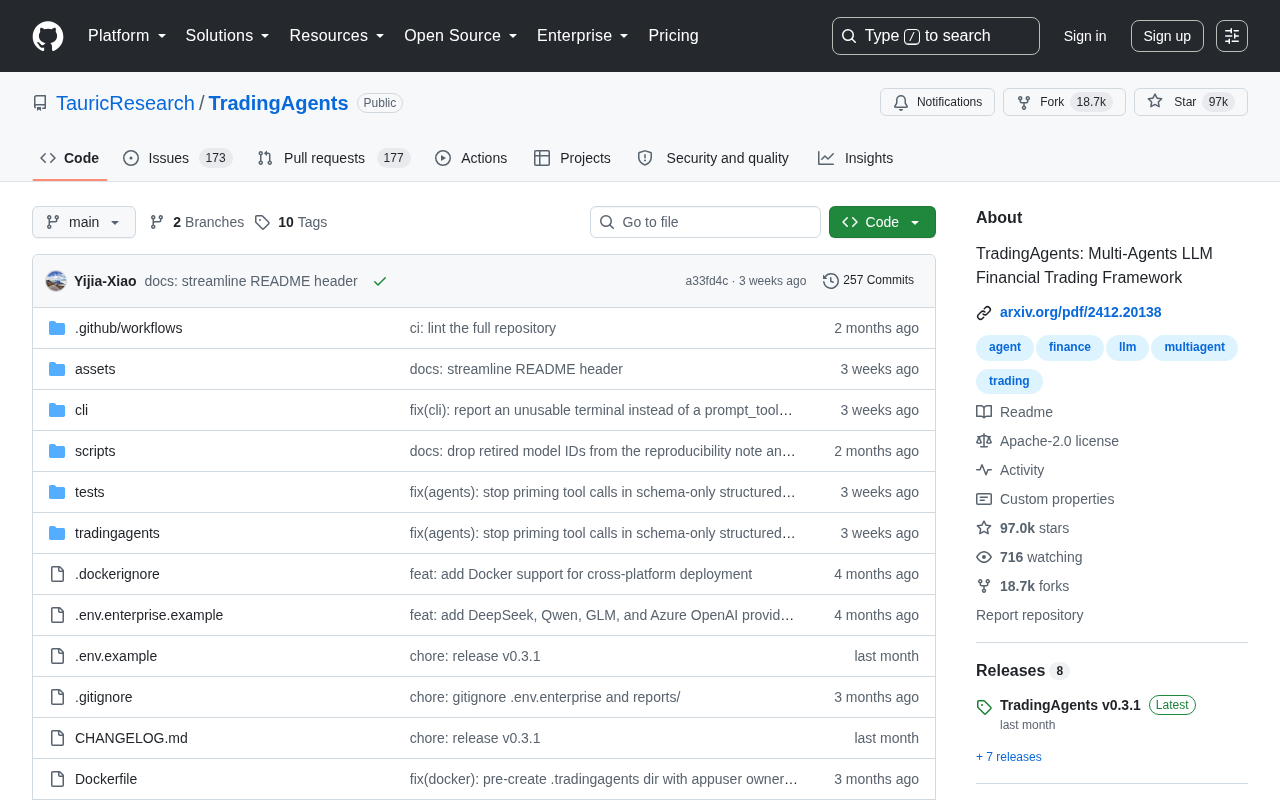
The TradingAgents project, open-sourced by the TauricResearch team, is a prime example of this trend. The project has already earned over 96,000 Stars on GitHub, with 598 new stars in a single day and 18,000 Forks, demonstrating the community's intense interest in the "AI + Financial Trading" direction.
Core Philosophy: Simulating Real Trading Team Collaboration
What Is a Multi-Agent Trading Framework
The core innovation of TradingAgents lies not in relying on a single model for trading decisions, but in building a Multi-Agent collaborative system. This design philosophy draws from how financial institutions operate in the real world—a mature trading decision is rarely made by one person alone, but rather through layered collaboration and deliberation among analysts, researchers, traders, and risk management teams.
Multi-Agent Systems (MAS) represent a classic research direction in distributed artificial intelligence, dating back to distributed problem-solving research in the 1980s. Before the LLM era, multi-agent systems were primarily applied in robotics coordination, traffic scheduling, and similar scenarios. Since 2023, as GPT-4 and other large models demonstrated powerful role-playing and reasoning capabilities, researchers began exploring paradigms where multiple LLM instances play different roles in collaboration. Stanford's "Generative Agents" experiment and Microsoft's AutoGen framework were early milestones in this direction, proving LLMs' enormous potential in role consistency and collaborative reasoning. TradingAgents is a quintessential case of applying this multi-agent collaboration paradigm to financial decision-making.
By having multiple specialized LLM agents play different roles, the framework can analyze, debate, and verify market information from multiple dimensions, thereby reducing the bias risk of single-point decisions and simulating a decision-making process closer to that of professional institutions.
The Decision-Making Advantages of Role Specialization
Under this architecture, different agents each handle their own responsibilities:
- Fundamental Analyst: Responsible for interpreting earnings reports, industry data, and other fundamental information, including trend analysis of key financial metrics such as revenue growth rates, profit margin changes, and cash flow health
- Technical Analyst: Focuses on candlestick patterns and technical indicator signals, such as multi-timeframe confluence analysis of classic indicators like MACD, RSI, and Bollinger Bands
- Sentiment Analyst: Interprets news sentiment and market mood changes, leveraging LLM's natural language understanding capabilities to assess sentiment polarity and impact of unstructured information
- Risk Manager: Dedicated to risk assessment and position sizing, including VaR (Value at Risk) estimation, maximum drawdown constraints, and correlation risk analysis
This division of labor not only enhances the depth of information processing but also makes the entire decision chain more transparent and interpretable—the specific analytical logic behind every trading signal can be traced. Notably, this architecture also introduces a "debate mechanism," where the system triggers multiple rounds of argumentative dialogue when different agents reach contradictory conclusions, achieving more robust consensus decisions through the exchange of evidence.
Technical Implementation and Project Positioning
Python-Based Open Source Implementation
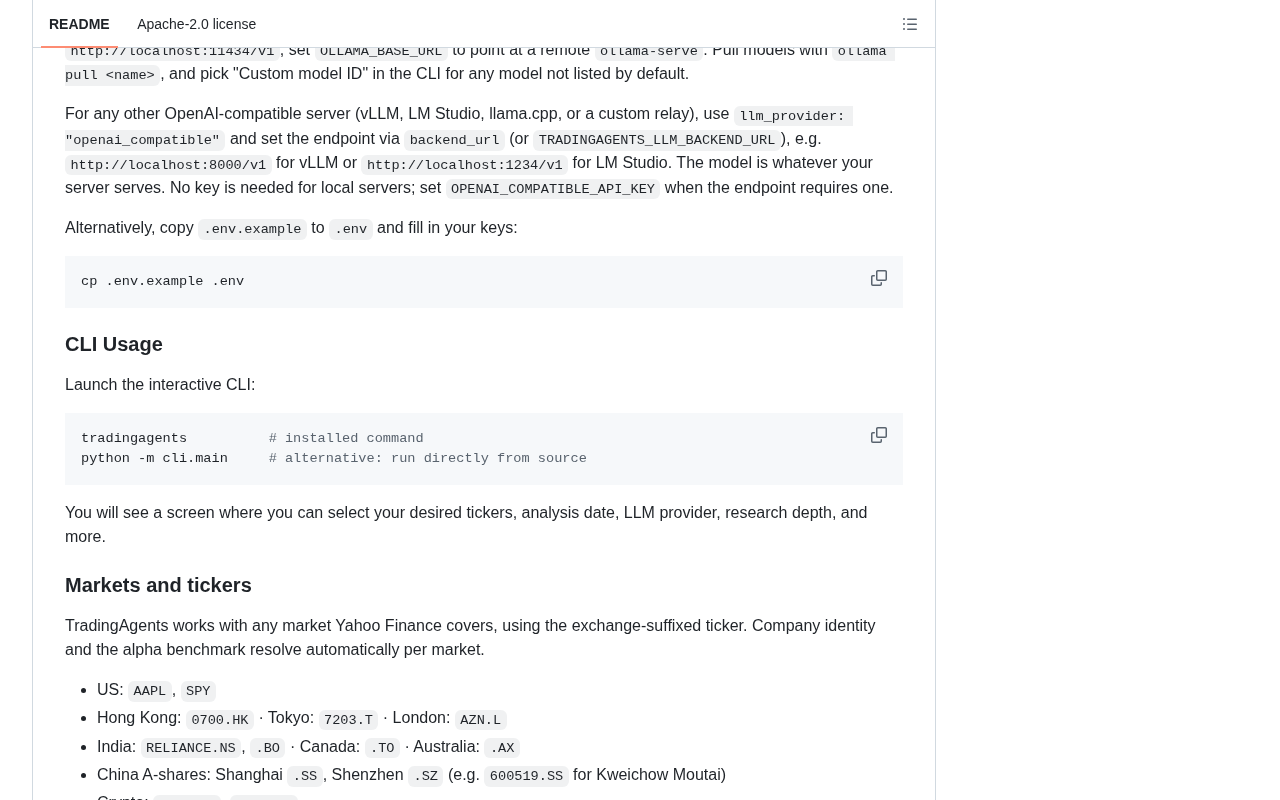
The project is developed in Python, which aligns perfectly with the mainstream AI and quantitative trading ecosystem. Python's rich financial data processing libraries (such as pandas and numpy) and mature LLM toolchain enable developers to conveniently perform secondary development and strategy customization on top of the framework.
At the engineering level of multi-agent system implementation, the communication protocol design between Agents directly impacts collaboration efficiency and decision quality. Common communication patterns include: Sequential (Chain)—Agents process information in a fixed order; Broadcast—one Agent's output is simultaneously sent to all other Agents; Hierarchical—a superior Agent coordinates task allocation among subordinate Agents; and Debate—multiple Agents present different viewpoints on the same issue and cross-validate. State management involves maintaining context consistency across multiple interaction rounds, including shared memory pools, message queues, and state machines. Frameworks like LangGraph and CrewAI provide infrastructure for such designs, while TradingAgents makes specific optimizations for financial scenarios' temporal nature, real-time requirements, and risk constraints.
As an open-source framework, TradingAgents' significance lies not only in providing a runnable trading system, but more importantly in offering a paradigmatic reference for engineering LLM reasoning capabilities into financial decision-making.
Research-Oriented Project Nature
A notable detail: the project is maintained by the TauricResearch team, and judging from its naming and positioning, it leans more toward research and exploration. This means its value is primarily reflected in:
- Validating the feasibility of multi-agent collaboration in financial scenarios
- Providing an experimental platform for academic research and industry practice
- Exploring the capability boundaries of LLM Agents in complex decision-making tasks
Rather than serving directly as a live trading tool in production environments. From a research perspective, the project provides a quantifiable experimental framework for exploring the core question: "Can LLM reasoning capabilities be effectively translated into financial decision quality?"
A Sober Assessment: Opportunities and Risks Coexist
Limitations of LLM Trading Systems
Although TradingAgents demonstrates an exciting technological direction, applying LLMs to real financial trading still requires extreme caution:
- Hallucination Problems: LLMs may generate analyses that appear reasonable but are actually incorrect. This issue stems from the fundamental nature of the model's generation mechanism—LLMs generate the next token based on probability distributions and do not possess true fact-verification capabilities. This is particularly dangerous in financial scenarios: models may fabricate non-existent financial data, misjudge the meaning of technical indicators, or generate analytically coherent reports with incorrect premises. Current mitigation approaches include RAG (Retrieval-Augmented Generation) connected to real-time data sources, multi-agent cross-validation, and confidence threshold settings, but none can completely eliminate hallucination risk.
- Black Swan Risk: The highly nonlinear nature of financial markets and extreme events are fundamentally unpredictable by any model trained on historical data. The liquidity crisis of March 2020 and the Silicon Valley Bank event of 2023 demonstrate that markets can exhibit behavioral characteristics completely different from historical patterns under extreme conditions.
- Systemic Uncertainty: While the multi-agent framework reduces single-point risk through role-based deliberation, it cannot eliminate uncontrollable market factors. Furthermore, when multiple AI trading systems employ similar LLM foundations and strategy logic, new systemic risks may emerge—an "AI herding effect."
- Latency and Cost Constraints: Multi-agent systems require multiple rounds of LLM inference calls, which may face excessive latency issues in high-frequency trading scenarios; API call costs are also a non-negligible factor in practical deployment.
Any claim of stable profits through AI should be met with rational skepticism.
Practical Value for Developers
For AI developers and quantitative researchers, the true value of TradingAgents lies in:
- Providing a reusable multi-agent collaboration template whose design philosophy can be transferred to other complex decision-making scenarios such as medical diagnosis and investment research
- Demonstrating how to integrate role specialization and debate mechanisms into LLM application architecture design
- As an open-source project, significantly lowering the technical barrier to exploring the "AI + Finance" intersection
- Offering practical reference for understanding inter-Agent communication protocols and state management
- Providing a controlled experimental environment for studying LLM decision-making behavior under uncertainty
Conclusion
The explosive popularity of TradingAgents reflects the community's strong interest in deploying multi-agent systems in professional domains. It is not merely a financial trading framework, but an important practice of the multi-agent collaboration paradigm in complex decision-making scenarios.
For developers looking to deeply understand Agent architecture design, this is a high-quality open-source sample worth studying. For financial applications, rationally assessing its capability boundaries and fully recognizing market risks is the correct posture for embracing such technology. As LLM reasoning capabilities continue to improve, long context windows break through limitations, and multimodal capabilities strengthen, the practicality of multi-agent financial decision systems is expected to gradually improve. However, between a research prototype and a reliable production system, there remains a long road of engineering and validation to travel.
Related articles

Bias and Double Standards in AI Content Moderation: Technical Roots and Solutions
An in-depth analysis of bias and double standards in AI content moderation systems, exploring technical roots including training data flaws, annotation subjectivity, and rule design issues, with solutions for building fairer systems.

Altman Says AI Won't Bring a 4-Day Work Week — The Internet Fires Back
OpenAI CEO Sam Altman says AI won't bring a 4-day work week because people like being busy. Reddit erupts, arguing that enjoying busyness and being forced to work are fundamentally different things.

The State of Reinforcement Learning in Montezuma's Revenge: From Exploration Challenges to General Intelligence
In-depth analysis of Montezuma's Revenge in RL research: reviewing Go-Explore and RND breakthroughs, and the shift toward sample efficiency and generalist agents.