Trae China Edition In-Depth Review: Free AI Coding IDE Hands-On Experience & Comparison with International Version

ByteDance's Trae China edition launches with Doubao and DeepSeek — VPN-free but code quality trails the international version.
On March 3, 2025, ByteDance launched the China edition of its AI coding tool Trae (trae.com.cn), powered by Doubao and DeepSeek models with phone number login and no VPN required. It retains both Chat and Build modes but lacks multimodal input (image-to-code). Testing shows usable but inconsistent code generation quality, lagging behind the Claude-powered international version, especially for complex multi-file projects. Both versions are currently free.
Introduction
On March 3, 2025, ByteDance's AI coding tool Trae officially launched its China edition at trae.com.cn, accessible without a VPN. Previously, the international version of Trae relied on overseas models like Claude and ChatGPT, requiring Chinese users to use a VPN to log in and operate — a limitation that frustrated many developers who wondered, "Why do I need a VPN for a Chinese-made app?" Now, the China edition runs on the Doubao large language model and DeepSeekAd, finally resolving this pain point.
This article provides a comprehensive review of Trae's China edition from two dimensions — feature comparison and hands-on experience — to help developers decide whether it's worth switching.
About AI Coding IDEs: A Rapidly Emerging New Category
AI coding IDEs (Integrated Development Environments) represent a new generation of development tools that deeply embed large language model capabilities into code editors. Unlike traditional IDEs (such as VS Code or IntelliJ IDEA), AI coding IDEs go beyond syntax highlighting and code completion — they can understand the semantic context of an entire codebase, enabling natural language-driven code generation, refactoring, and debugging. This category was pioneered by GitHub Copilot in 2021, followed by products like Cursor and Windsurf. Trae represents ByteDance's major play in this space. Understanding this background helps us more accurately assess the positioning and value of Trae's China edition.
Trae China Edition vs. International Edition: Core Differences
Access and Login
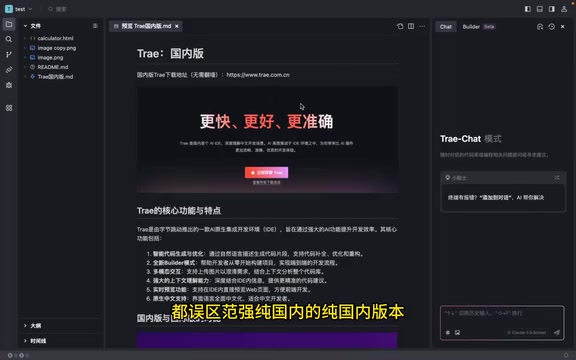
The most immediately obvious improvement of Trae's China edition is zero-barrier access. The URL is trae.com.cn, with login options including phone number and one-click authorization via Juejin community accounts. The entire flow operates entirely within China's domestic network environment, including subsequent online features — no proxy needed.
In contrast, the international version is at trae.ai, requires a Google or GitHub account to log in, and needs a VPN connection throughout use.
AI Model Support
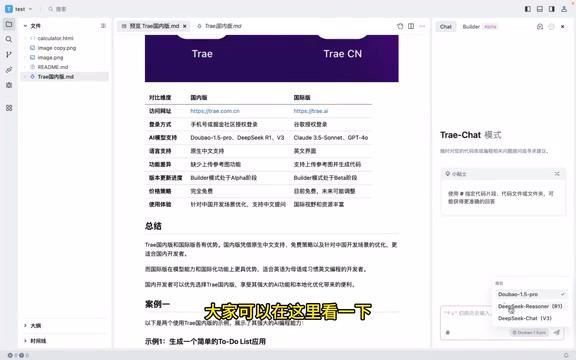
This is the most critical difference between the two versions. Trae's China edition currently supports two models:
- Doubao (ByteDance's in-house model)
- DeepSeek R1 / V3
The international version supports Claude and ChatGPT-4o, which was the fundamental reason the China edition couldn't launch earlier — Claude and GPT-4o APIs cannot be called directly within China.
Technical positioning of Doubao and DeepSeek: Doubao is ByteDance's proprietary general-purpose large language model, trained on the Transformer architecture with specialized optimizations for Chinese language understanding and generation tailored to domestic user scenarios. DeepSeek is an open-source large model series from DeepSeek AI, where the R1 version employs reinforcement learning (RLHF) and Chain-of-Thought reasoning mechanisms, performing well on mathematical reasoning and code generation benchmarks; the V3 version is their latest general conversational model with a 671B parameter MoE architecture. The combination of both provides Trae's China edition with complementary reasoning and generation capabilities.
Feature Completeness: Chat Mode and Build Mode
Both versions retain Trae's core functional architecture: Chat Mode and Build Mode, along with automatic context understanding and code completion capabilities. For example, after deleting a code segment in the editor, the AI automatically suggests completions that can be accepted by pressing Tab.
It's worth noting that these two modes represent two mainstream interaction paradigms in AI coding tools. Chat Mode is essentially a context-aware conversational interface where AI can read the contents of currently open files, answer code questions, explain logic, or generate code snippets — users need to manually paste results into the editor. Build Mode is more aggressive, adopting an Agent architecture where AI can autonomously plan task steps, create and modify multiple files, and execute terminal commands, forming an automated "perceive-plan-execute" loop. Build Mode is currently in Alpha/Beta stage, meaning its stability and complex task handling capabilities are still being iterated — which explains why generation quality for complex projects remains inconsistent.
However, the China edition currently has one notable feature gap — no multimodal input support. The international version allows users to upload screenshots or design mockups, and the AI can directly generate corresponding code from images, which is extremely useful in frontend development scenarios.
The value of multimodal input: Multimodal Input refers to an AI system's ability to simultaneously process multiple types of information such as text and images. In the context of AI coding tools, this feature allows developers to directly upload UI design mockups (such as Figma screenshots or prototypes) or error screenshots, and the AI converts the visual information into runnable frontend code (HTML/CSS/React components, etc.). This workflow dramatically compresses the design-to-code conversion cycle and offers significant efficiency value in frontend development and product prototyping scenarios. Tools currently supporting this capability rely on GPT-4o Vision or Claude 3 series visual understanding modules, which is the technical root cause for Trae's China edition temporarily lacking this feature.
Pricing Strategy Analysis
The good news is that both versions are currently completely free. The China edition's Build Mode is in Alpha stage, while the international version is in Beta. However, since the international version uses commercial models like Claude, it will very likely move to a paid model in the future, whereas the China edition — leveraging ByteDance's in-house Doubao model — has a greater chance of remaining free long-term.
Hands-On Testing: Trae China Edition Code Generation Evaluation
Test 1: Generating a To-Do List App
To quickly verify AI code generation quality, a classic task was chosen — generating a To-Do List application. Given that it was the first day of launch with heavy user traffic, and to avoid network issues with build environments, the test directly requested pure HTML generation, skipping frameworks like React that require npm builds.
After selecting the DeepSeek R1 model, you can observe it entering a typical "thinking and reasoning" process — this is the direct manifestation of its Chain-of-Thought mechanism, where the model performs step-by-step derivation before generating the final code, helping improve accuracy for complex logic. Trae has a built-in external preview feature (similar to VS Code's Live Preview), allowing generated HTML files to be previewed in real-time in a local browser. The overall experience was fairly smooth.
Test 2: Generating a Snake Game
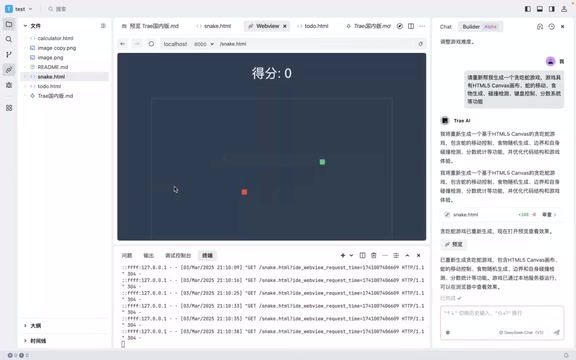
A slightly more complex task was further tested — generating a Snake game. After three generation iterations, a "barely playable" version was produced: green snake body, red food, with basic movement and growth logic functioning correctly.
Overall Code Quality Assessment: Why Claude Still Has the Edge
Based on actual testing results, Trae China edition's code generation quality still lags behind the international version (powered by Claude). Specific observations include:
- Reasoning and debugging capability: DeepSeek R1 performs reasonably well at analyzing code logic and locating bugs
- Code generation stability: Generated code quality is inconsistent, sometimes requiring multiple iterations to produce usable results
- Complex project support: For complex projects involving multiple files and modules, current models still have room for improvement
This gap has technical context: Claude is a large language model developed by Anthropic, renowned for its ultra-long context window (supporting up to 200K tokens) and precise adherence to complex instructions. In the code generation domain, Claude has undergone extensive specialized training on high-quality code corpora and incorporates Constitutional AI alignment methods, resulting in stable performance in terms of code safety, readability, and logical rigor. Multiple third-party benchmarks (such as HumanEval and SWE-bench) show that Claude has a clear advantage when handling multi-file, cross-module complex programming tasks.
This doesn't mean DeepSeek and Doubao models are inherently weak — it's more about the specialized optimization for "AI coding" scenarios that still needs further refinement.
One-line Summary
ByteDance's Trae China edition launches with Doubao and DeepSeek models — VPN-free but code generation quality still trails the international version.
Related articles
 Product Reviews
The Programmer's Desk Setup Guide: Building a Workspace That Feels Like Home
Discover how programmers build productive, comfortable workspaces. From multi-monitor setups to ergonomic design, explore the desk philosophy that drives focus and flow.
 Product Reviews
Qoder vs Cursor Real-World Comparison: Which $20/Month AI IDE Is Better?
Hands-on comparison of Qoder vs Cursor AI IDEs: Agent autonomy, human interaction count, and architecture decisions. Qoder needed only 2 interactions vs Cursor's 8.
 Product Reviews
Cursor Cloud Agent Demo: Eliminating Bottlenecks Across the Entire Software Development Lifecycle
Deep analysis of Cursor's Cloud Agent demo showing how cloud VMs, automated test artifacts, and a full-chain control plane systematically eliminate human bottlenecks across the software development lifecycle.