Trae Download & Installation Guide: A Complete Review of ByteDance's AI Programming IDE

ByteDance launches free AI programming IDE Trae with multi-model support as a domestic Cursor alternative
ByteDance has released Trae, a self-developed AI integrated development environment supporting Claude 3.7 Sonnet, GPT-4.0, and DeepSeek R1 (full version). Trae features a native Chinese interface and a free-to-use model, enabling users to automatically generate complete project code through natural language — significantly lowering the programming barrier and positioning itself as a domestic alternative to Cursor.
Overview
ByteDance has officially launched its self-developed AI integrated development environment — Trae, which many developers see as a domestic alternative to Cursor. Trae not only supports the latest Claude 3.7 Sonnet programming model but also integrates DeepSeekAd R1 (full version), providing Chinese developers with an out-of-the-box AI programming tool.
Technical Background of the AI IDE Space: AI integrated development environments (AI IDEs) are a new generation of programming tools that deeply integrate large language model capabilities on top of traditional IDEs. Unlike traditional IDEs (such as VS Code and IntelliJ IDEA) that only provide static assistance like syntax highlighting and code completion, AI IDEs can understand natural language instructions, perceive the entire codebase context, and proactively generate, modify, and debug code. This space was pioneered by GitHub Copilot in 2021, followed by Cursor's rapid rise through deeper AI integration, becoming a phenomenon in the developer community. The core technical architecture of AI IDEs typically includes: codebase vector indexing (RAG — Retrieval-Augmented Generation), multi-file context window management, and real-time streaming communication with LLM APIs.
For users unfamiliar with programming, these AI IDEs are significantly lowering the barrier to software development. This article will walk you through everything from Trae's download and installation to its interface layout and actual programming experience.
Downloading and Installing Trae
Installation Steps
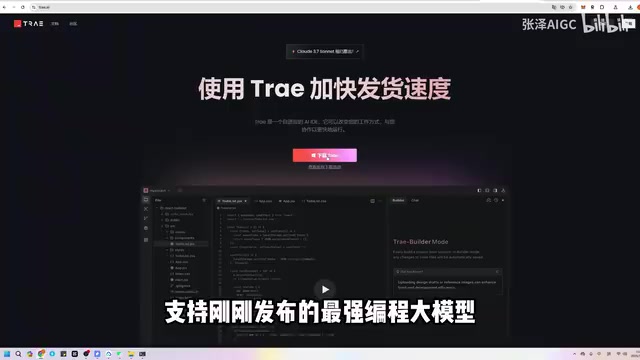
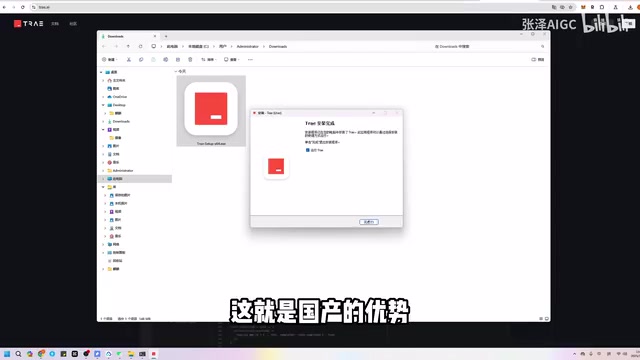
Trae's installation process is very straightforward. Go to the Trae official website (trae.ai), click the Download button on the page to download the installer. After double-clicking to run the installation package, the system defaults to a Chinese interface — no need to install a Chinese language plugin separately like with VS Code or Cursor.
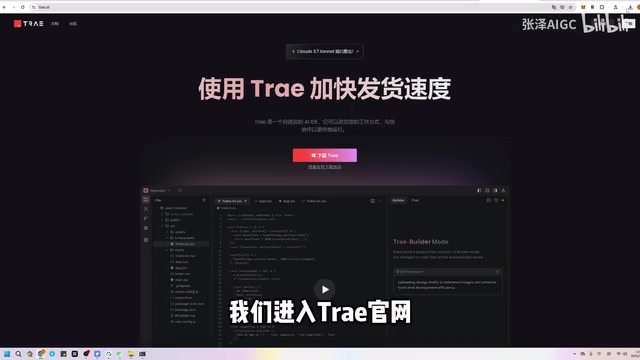
This is a localization advantage of domestic tools — for Chinese-speaking users, out-of-the-box Chinese support saves considerable configuration time. After installation, simply log in to your account and you can start using the main interface right away.
Trae Interface Layout and Core Features
Three-Panel Design
Trae adopts the classic three-panel IDE layout:
- Left panel: File navigation area for managing project file structure
- Middle panel: Code editing area with syntax highlighting and code completion
- Right panel: AI interaction area — this is the core feature area that distinguishes Trae from traditional IDEs
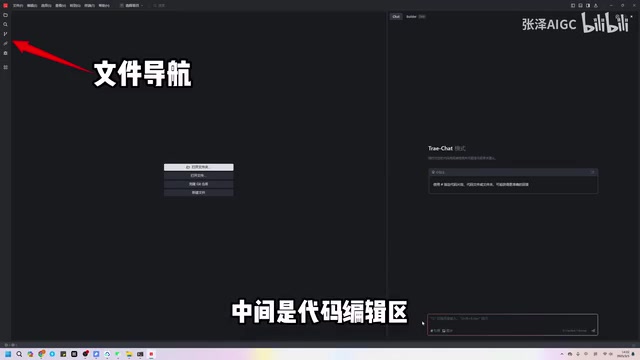
The overall interface style is clean and refreshing, similar in design philosophy to Cursor, but with targeted optimizations for Chinese adaptation and interaction details. Notably, the underlying capability of the right-side AI interaction area relies on RAG (Retrieval-Augmented Generation) technology — the system pre-converts all files in the codebase into vectors stored locally. When users submit programming requests, it automatically retrieves the most relevant code snippets and injects them into the LLM, enabling the AI to generate more accurate code with full understanding of the project context.
Supported AI Models
Trae currently supports the following AI models:
- Claude 3.5 Sonnet: Anthropic's mature programming model
- Claude 3.7 Sonnet: The latest enhanced version with stronger programming capabilities
- GPT-4.0: OpenAI's flagship model
- DeepSeek R1 (full version): The complete version of China's open-source large model
About Claude 3.7 Sonnet: This is Anthropic's latest model released in 2025, introducing an "Extended Thinking" mechanism that allows the model to perform deeper chain-of-thought reasoning before providing answers. On the SWE-bench Verified benchmark (which simulates real GitHub software engineering tasks), Claude 3.7 Sonnet scored over 60%, making it one of the strongest performing programming models in public evaluations. It particularly excels at complex multi-file refactoring and cross-scenario programming tasks.
About DeepSeek R1 (full version): DeepSeek R1 is a reasoning-enhanced large model released by DeepSeek in early 2025. The "full version" specifically refers to the 671B full-parameter version (using MoE — Mixture of Experts architecture, activating approximately 37B parameters per inference), as distinguished from distilled smaller versions. R1 achieves "slow thinking" reasoning capabilities similar to OpenAI's o1 through reinforcement learning, excelling in mathematics, coding, and logical reasoning tasks. Since DeepSeek is a domestically developed open-source model, its data processing compliance better meets the data security requirements of Chinese enterprises — an important strategic consideration for Trae's integration of this model.
Multi-model support allows users to choose the most suitable model for different programming tasks and facilitates comparative testing between models.
Hands-On Programming Experience: AI Auto-Generated Code
In a practical demonstration, by describing "write a Snake game" in natural language, Trae was able to automatically complete the following tasks:
- Create all files needed for the project
- Generate complete game logic code
- Provide results that can be directly previewed and run
The entire process requires no manual coding — the AI handles everything from project structure setup to specific implementation in one go. This is extremely practical for programming beginners or scenarios where you need to quickly validate ideas. This type of "generate a complete project from scratch" task is a typical scenario where the AI IDE's Agent mode shines — the model not only generates code but also autonomously plans file structures, executes terminal commands, handles dependencies, and achieves end-to-end programming automation.
Trae vs. Cursor: Comparative Analysis
Cursor's Market Background: Cursor was built by Anysphere through deep modification of VS Code's open-source codebase and began spreading explosively in the developer community in the second half of 2023. By the end of 2024, Cursor's annualized revenue had surpassed $100 million with a valuation exceeding $2.5 billion, making it one of the fastest-growing products in the AI programming tool space. However, Cursor's main limitations include: high pricing (Pro plan at $20/month), Chinese interface requiring additional configuration, and network obstacles when accessing certain model APIs from mainland China — these pain points are exactly the core entry opportunities for domestic tools like Trae.
| Dimension | Trae | Cursor |
|---|---|---|
| Chinese Support | Native Chinese interface | Requires plugin installation |
| Model Selection | Claude/GPT/DeepSeek | Claude/GPT |
| Pricing | Currently free | Paid subscription |
| Ecosystem Maturity | New product, continuously iterating | Relatively mature |
As a latecomer, Trae has clear advantages in localization and model variety, especially its free-to-use strategy and DeepSeek integration, which significantly lower the barrier for users to try it out. However, in terms of plugin ecosystem and community accumulation, it still needs time to catch up with Cursor.
Conclusion
ByteDance's launch of Trae signals further intensification of competition in China's AI programming tool space. For domestic developers, a natively Chinese, free-to-use AI IDE supporting multiple mainstream large models is certainly worth trying. As AI programming capabilities continue to advance, "developing applications without knowing how to code" is transitioning from concept to reality.
Key Takeaways
- ByteDance launched AI IDE Trae, positioned as a domestic alternative to Cursor
- Supports multiple models including Claude 3.7 Sonnet, GPT-4.0, and DeepSeek R1 (full version)
- Native Chinese interface with no additional language plugin needed; simple installation and configuration
- Automatically generates complete project code from natural language descriptions, lowering the programming barrier
- Currently free to use, with differentiated advantages in localization and model variety
Related articles
 Product Reviews
The Programmer's Desk Setup Guide: Building a Workspace That Feels Like Home
Discover how programmers build productive, comfortable workspaces. From multi-monitor setups to ergonomic design, explore the desk philosophy that drives focus and flow.
 Product Reviews
Qoder vs Cursor Real-World Comparison: Which $20/Month AI IDE Is Better?
Hands-on comparison of Qoder vs Cursor AI IDEs: Agent autonomy, human interaction count, and architecture decisions. Qoder needed only 2 interactions vs Cursor's 8.
 Product Reviews
Cursor Cloud Agent Demo: Eliminating Bottlenecks Across the Entire Software Development Lifecycle
Deep analysis of Cursor's Cloud Agent demo showing how cloud VMs, automated test artifacts, and a full-chain control plane systematically eliminate human bottlenecks across the software development lifecycle.