Trae Pricing Strategy Deep Dive: How to Choose the Most Cost-Effective AI Coding Tool
Breaking down Trae's pricing tactics and comparing top AI coding tools for the best value.
This article examines ByteDance's AI coding tool Trae, exposing the auto-renewal trap behind its 14-day free trial and comparing it against Cursor, Codex, and other leading tools on price and features. The core dilemma: users want both affordability and quality. The article recommends exploring multi-model orchestration while taking a wait-and-see approach with Trae's free China version.
The Hidden Pricing War of AI Coding Tools: Starting with Trae
Recently, ByteDance's AI coding tool Trae has sparked quite a bit of discussion. On the surface, it offers a 14-day free trial at just $10/month — significantly cheaper than Cursor's $20-30. But dig deeper and you'll find some rather "calculated" pricing tactics behind the scenes — auto-renewal, Alipay binding, opaque cancellation processes… These tricks have left many users feeling blindsided.
Today, we'll break down Trae's pricing model and compare it against the leading AI coding tools on the market to help you make a smarter choice.
Trae's Pricing Model Explained: What's Hiding Behind the Low Price
The Auto-Renewal Trap in the 14-Day Free Trial
Trae offers a 14-day free trial that automatically renews at $10/month once the trial ends. Compared to Cursor (roughly $20-30/month, or about 100-200 RMB), this is genuinely attractive. But here's the catch:
- Auto-renewal mechanism: Once the trial expires, payment is automatically deducted from your linked Alipay account — many users may simply forget to cancel
- Inconvenient cancellation process: You need to find the corresponding auto-debit agreement within Alipay and manually disable it — the path isn't intuitive at all
- Tight cancellation window: You essentially need to cancel by day 12-13, or you risk getting charged
This "free first, auto-renew later" model is nothing new in the SaaS industry. Auto-renewal is the standard business model in SaaS, first popularized by enterprise software companies like Salesforce and now the default approach for consumer subscription services. The core logic exploits the "Default Effect" — users tend to stick with the default option, and the higher the friction cost of actively canceling, the higher the retention rate.
From a regulatory perspective, the U.S. Federal Trade Commission (FTC) has repeatedly investigated "Dark Patterns" in subscription practices, requiring companies to provide "one-click cancellation" and clearly disclose renewal terms. The EU's Digital Services Act (DSA) also imposes explicit restrictions on such design patterns. In the Chinese market, while Alipay's auto-debit agreements are technically compliant, the cancellation path is buried deep within multiple menu levels under "My" → "Payment Settings" → "Password-free Payment/Auto-debit," which objectively increases the operational burden on users. For domestic users, the friction involved in canceling cross-border payment agreements is considerable — this could be an oversight in product design or a deliberate retention strategy.
Trae Plan Tiers Compared: Which Version Is Worth Buying?
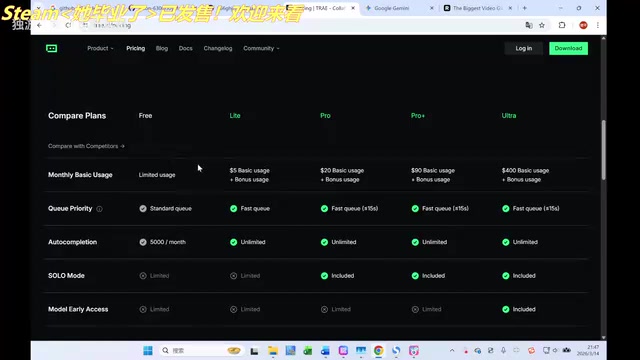
Trae offers multiple subscription tiers, but in practice, the lower-end plans have very limited utility. According to user feedback, the basic version without Solo and Mate features can only handle simple code completion, and the token quota runs out quickly. The plans that actually meet daily development needs are Pull, Pull Plus, and Ultra.
Interestingly, the Ultra version is free in China, though its actual performance remains unclear. This "charge overseas, free domestically" differentiation strategy is clearly ByteDance's play to capture users in the Chinese market. This approach mirrors the subsidy wars waged by Didi and Meituan in earlier years: establish user habits and market share with low prices or free offerings first, then gradually push toward monetization. For developers, there's nothing wrong with taking advantage of the free tier right now, but you should be prepared for potential price increases or feature restrictions down the road.
AI Coding Tools Compared: Trae vs. Cursor vs. Codex — Which Is Worth Using?
Pricing Overview of Major AI Coding Tools
The AI coding tool market is currently in a "warring states" phase, and understanding each player's market positioning helps you make a more rational choice. GitHub Copilot, backed by Microsoft/OpenAI and deeply embedded in the VS Code ecosystem, dominates the enterprise market with over 1.3 million paying users as of 2024 — its advantages lie in deep integration with GitHub repositories and enterprise-grade security compliance. Cursor has carved out the premium developer market with its "AI-native IDE" positioning, surpassing $100 million in ARR (Annual Recurring Revenue) in 2024 to become one of the fastest-growing developer tools in history — its core differentiator is codebase-aware context understanding. Traditional players like JetBrains AI Assistant and Amazon CodeWhisperer are also catching up quickly. ByteDance's entry timing is quite strategic — the Chinese developer market is extremely price-sensitive and faces VPN access barriers, creating a clear market gap for localized products.
Notably, the competitive moat in this space is undergoing a structural shift: from early-stage "model capability" (whose code completion is more accurate) to "IDE integration depth" (can it understand the entire project context) and "codebase comprehension" (can it reason across files and modules). Price wars alone won't create lasting advantages. This also explains why Cursor maintains strong growth despite higher pricing — it has built a clear technical moat in codebase-level understanding.
| Tool | Monthly Price | Key Features |
|---|---|---|
| Cursor | ~$20-30 | Strong reputation overseas, powerful features, mature ecosystem |
| Trae (International) | $10 | Lower price, made by ByteDance, strong value proposition |
| Trae (China) | Free | Performance unverified, good for zero-cost experimentation |
| Codex (OpenAI) | ~$20 | Requires VPN, not accessible even from Hong Kong |
| Cody/Buddy etc. | Varies | Domestic alternatives with inconsistent quality |

The Core Dilemma in Choosing an AI Coding Tool
The core dilemma users face is straightforward: wanting both affordability and quality. But reality says:
- Free tools often have insufficient training data, resulting in inconsistent code quality
- Paid tools deliver better results, but monthly fees easily run into hundreds of RMB
- Tools requiring a VPN (like Codex) directly raise the barrier to entry — many users never even get the chance to evaluate whether they're any good
Some advanced users have already started exploring multi-model orchestration — using different AI models for different modules, then coordinating and integrating the outputs to boost efficiency while controlling costs.
Multi-model orchestration is a cutting-edge practice in AI applications, rooted in the "Mixture of Experts" (MoE) concept — different models excel at different tasks, and combining them can achieve results that surpass any single model. In programming scenarios, this means using Claude 3.5 for complex algorithmic logic requiring deep reasoning, DeepSeekAd-Coder for Chinese comments, documentation generation, and domestic framework adaptation, Gemini 1.5 Pro for large codebase analysis requiring ultra-long context windows, and then integrating outputs from each model into coherent code through orchestration frameworks like LangChain, AutoGen, or CrewAI. This trend has also spawned a wave of startups focused on "AI coding middleware," along with open-source projects like Continue.dev and Aider that let developers freely combine different model backends. For developers on a budget who still want quality results, this is a path worth exploring — though the initial setup cost is higher.
Key Takeaways
- Trae uses a 14-day free trial + auto-renewal strategy at $10/month — cheaper than Cursor but with an inconvenient cancellation process; users should watch out for passive charges
- The AI coding tool market is fiercely competitive, with Cursor, Trae, Codex, and others each having their pros and cons — the core tension lies in balancing price and performance
- Trae's China version is currently free but its performance is unverified; the international version is more capable but requires payment
- Advanced users are exploring multi-model orchestration for coding, using different AI models for different modules to boost efficiency and control costs
- AI coding tools lower the barrier to programming, but for indie developers and game developers, this is both an opportunity and a source of intensified competition
Related articles
 Product Reviews
The Programmer's Desk Setup Guide: Building a Workspace That Feels Like Home
Discover how programmers build productive, comfortable workspaces. From multi-monitor setups to ergonomic design, explore the desk philosophy that drives focus and flow.
 Product Reviews
Qoder vs Cursor Real-World Comparison: Which $20/Month AI IDE Is Better?
Hands-on comparison of Qoder vs Cursor AI IDEs: Agent autonomy, human interaction count, and architecture decisions. Qoder needed only 2 interactions vs Cursor's 8.
 Product Reviews
Cursor Cloud Agent Demo: Eliminating Bottlenecks Across the Entire Software Development Lifecycle
Deep analysis of Cursor's Cloud Agent demo showing how cloud VMs, automated test artifacts, and a full-chain control plane systematically eliminate human bottlenecks across the software development lifecycle.