Trae Work Full-Pipeline Workflow Review: From Topic Selection to Final Delivery in One Go
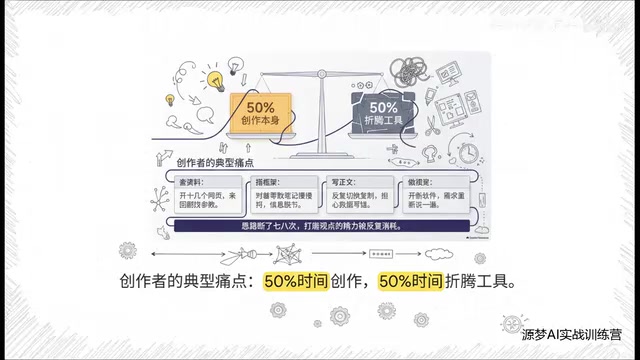
Trae Work's four-step full-pipeline workflow and context lock aim to free creators from tool-switching busywork.
The article tackles a core creator pain point: roughly 50% of work time is consumed by tool-switching, re-feeding context, and manual research. Trae Work proposes a full-pipeline platform integrating information gathering, outline building, draft generation, and asset creation in one place. Its context lock feature ensures the AI shares the same research memory across all steps, eliminating the "goldfish memory" of traditional chat-based AI. A plugin marketplace adds image and video generation, enabling copy and visuals to co-exist in a single workflow. The core conclusion: AI's real value isn't replacing creative judgment, but taking over standardized busywork so creators can focus on unique perspective and depth.
The Creator's Real Dilemma: Half Your Time Fighting Your Tools
If your workday involves endlessly toggling between dozens of browser tabs — watching hard-won inspiration slowly die in the jaws of formatting software and chaotic spreadsheets — this article might resonate with you. According to a deep-dive analysis by a Bilibili content creator, the modern content creator's daily reality is a severely lopsided equation: you think you're doing creative work, but roughly 50% of your time goes toward squeezing out ideas, while the other 50% gets burned in close-quarters combat with a fragmented stack of tools.
Researching means opening fifteen browser tabs. Building an outline means stitching together scattered notes. Writing the body copy means flipping between windows to hunt down data — and still getting things wrong. Once you've finished writing, you fire up yet another app to make graphics, then start explaining your entire brief to an AI from scratch all over again. By the end of the day, your train of thought has been derailed eight to ten times, and every ounce of mental energy that should have gone toward sharpening your ideas has been drained by low-skill busywork.
Trae Work's answer is a full-pipeline platform that strings all these steps together — information gathering, framework building, draft generation, and asset creation — completed within a single environment. The goal: eliminate the "goldfish memory" problem that plagues traditional AI tools.
Step 1: Information Integration — Say Goodbye to Tab Fatigue
The tool's most immediate value shows up at the information-gathering stage. Writing a tech analysis piece used to mean spending at least half an hour skimming media coverage, digging through product launch materials, and manually building your own spreadsheet — with a real chance of missing critical data along the way. In Trae Work, a single prompt is theoretically enough to pull the web's core information and organize it into highly structured categories.
The Bilibili creator demonstrated this by gathering key information about Xiaomi's automotive lineup: the tool surfaced not just hard data like brand positioning and technical architecture, but even granular details like wheelbase dimensions and pre-sale prices across different models.
More importantly, there's a context lock feature — every piece of generated information automatically carries its source link, essentially hard-wiring the research into the AI's memory. No matter what you do next, the AI won't "forget" — you never have to re-explain the background. This is the core differentiator from ordinary conversational AI.
The "context lock" maps onto what the AI field calls a Long Context Window. Early conversational AI tools (like early versions of ChatGPT) started fresh with every new conversation, unable to retain anything from previous interactions — creators nicknamed this "goldfish memory." In recent years, models like GPT-4o and Claude 3 have expanded context windows to hundreds of thousands or even millions of tokens, dramatically increasing how much information an AI can "hold" within a single session. Trae Work takes this a step further through engineering: it locks scraped content and source links into the task context as structured data, rather than relying on users to manually paste background information each time. This means subsequent steps — outline generation, draft writing, image creation — all share the same "memory" instead of operating in isolation.
Step 2: Building the Framework — Turning Scattered Notes into a Logical Outline
Facing a pile of organized data, the hardest part is arranging it into an article with a clear, compelling structure. Working from the information locked in the previous step, Trae Work can generate a complete deep-dive article outline — covering introduction, core arguments, data analysis, and more — while simultaneously offering five different headline options in varying styles.
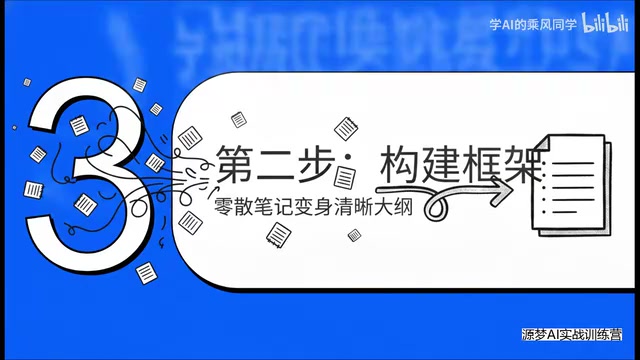
Notably, it handles team collaboration too: outlines with full Markdown formatting can be synced to tools like Feishu with one click, avoiding the formatting chaos that comes with copy-pasting. For content workflows that require team sign-off, details like this often determine whether a tool is actually usable in practice.
Step 3: Generating the Draft — Seamless Context Flow
The most frustrating part of using a generic AI to write isn't the writing itself — it's having to re-feed context every single time. Trae Work works more like an automated pipeline: the organized research and confirmed outline flow directly into the writing task. You just issue a directive — something like "based on the outline above, write an in-depth analysis with an objective tone that highlights technical details" — and it picks up all the context and produces a full draft.
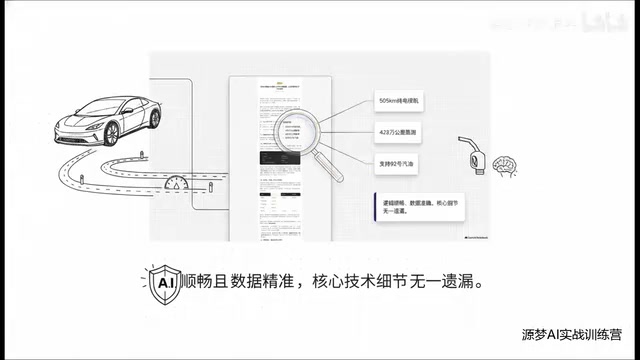
The creator specifically highlighted the AI's precision when handling hard technical specs: details like all-electric range, road-test mileage, and supported fuel grades were all accurately embedded in the article. Every revision is also tracked within the same task thread, making it easy to trace changes. Of course, results like these are worth validating against your own use cases rather than taking at face value.
Step 4: One-Stop Asset Creation — Text, Images, and Video Without Switching Apps
Trae Work fills out its visual capabilities through a plugin marketplace. The creator highlighted two plugins in particular: one for image generation (useful for concept posters or inline visuals), and one for generating short video clips. Images, copy, and video are all bound within the same workflow.
The classic nightmare of creating visuals has always been "image-copy mismatch" — to make a graphic that actually fits your content, you'd open a separate app and re-explain your article's key points from the beginning. In a context-connected environment, you can simply tell it to "generate an image based on the article's core selling points." Generated visual assets are automatically saved in the current task's folder alongside the copy, eliminating the all-too-familiar file management hell of hunting for "FINAL_graphic_v3_REAL.jpg."
The Plugin Marketplace model is becoming the dominant extension strategy across the AI tool ecosystem. The core idea: the platform focuses on its core competency (text processing and context management), while vertical capabilities like image generation, video synthesis, and data visualization are plugged in on demand via first- or third-party plugins. This mirrors the paths taken by ChatGPT's GPT Store and Notion's AI plugin integrations. For users, the plugin approach's main advantage is an unbroken workflow — data, instructions, and generated outputs share the same context. The potential downside is inconsistency: different plugins vary in model quality and output reliability, so real-world use requires validating each plugin against your specific scenario, rather than assuming every module performs at the same level as the platform's core text capabilities.
The Deeper Value: A Fundamental Redistribution of Cognitive Labor
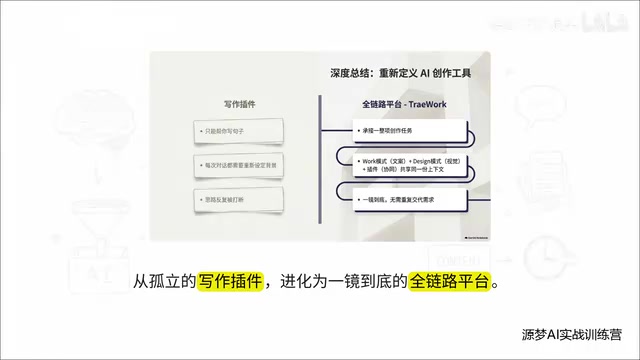
There are plenty of AI tools on the market, but Trae Work is trying to redefine what an "AI creative platform" actually means. A generic AI is more like an amnesiac sentence machine — every conversation starts from zero, and your workflow gets chopped into isolated islands of information. A full-pipeline platform, by contrast, takes ownership of an entire creative project, with copywriting and design sharing the same context throughout.
Zoomed out, this is fundamentally a redistribution of cognitive labor between AI and creator. The most low-level, labor-intensive tasks — scouring the web for sources, producing standardized drafts, building technical charts — get handed off to AI. Meanwhile, the creator's most valuable mental energy can be concentrated where it truly counts: core judgment, distinctive perspective, and depth of expression.
As the creator put it in one sharp line: for a content creator, what's valuable has never been typing speed — it's what's inside your head. The real irreplaceable value of a tool lies in giving time back to your brain, so that at the end of the day what you feel is the satisfaction of finishing something great — not the exhaustion of having been beaten up by your software all day.
Now that AI has reliably taken over the heavy lifting, you're the content director in command of the whole production. The real question is: what uniquely yours perspective are you going to bring to your next piece? That, perhaps, is exactly what a full-pipeline tool is trying to set free.
Related articles

Andrew Ng on Agentic AI: Cutting Through the Hype to Find Real Value in Agent Development
Andrew Ng's Agentic AI course intro: separating hype from real value, exploring agent workflows in customer service, research, law, and healthcare, and why evals and error analysis define expert-level agent development.

The Netflix Microservices Myth: An Architecture Migration Misunderstood by an Entire Industry
The real story behind Netflix's cloud migration and microservices transformation — and why the entire industry copied the solution while missing the actual problem.

Java 27 Deep Dive: How Default Changes Are Quietly Reshaping Production Environments
Java 27 has just 9 JEPs but changes key defaults: compact object headers on by default, G1 as unconditional default GC, Flight Recorder redaction, and built-in post-quantum TLS 1.3.