Training a Production-Grade Image Classifier at Home: Feasibility and Practical Roadmap

A practical guide to training production-grade image classifiers at home using transfer learning and open datasets.
This article examines whether individual developers can train production-grade image classifiers on personal hardware. It explains why training from scratch is infeasible, demonstrates how transfer learning with open-source pretrained models and public datasets offers a realistic path, and covers model selection, fine-tuning strategies, data augmentation, and production engineering considerations like quantization and distribution drift monitoring.
A Real Engineering Need
Recently, a developer on Reddit posed a highly representative question: they're working on an image-based search project that already has a layer of logic for "analyzing text surrounding images," but still needs a module that can directly analyze image content itself. Their core requirements were twofold—first, they don't want to use others' training data or pretrained models, and second, they want to train a classifier at home (on personal hardware) using open datasets that performs well on general image classification tasks.
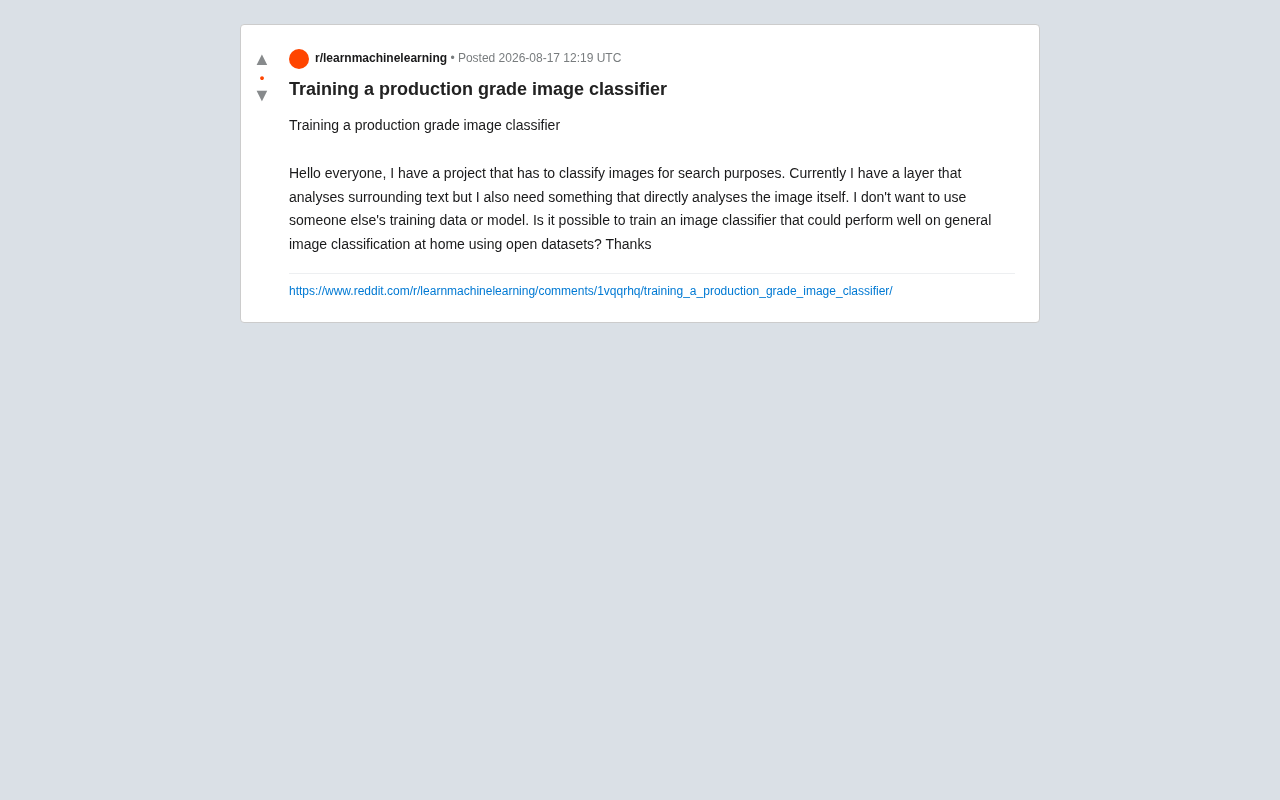
This question seems simple but actually touches on a core tension in modern machine learning engineering: the gap between the idealized "build everything from scratch" approach and production-level performance requirements. This article will analyze this need, exploring the feasibility of training a production-grade image classifier on personal hardware, the technical paths available, and the real-world tradeoffs involved.
Is Training an Image Classifier Completely from Scratch Realistic?
First, we need to clarify a key concept. The poster mentioned "not wanting to use others' training data or models"—a desire typically motivated by data compliance concerns, worries about uncontrollable model provenance, or simply wanting to master the complete tech stack. But from an engineering perspective, training a general-purpose image classifier completely from scratch on personal hardware is virtually infeasible.
Take industry benchmarks as an example: training an ImageNet classifier capable of handling 1,000 classes, even using a mature ResNet architecture, requires running on multiple high-end GPUs for days or longer. The ImageNet-1K dataset contains approximately 1.28 million training images distributed across 1,000 categories. Using ResNet-50 as an example, training for 90 epochs on 8 NVIDIA V100 GPUs takes roughly 29 hours—on a single V100, that's about a week. Larger models like ViT-Large pretrained on ImageNet-21K (approximately 14 million images) typically require hundreds of GPU-days of compute. This means even with a top-tier consumer GPU (like an RTX 4090), training a competitive general classifier from scratch would take weeks to months, and the final accuracy might fall well below industry benchmarks due to insufficient hyperparameter tuning.
Achieving the breadth needed for "general image classification" typically means millions to tens of millions of labeled samples and the corresponding compute investment. For a "train at home" scenario, this sets an extremely high bar.
Distinguishing Pretrained Model Weights from Private Training Data
There's an important misconception to clarify here: using open-source pretrained model weights is an entirely different thing from using others' private training data.
Pretrained weights for models like ResNet, EfficientNet, and Vision Transformer (ViT) are open resources trained on public datasets such as ImageNet and COCO, with licenses that typically permit commercial use. Using these weights for transfer learning doesn't violate the principle of "using open datasets"—in fact, it's the most efficient technical path.
Transfer Learning: The Optimal Technical Path for Individual Developers
For the poster's needs, Transfer Learning is virtually the only realistic and efficient solution. The core idea: use a model pretrained on a large-scale dataset as a feature extractor, then fine-tune it on your own task-specific data.
The effectiveness of transfer learning stems from the hierarchical feature learning properties of deep convolutional networks. In 2014, Yosinski et al. demonstrated in their seminal paper How transferable are features in deep neural networks? that features learned in shallow layers (such as Gabor filters and color blobs) are highly universal and applicable to virtually all visual tasks, while deeper features gradually become task-specific. This finding established the theoretical basis for the "freeze shallow layers + fine-tune deep layers" strategy. Subsequent research has shown that even when the source task (e.g., ImageNet classification) differs significantly from the target task (e.g., medical image analysis), transfer learning still yields substantial performance improvements, demonstrating the remarkable generalization capability of the visual priors captured by pretrained features.
Why Transfer Learning Is the Optimal Solution for Training Image Classifiers
Pretrained models have already learned universal visual features on massive image collections—edges, textures, shapes, object parts, and more. These low-level features are universal across the vast majority of image tasks. All you need to do is teach the model your specific classification boundaries on top of this solid foundation using relatively small amounts of data.
This brings several significant advantages:
- Dramatically reduced data requirements: From needing millions of samples down to a few hundred to a few thousand per class for decent results.
- Manageable training time: Fine-tuning on a single consumer GPU (like an RTX 3090/4090) typically takes only a few hours.
- Guaranteed performance: The quality of pretrained features far exceeds what any individual could achieve training from scratch.
Concrete Steps for Model Fine-Tuning
-
Choose an appropriate backbone network: For accuracy, consider EfficientNet-B4/B7 or ViT; for inference speed, MobileNetV3 or EfficientNet-B0 are more suitable.
The EfficientNet family was proposed by Google Brain in 2019, with its core innovation being Compound Scaling—simultaneously scaling network depth, width, and input resolution by a fixed ratio, rather than adjusting any single dimension independently. From B0 to B7, model parameters grow from 5.3M to 66M, with Top-1 accuracy improving from 77.1% to 84.3%. Vision Transformer (ViT) introduces the Transformer architecture from NLP into visual tasks, splitting images into sequences of 16×16 patches fed into a standard Transformer encoder. ViT excels with large-scale pretraining data but may underperform CNNs in small-data scenarios since it lacks CNN's inherent inductive biases (such as locality and translation invariance). For individual developers, EfficientNet is usually the safer choice, while ViT is better suited for scenarios with ample fine-tuning data.
MobileNetV3 is a lightweight architecture designed by Google for mobile and edge devices, employing Depthwise Separable Convolution to decompose standard convolutions into depthwise and pointwise convolution steps, reducing computation by approximately 8-9x. The V3 version also introduces hardware-aware Neural Architecture Search (NAS) and the NetAdapt algorithm to automatically optimize network structure. Its Large version achieves 75.2% Top-1 accuracy on ImageNet with inference latency roughly 1/5 that of ResNet-50. In search scenarios where you need to handle hundreds to thousands of image classification requests per second, MobileNetV3 combined with INT8 quantization can achieve millisecond-level inference on CPUs, dramatically reducing deployment costs.
-
Prepare your task dataset: Since this is an image search scenario, you need to define a classification taxonomy based on actual search categories and collect and clean the corresponding labeled data.
-
Freezing and fine-tuning strategy: Initially freeze the backbone network and only train the classification head; after convergence, unfreeze some layers for end-to-end fine-tuning with a correspondingly reduced learning rate.
-
Data augmentation: Random cropping, flipping, color jittering, Mixup/CutMix and other augmentation techniques effectively improve generalization, which is especially critical when data is limited.
Mixup (proposed by Zhang et al. in 2018) generates new training samples by linearly interpolating between two training images and their labels: x̃ = λx_i + (1-λ)x_j, ỹ = λy_i + (1-λ)y_j, where λ follows a Beta distribution. This simple operation effectively smooths decision boundaries and reduces overfitting and vulnerability to adversarial examples. CutMix (proposed by Yun et al. in 2019) goes further: it crops a rectangular region from one image and pastes it onto another, mixing labels proportionally to the area. Unlike Mixup's unnatural blended images, CutMix preserves local pixel integrity, forcing the model to attend to multiple regions rather than a single discriminative area. In fine-tuning scenarios with limited data, CutMix typically provides 1-3% accuracy improvement.
Open Datasets Suitable for Image Classification Training
The poster's desire to use open datasets is entirely feasible, with abundant resources available. Here are several high-quality public options:
- ImageNet: The gold standard for general image classification—1,000 classes, over a million images, suitable as a foundation for pretraining or transfer learning.
- Open Images: A massive-scale dataset released by Google containing approximately 9 million images with multi-label annotations covering a broad range of categories.
- COCO: Though primarily used for object detection, its category annotations can also serve classification tasks.
- LAION: Worth considering if your search scenario involves image-text matching, as this large-scale image-text pair dataset is highly relevant.
For the specific application of image search, beyond pure classification, consider training an image embedding model (e.g., contrastive learning in the style of CLIP) that maps images to a vector space, supporting more flexible similarity retrieval—this may better serve the essential nature of "search" than rigid category classification.
CLIP (Contrastive Language-Image Pre-training), released by OpenAI in 2021, performs contrastive learning on 400 million image-text pairs to map images and text into a shared vector space. Its training objective is to bring matching image-text pairs closer in vector space while pushing non-matching pairs farther apart. The resulting image embeddings naturally support zero-shot classification—no training data needed for new categories, just text descriptions. For image search scenarios, CLIP-style embedding models offer a unique advantage: users can describe what they want to search for in natural language, and the system computes cosine similarity between the text embedding and all image embeddings in the library to complete retrieval. Open-source alternatives include OpenCLIP (trained on LAION datasets) and SigLIP (Google's improved version), both commercially permissive and amenable to domain-specific fine-tuning.
Engineering Considerations for Production-Grade Image Classifiers
The poster used the term "production grade," reminding us that performance and engineering maturity go beyond just model accuracy. Production environments also need to consider:
-
Inference latency and throughput: Search scenarios are typically latency-sensitive, requiring tradeoffs between accuracy and speed, with model quantization or distillation when necessary.
Model quantization converts model weights and activations from 32-bit floating point (FP32) to lower-precision representations (such as INT8 or FP16). Post-Training Quantization (PTQ) requires no retraining, typically delivers 2-4x inference speedup with accuracy loss under 1%; Quantization-Aware Training (QAT) simulates quantization effects during training for even smaller accuracy loss. Knowledge Distillation uses a large "teacher model" to guide the training of a small "student model"—the student learns the teacher's soft label distribution rather than hard labels, thereby inheriting the teacher's generalization ability. In practice, a common approach is to fine-tune EfficientNet-B7 for a high-accuracy teacher model, distill to a MobileNetV3 student model, then apply INT8 quantization to the student. The final model can be compressed to less than 1/10 of the original size while maintaining 90-95% of the original accuracy.
-
Data distribution drift: The distribution of images uploaded by real users may differ from the training set, requiring continuous monitoring and iteration.
Data distribution drift (Distribution Shift/Data Drift) is the primary cause of model performance degradation in production environments. It divides into covariate shift (input distribution changes) and concept drift (changes in the mapping between inputs and labels). In image search scenarios, typical drift includes: changes in user-uploaded image styles over time (e.g., image quality changes from smartphone camera upgrades), emergence of new category images, and seasonal content changes. Monitoring strategies include: tracking changes in model prediction confidence distributions, performing statistical tests on input image embeddings (such as KL divergence or MMD distance), and setting alert thresholds on prediction entropy. Countermeasures include periodic re-fine-tuning with new data, establishing human review feedback loops, and using online learning strategies for incremental updates. A mature MLOps pipeline should automate these monitoring processes to ensure model performance remains stable over time.
-
Maintainability: A completely self-built tech stack, while controllable, also means higher long-term maintenance costs.
Therefore, a more pragmatic recommendation is: find the balance point between "not depending on others' private resources" and "achieving production-grade performance." Using open-source pretrained weights + public datasets + fine-tuning on your own task data satisfies both compliance/control requirements and leverages existing community achievements—this is the optimal practice for the vast majority of teams and individuals.
Conclusion
Returning to the original question: can you train a well-performing general image classifier at home using open datasets? The answer is—if you insist on training completely from scratch, it's virtually infeasible; but through transfer learning combined with open-source pretrained models and public datasets, it's not only feasible but can achieve near production-grade results.
The key is letting go of the "must start from zero" fixation, correctly distinguishing between "public resources" and "others' private data," and investing limited compute and effort into the steps that generate the most value—namely, meticulous data preparation and model fine-tuning for your specific search scenario on top of a solid foundation. This is the most realistic path for individual developers to reach a production-grade image classifier.
Related articles

Chain of Thought Isn't Just for AI: How Humans Can Use CoT to Improve Thinking Quality
Chain of Thought isn't just a prompt trick for large models. Starting from a Hacker News discussion, this article analyzes why CoT works for human thinking too, breaks down actionable ways to transfer it, and highlights the key differences between human CoT and machine CoT.
Cloudflare Teams Up with OpenAI: Closi…
Cloudflare Teams Up with OpenAI: Closing the Loop from Vulnerability Discovery to Defense with AI
Cloudflare uses OpenAI Daybreak to investigate security vulnerabilities and generate reviewable remediation plans, while developers use Codex to boost coding efficiency and quality.

Orca Multi-Agent Orchestration in Practice: A Guide to Parallel Collaboration with Claude and Codex
Orca is Stable AI's free open-source agent workbench supporting 34 agents like Claude Code and Codex in parallel. Learn its Git worktree isolation, multi-model orchestration, and mobile management.