Training a Small DQN on CPU: How to Properly Scale the Learner Side

How to correctly scale a multi-Worker DQN on CPU without parameter overwriting in the Learner.
Using a Reddit user's CPU-based DQN training bottleneck as a starting point, this article examines the core engineering challenges of RL at scale. Single-env throughput was limited by Python's GIL and the collection bottleneck; switching to multi-process parallel Workers boosted throughput to nearly a million steps in 10 minutes. But this raises a deeper issue: without proper design, gradient updates from multiple Workers can overwrite Learner parameters, breaking training. The article recommends an Ape-X-style architecture — Workers collect only, a single Learner updates centrally, connected via a shared Replay Buffer — and also covers replay ratio tuning risks and why small networks may not benefit from GPU.
Background: Single-Environment Training Hits a Performance Wall
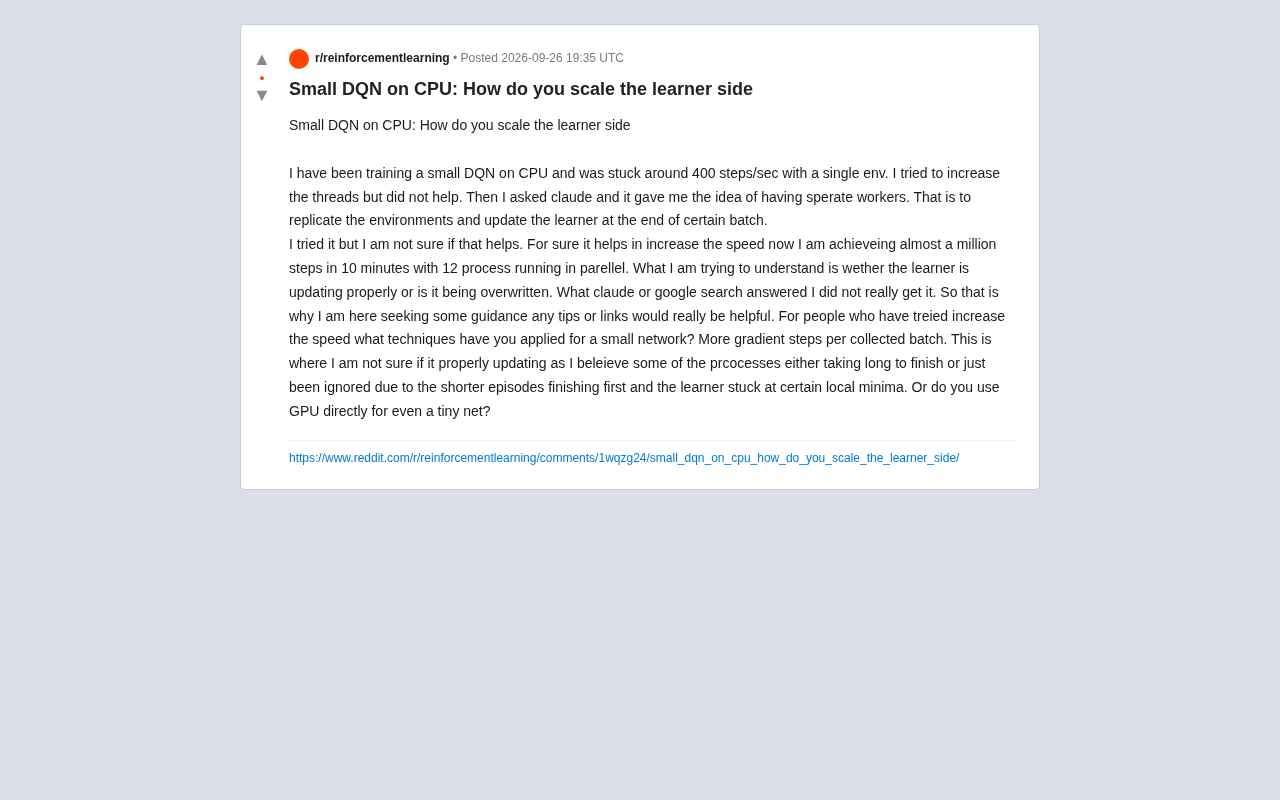
Training reinforcement learning models on CPU is a common choice for developers with limited resources. A Reddit user shared his predicament: when training a small DQN (Deep Q-Network) in a single-environment setup, throughput was stuck at around 400 steps/sec, and adding more threads made no difference.
This is actually a very typical symptom. For small neural networks, simply adding threads rarely yields linear speedups — Python's GIL (Global Interpreter Lock) limits multi-threaded parallelism on CPU-bound tasks, and the environment stepping itself can become a bottleneck. When the network is small, the gradient computation overhead is minimal; the real culprit slowing things down is usually the rollout (data collection) phase.
Multi-Process Worker Architecture: Speed Gains and Hidden Pitfalls
Following advice from Claude, the user adopted an "independent Worker" architecture: multiple environment instances run in parallel, each collecting experience, with the learner updated collectively after specific batch intervals. This is essentially the Actor-Learner decoupling approach common in distributed RL — the core idea behind architectures like A3C, IMPALA, and Ape-X.
The results were immediate — with 12 parallel processes, nearly one million steps were collected within 10 minutes, an order-of-magnitude improvement over the original 400 steps/sec.
But with the speed boost came a new concern: Is the learner actually being updated correctly, or are different processes overwriting each other's updates? This is exactly the trap most developers fall into when moving from a single-environment setup to a multi-Worker architecture.
The Core Question: Are Updates Being Overwritten?
The user's concerns were specific:
- Some processes may take much longer to finish, causing stale updates
- Processes with short episodes finish first and "rush" to update, while long-episode experience gets ignored
- The learner might get stuck in a local minimum as a result
These concerns point to a key design question in parallel RL: how to manage the synchronization between experience flow and parameter updates.
The core idea behind Actor-Learner decoupling is to separate "experience collection" from "parameter optimization" into different processes, allowing both to proceed asynchronously. A3C (Asynchronous Advantage Actor-Critic) was one of the first algorithms to popularize this approach, allowing multiple Workers to each maintain a copy of the network and asynchronously push gradients to a global network. IMPALA went further by introducing the V-trace correction mechanism specifically to handle the "off-policy lag" between the collection policy and the learning policy — since Workers collect data using outdated parameters while the Learner has already advanced several steps, this policy gap introduces bias in gradient estimates. Ape-X takes an even more radical approach by abandoning synchronized gradients entirely, instead relying on a shared Prioritized Replay Buffer to decouple collection from learning. Understanding this architectural evolution helps you identify where your own implementation sits in terms of complexity, and what consistency issues you need to address.
In multi-process parameter sharing scenarios, parameter overwriting is a real danger. If multiple Worker processes each hold a reference to the Learner and directly invoke backpropagation, multiple processes will simultaneously write gradients to the same set of parameters — a classic race condition. In Python's multiprocessing module, if shared_memory or Manager is used to share model weights without locking, gradient updates from different processes can overwrite each other, causing the parameter update directions to become chaotic. PyTorch's Hogwild! training mode intentionally allows this kind of lock-free asynchronous updating in some scenarios, but it works well primarily for sparse gradients (e.g., NLP embedding layers). For the dense fully-connected layers typical in DQN, unprotected concurrent writes will almost certainly harm training stability. To check whether your code has an overwrite problem, the key is to examine whether the write paths to parameter tensors are mutually protected across processes.
The Right Way to Parallelize DQN
For this type of scenario, mature patterns from the community offer useful direction.
Separating "Collection Parallelism" from "Learning Parallelism"
For off-policy algorithms like DQN, the most reliable architecture is to have multiple Workers responsible only for collecting data and writing to a shared Replay Buffer, while the learner remains a single instance that samples from the buffer for gradient updates. This eliminates the "multiple processes overwriting learner parameters" problem entirely — only one learner writes to the parameters, and Workers only read the latest parameters for collection.
The Ape-X architecture is the canonical example of this approach: many Actors collect in parallel, a single Learner performs centralized updates, and Workers periodically pull the latest network weights from the Learner. This design naturally prevents parameter overwriting and ensures that experience from both short and long episodes can fairly enter the replay buffer.
On "More Gradient Steps Per Collected Batch"
The user's mention of "more gradient steps per collected batch" is a common technique for improving sample efficiency, but it requires care. For off-policy DQN, increasing the replay ratio (the ratio of updates to collected steps) can indeed extract more information when data is limited, but too high a ratio can cause overfitting to recent experience and exacerbate instability. This may be related to the "local minima" phenomenon the user observed.
Replay Ratio (also known as Update-to-Data ratio, or UTD) refers to how many gradient updates the Learner performs per environment step collected. Standard DQN typically uses a UTD of 1 or lower, while recent research (e.g., DER, SR-SAC) has explored pushing UTD to 4, 10, or even higher to squeeze out data efficiency. However, high UTD exacerbates the "deadly triad" problem — the instability that arises when function approximation, bootstrapping, and off-policy learning coexist. Symptoms include Q-value divergence, gradient explosion, or getting stuck in a suboptimal policy with no escape. Mitigation strategies include increasing target network update delays, using Layer Normalization, or periodically resetting the network's final layers (Plasticity Reset) — all active areas of research in recent RL engineering practice. The "local minima" phenomenon the user observed is quite likely a case of implicit overfitting or value function collapse under high UTD, rather than a true policy trap.
CPU vs. GPU
For the question of whether small networks benefit from GPU, the answer is generally: if the network is small enough, GPU may not be faster. The data transfer overhead between CPU and GPU can easily cancel out any speedup gained from accelerating small matrix operations. For small DQNs, the performance bottleneck is typically on the collection side, not the computation side. The optimization priority should be parallel collection and an efficient Replay Buffer implementation — not rushing to move to GPU.
Practical Recommendations for Developers in Similar Situations
Based on this case, here are a few actionable directions:
- Clarify architectural responsibilities: Workers only collect, a single Learner performs centralized updates, and a shared Replay Buffer connects the two — this fundamentally eliminates parameter overwriting concerns.
- Validate that updates are working: Monitor Q-value distributions, loss curves, and the distribution of experience sources in the buffer to confirm that data from all Workers is being consumed and none are being ignored.
- Tune replay ratio conservatively: Start with a conservative update frequency, observe training stability, and increase gradually.
- Be pragmatic about GPU: For small networks, prioritize optimizing CPU-side collection parallelism and use profiling tools to identify the real bottleneck.
This question also reflects a broader pattern: AI assistants like Claude can suggest viable architectural approaches that quickly show results, but for questions like "are the updates actually correct" — which require deep understanding of algorithmic mechanisms — developers still need to validate using monitoring metrics and community experience. A speed improvement is only the first step; ensuring the correctness of the learning process is the true challenge of RL engineering.
Related articles

Felix Rieseberg Personal Homepage
Felix Rieseberg's personal homepage sparks attention on Hacker News. This article covers the Slack engineer's technical background, the rise and fall of nativefier, and the value of a developer homepage as a tech calling card.

@ai-sdk/vue 3.0.306 Patch Release Syncs with [email protected] Update
@ai-sdk/vue 3.0.306 released, synced with [email protected]. A routine patch release for the Vercel AI SDK ecosystem with no public API changes; the Vue adapter layer stays version-aligned with the core package.

Gemini 4 Argon API Launches: The Era of Million-Token Output Begins
Google launches Gemini 4 Argon with sparse MoE architecture, up to 1M output tokens, and a 68.90% Vals Index score, available across API, AI Studio, and the Gemini app.