Training AI Racers with Reinforcement Learning: A Racing Game Where You Play as the AI Coach
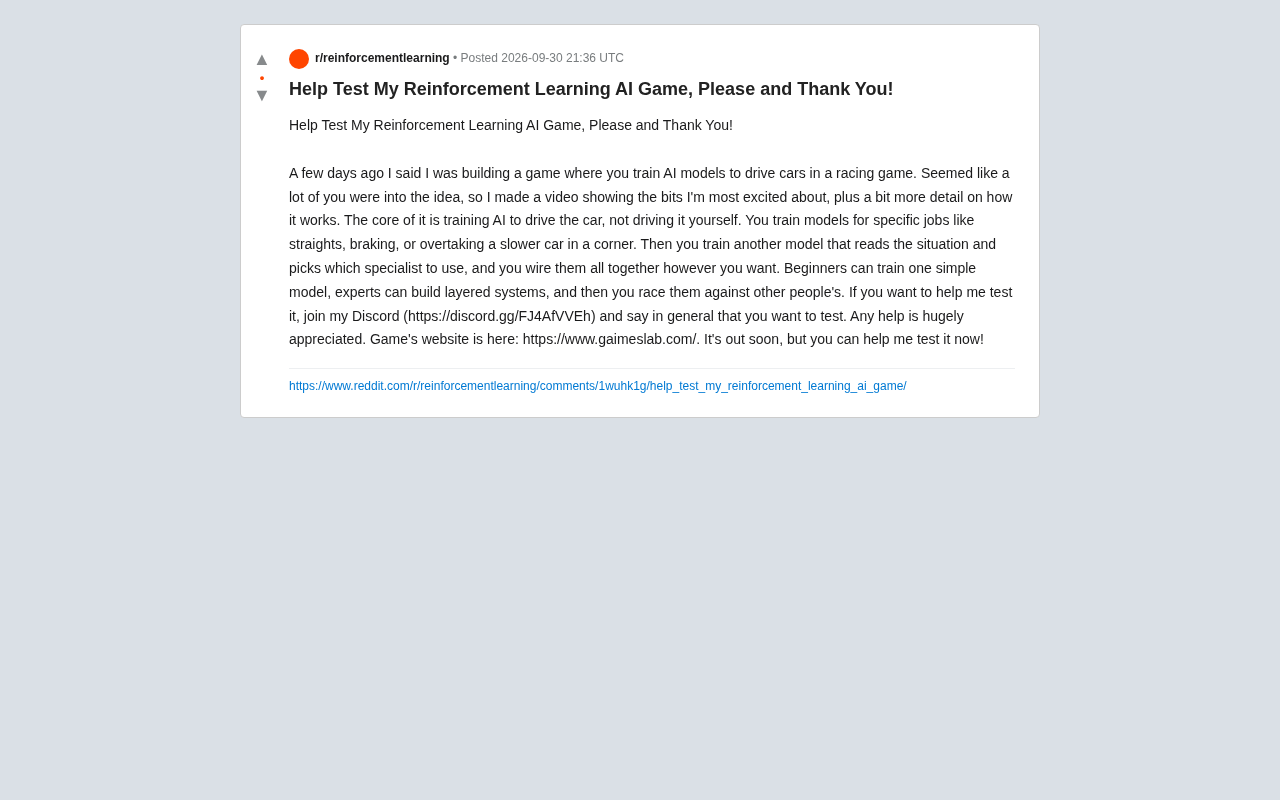
An indie racing game where you train AI drivers with reinforcement learning instead of driving yourself.
This indie racing game flips the genre on its head: players act as AI trainers rather than drivers, using reinforcement learning to build autonomous racing systems. The layered architecture has players training specialized models for specific scenarios — acceleration, braking, overtaking — coordinated by a top-level decision model, closely mirroring the MoE architecture in ML. Difficulty scales from casual to hardcore. The game is currently in beta via Discord, with the official site at gaimeslab.com.
A Racing Game Where You Never Touch the Wheel
Traditional racing games test your reflexes and precision. But one indie developer is building something that completely flips that logic: instead of being the driver, you're the AI trainer. The core gameplay isn't about controlling a car — it's about using Reinforcement Learning (RL) to train an AI model that drives for you.
As the developer shared on Reddit, the goal is for players to design, train, and debug an AI driving system, then send it onto the track to compete against AI systems trained by other players. This design transforms the player from an "operator" into a "coach" and "architect" — a genuinely fresh take on the genre.
Divided Labor: A Layered Architecture of Expert Models + a Decision Model
The most interesting design choice in this game is its layered AI architecture. Rather than training one "all-purpose" model to handle every situation, players train specialized models for specific scenarios.
The developer gave a few examples: you might train one model for straight-line acceleration, another for braking through corners, and yet another specifically for overtaking slower cars mid-turn. Each model is an "expert" in its narrow domain.
A Top-Level Decision Model Handles Coordination
Once those specialist models exist, players must also train a higher-level decision model. This model reads the current track situation and determines which expert model to call upon at any given moment. Finally, players wire all the models together according to their own design, forming a complete driving decision system.
This "expert models + dispatcher model" structure closely mirrors the Mixture of Experts (MoE) concept in machine learning — using a gating mechanism to select among multiple sub-networks. Packaging this fairly advanced concept into a game mechanic significantly lowers the barrier to understanding it.
Reinforcement Learning (RL) is a branch of machine learning where an agent learns optimal behavior through repeated interaction with an environment, following a cycle of "take action → receive reward or penalty → adjust strategy." Unlike supervised learning, which requires large amounts of labeled data, RL only needs a well-defined reward function — for example, "earn points for completing an overtake, lose points for hitting a wall" — and the model can explore and improve on its own. Racing is a classic RL testbed; organizations like DeepMind and Sony AI have used RL to train racing AIs that surpass human performance. This game hands the core RL workflow — reward design and policy iteration — directly to the player, effectively gamifying the work of an AI engineer.
Mixture of Experts (MoE) is a model architecture consisting of multiple "expert" sub-networks, each specialized in different sub-tasks, alongside a gating network that decides which expert should handle a given input. The advantage is that the overall model can have a large parameter count while only activating a small fraction of those parameters per inference, balancing capability with computational efficiency. Recent large language models like GPT-4 and Mistral's Mixtral series both use MoE architectures. The game's design — straight-line model / braking model + a top-level dispatcher — closely mirrors the gating-expert paradigm of MoE. When players tune their dispatch logic, they're essentially implementing a discrete gating mechanism by hand.
Accessible to Beginners, Deep Enough for Hardcore Players
Worth highlighting is the game's scalable difficulty. The developer emphasizes that beginners can train a single simple model and get on the track right away, while experienced players can build complex layered systems, stacking multiple expert models and decision logic on top of each other.
This means the game works both as a lightweight introductory experience and as a deep platform for strategy and fine-tuning. Competition between players is fundamentally a battle of AI system design skill and training quality — adding a layer of intellectual strategy to the rivalry, rather than making it purely a test of reaction speed.
Currently Recruiting Testers
The game hasn't officially launched yet. The developer is actively recruiting beta testers. A few days ago, he floated the concept in the community, received plenty of positive feedback, and then produced a video further showcasing what excites him most and how the game works in detail.
Users interested in testing can join through the developer's Discord channel and express their interest there. The official website is gaimeslab.com — the full release is coming soon, but you can already sign up to participate in testing.
Why This Direction Is Worth Watching
Turning the reinforcement learning training process into a playable, competitive game is a compelling attempt at AI education and outreach. It lets players intuitively experience the core workflow of "training an AI" in a gamified environment: define the task, train the model, compose the system, evaluate performance.
For casual players, it's a low-friction entry point into AI concepts. For those with some background, it offers a sandbox for continuous iteration and optimization. Of course, as an indie project still in testing, its actual training experience, playability, and balance all remain to be validated by more user feedback — which is precisely why the developer is actively recruiting testers right now.
Related articles

LangGraph Crash Course: Building Enterprise-Grade AI Agents and Workflows from Scratch
LangGraph crash course: learn its independence from LangChain, MIT license, FastAPI high-concurrency deployment, human approval, and memory storage for enterprise AI agents.

Building an AI Customer Service Agent from Scratch: A 92% Intent Recognition Case Study
A Bilibili case study: building an AI customer service agent from scratch with BERT intent recognition, dialogue state tracking, hybrid vector retrieval, and a weighted handoff model—raising intent accuracy from 65% to 92%, 78% conversation completion, handling 100K conversations daily.
Loop Engineering: An Engineering Paradigm for AI That Writes Code and Merges PRs Autonomously
Loop Engineering is transforming AI development pipelines: Stripe's Minions system merges over 1,300 machine-generated PRs weekly. This article breaks down Loop Engineering's five core actions, six components, five failure modes, and three safety disciplines, explaining why independent evaluators, state files, and budget caps matter more than full automation.