Training-Free Change Detection: DI-SCUSUM Leverages Diffusion Scores for Fast Detection

DI-SCUSUM uses diffusion noise and Hyvärinen scores for training-free change detection, achieving near-optimal performance with 91% lower delay.
This article introduces DI-SCUSUM, a training-free change detection method. It constructs smooth density estimates by adding Gaussian noise to finite samples and computes Hyvärinen scores to recursively update CUSUM statistics, bypassing the need for likelihood ratios of unknown distributions. Theory shows the average post-change increment is proportional to KL divergence, false alarm probability decays exponentially, and detection delay is inversely proportional to KL divergence. In calibrated Gaussian simulations, DI-SCUSUM approaches optimal likelihood ratio CUSUM, reducing delay by ~91% versus score-based SCUSUM, and is validated on MNIST and Oxford-IIIT Pet datasets. Combining diffusion noise injection with classic statistical detection, it offers a training-free, theoretically interpretable solution for rapid change detection under limited data.
Change detection is a core problem in signal processing, industrial monitoring, and medical diagnostics—how can we detect a significant shift in data distribution as quickly as possible while controlling the false alarm rate? The classic CUSUM algorithm relies on the log-likelihood ratio, but in real-world scenarios, the distributions before and after the change are often unknown, with only limited samples available, making the likelihood ratio impossible to compute directly.
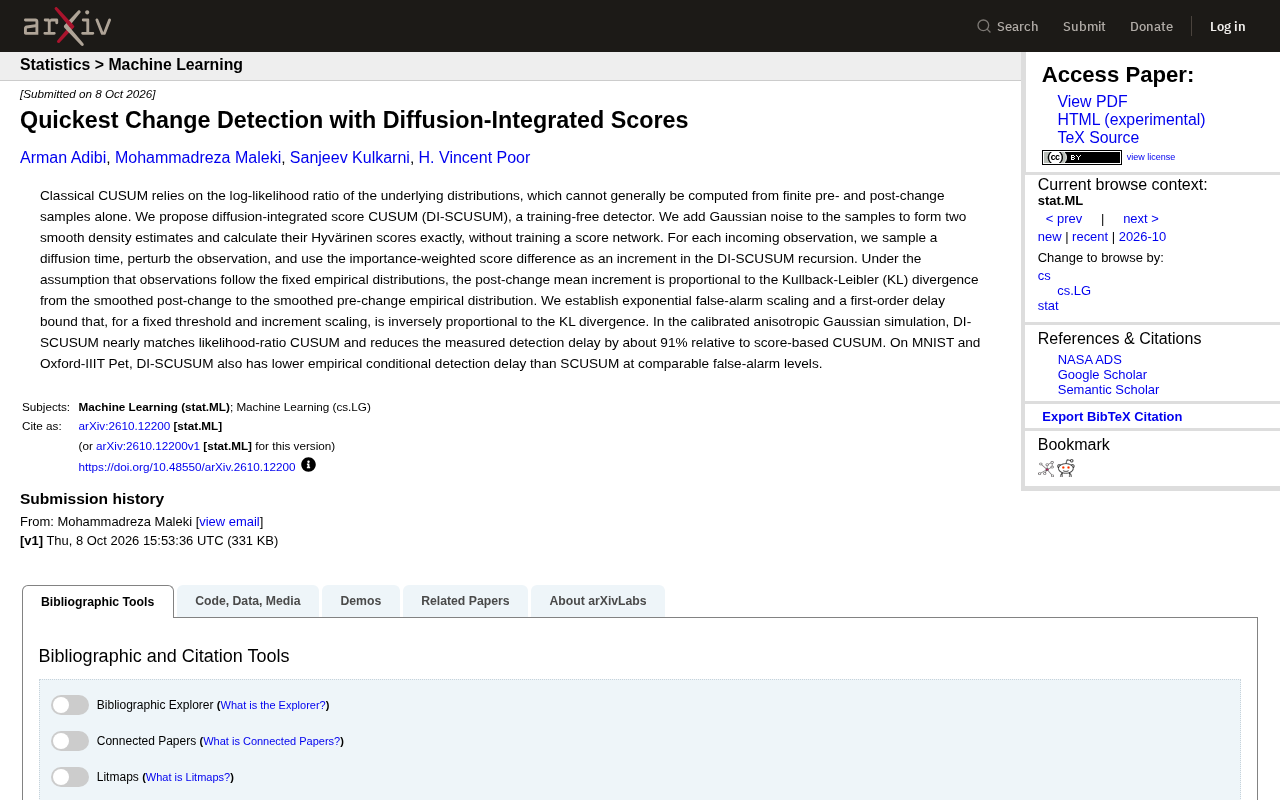
A recent study proposes DI-SCUSUM (Diffusion-Integrated Score CUSUM), a completely training-free change detector. It constructs smooth density estimates by adding Gaussian noise to samples, and computes detection statistics using the Hyvärinen score (i.e., the gradient of the log-density), bypassing the traditional reliance on likelihood ratios.
Core Idea: Replacing Training with Diffusion Noise
The key insight of the research is that by adding Gaussian noise to finite samples, two smooth density estimates can be obtained, and their Hyvärinen scores can be computed exactly without training any score network.
The specific procedure is as follows: for each new observation, the algorithm randomly samples a diffusion time, perturbs the observation, and then uses the importance-weighted score difference as the increment in the DI-SCUSUM recursion. The entire process is "training-free"—no pre-trained model is needed, nor is knowledge of the distributional forms before and after the change.
This design cleverly introduces the idea of diffusion models into change detection: the diffusion process is essentially multi-scale smoothing of the data distribution, while the score function provides directional information about the differences between distributions.
The Hyvärinen score is a tool in statistics and machine learning for estimating unnormalized probability densities. For a density function (p(x)), its score is defined as (\nabla_x \log p(x)), i.e., the gradient of the log-density with respect to the input. This quantity does not depend on the normalization constant, making it particularly suitable for models where the partition function is difficult to compute. In diffusion models, the score function is used to describe the log-gradient of the data distribution and is trained via denoising score matching. The cleverness of this paper lies in the fact that after adding Gaussian noise to finite samples, an analytically computable smooth density estimate can be obtained, whose score can be directly derived from the convolution of samples and noise, thus completely avoiding the process of training neural networks. This allows DI-SCUSUM to retain the directional advantages of the score function while being training-free and computationally efficient.
Theoretical Foundation: KL Divergence-Driven Detection Performance
The paper provides a solid theoretical analysis. Under the assumption that observations follow a fixed empirical distribution, the average post-change increment is proportional to the KL divergence from the smoothed post-change distribution to the smoothed pre-change distribution. This means that the larger the distributional change, the stronger the detection signal, which aligns with intuition.
More importantly, the study establishes two key theoretical guarantees:
- Exponential false alarm scaling: The false alarm probability decays exponentially with increasing threshold
- First-order delay bound: Under fixed threshold and increment scaling, the detection delay is inversely proportional to the KL divergence
These two conclusions provide theoretical guidance for threshold selection in practical deployment—the larger the KL divergence, the faster the detection at the same threshold.
KL divergence is an asymmetric measure of the difference between two probability distributions, defined as (D_{KL}(P | Q) = \int p(x) \log \frac{p(x)}{q(x)} dx). In change detection, KL divergence is often regarded as a theoretical "difficulty metric": the greater the distributional difference before and after the change, the larger the KL divergence, and the easier the detection task. The optimality of CUSUM-type algorithms is also typically characterized by KL divergence; for example, Lorden's lower bound shows that under a given average false alarm time constraint, the detection delay is at least proportional to (1/D_{KL}). This paper proves that the average increment of DI-SCUSUM is proportional to the KL divergence between the smoothed distributions, meaning that this training-free method theoretically captures the core quantity of detection difficulty and lays the foundation for the subsequent exponential false alarm bound and first-order delay bound.
Experimental Validation: Near-Optimal, Significantly Outperforming Score-Based Methods
In calibrated anisotropic Gaussian simulations, DI-SCUSUM performs close to the likelihood ratio CUSUM (theoretically optimal detector), while reducing detection delay by approximately 91% compared to the score-based CUSUM (SCUSUM). This improvement is quite substantial.
On the MNIST handwritten digits and Oxford-IIIT Pet datasets, DI-SCUSUM also exhibits lower conditional detection delays than SCUSUM at comparable false alarm levels. Cross-dataset validation demonstrates that the method is not only applicable to synthetic scenarios but also has practical value on real image data.
Conditional detection delay is a commonly used performance metric in change detection, typically referring to the expected time from the occurrence of a change to its detection under a given false alarm constraint. Unlike average detection delay, conditional delay often focuses on worst-case or specific post-change delay distributions, better reflecting the response speed in practical deployment. In the experiments of this paper, the comparison between DI-SCUSUM and SCUSUM is based on conditional delay at comparable average run length (ARL) or false alarm probability levels. The 91% reduction means that while maintaining the same false alarm level, DI-SCUSUM can issue alarms faster, which is particularly critical for time-sensitive scenarios such as fault warning and network intrusion detection. This metric is also commonly used for comparison with theoretical lower bounds to assess the gap between the algorithm and the optimal detector (such as the likelihood ratio CUSUM).
Why It's Worth Attention
The value of this work is reflected at several levels:
The training-free nature lowers the deployment barrier. Traditional deep learning methods require large amounts of labeled data and training time, whereas DI-SCUSUM can work directly from finite samples.
The combination of diffusion models and statistical detection opens up new ideas. Diffusion models have recently shone in the generation field, but using their noise injection mechanism for change detection is still novel. The score function plays the role of a "distribution difference detector" here.
Complete theoretical guarantees. There are not only experimental results but also rigorous bounds on false alarm rates and detection delays, which is not common in the change detection literature.
For scenarios that require rapid detection of distributional changes under limited data—such as equipment fault warning, network anomaly detection, or medical monitoring—DI-SCUSUM provides a new option that is training-free and theoretically interpretable.
One-line Summary
DI-SCUSUM uses diffusion noise and Hyvärinen scores for training-free change detection, achieving near-optimal performance with 91% lower delay.
Paragraph Summary
This article introduces a training-free change detection method called DI-SCUSUM. It constructs smooth density estimates by adding Gaussian noise to finite samples and computes Hyvärinen scores to recursively update CUSUM statistics, thereby bypassing the dependence on the likelihood ratio of unknown distributions. Theoretical analysis shows that the average post-change increment is proportional to the KL divergence between smoothed distributions, the false alarm probability decays exponentially with the threshold, and the detection delay is inversely proportional to the KL divergence. In calibrated Gaussian simulations, DI-SCUSUM approaches the optimal performance of the likelihood ratio CUSUM, reducing detection delay by approximately 91% compared to the score-based SCUSUM. Its effectiveness is also validated on the MNIST and Oxford-IIIT Pet datasets. This method combines the noise injection mechanism of diffusion models with the classic statistical detection framework, providing a training-free, theoretically interpretable new solution for rapid change detection under limited data.
Related articles

Chain of Thought Isn't Just for AI: How Humans Can Use CoT to Improve Thinking Quality
Chain of Thought isn't just a prompt trick for large models. Starting from a Hacker News discussion, this article analyzes why CoT works for human thinking too, breaks down actionable ways to transfer it, and highlights the key differences between human CoT and machine CoT.
Cloudflare Teams Up with OpenAI: Closi…
Cloudflare Teams Up with OpenAI: Closing the Loop from Vulnerability Discovery to Defense with AI
Cloudflare uses OpenAI Daybreak to investigate security vulnerabilities and generate reviewable remediation plans, while developers use Codex to boost coding efficiency and quality.

Orca Multi-Agent Orchestration in Practice: A Guide to Parallel Collaboration with Claude and Codex
Orca is Stable AI's free open-source agent workbench supporting 34 agents like Claude Code and Codex in parallel. Learn its Git worktree isolation, multi-model orchestration, and mobile management.