Training-Free Fix for Model Repetition Loops: The Weight-Surgery Claude Code Plugin

Developer builds the Claude Code plugin Weight-Surgery to directly edit small-model weights, excising repetition circuits without harming reading ability.
To fix small-model repetition loops without decoding penalties or more training, a developer built the Claude Code plugin Weight-Surgery for end-to-end weight surgery: scanning attention heads, attributing feed-forward writers, splitting head functions with contrast directions, and using reversible edits with validation. An induction head (score 0.425) drove the loops; excising only the loop direction cut the loop rate from 30.5% to 25.2% with reading nearly intact. Editing feed-forward write weights proved far cheaper than residual-stream projection, and a rank-1 edit halved sampling loops. Validation is currently limited to small models.
Title
Training-Free Fix for Model Repetition Loops: The Weight-Surgery Claude Code Plugin
Meta Description
A developer turned a weight-surgery pipeline for small models' repetition loops into a Claude Code plugin called Weight-Surgery. By scanning induction heads, splitting functional directions, and editing feed-forward write weights, it reduces loop rates without training or decoding penalties while preserving reading ability.
Article Content
Small models love to repeat themselves—a common headache in both training and deployment. The usual fixes are decoding penalties or continued fine-tuning, but one developer chose a third path: directly editing the model weights to locate and excise the "neural circuit" causing the loops. He packaged this pipeline into a Claude Code plugin called Weight-Surgery, letting a coding agent perform "weight surgery" end-to-end on any trained Transformer.
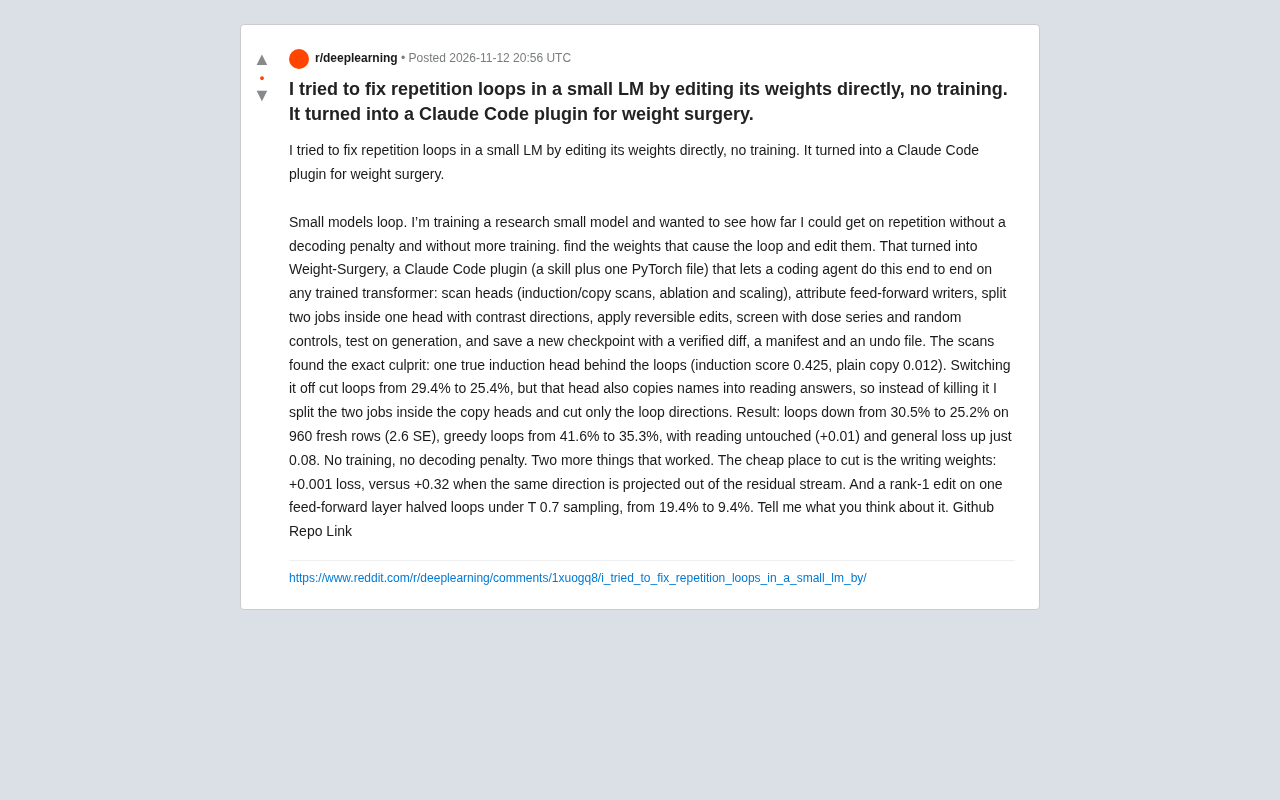
From Repetition Loops to Weight Surgery
The developer was training a small research model and found it frequently fell into repetition loops during generation. Rather than adopting the common decoding penalties (such as repetition penalty) or investing in more training, he wanted to test a more radical idea: can we find the specific weights causing the loops and directly edit them to eliminate the problem?
This idea eventually evolved into Weight-Surgery—a Claude Code plugin containing a skill and a PyTorch file. It allows a coding agent to execute the full weight-surgery pipeline on any trained Transformer: scanning attention heads (induction/copy scans, ablation and scaling), attributing feed-forward writers, using contrast directions to split two functions within a single head, applying reversible edits, screening with dose series and random controls, testing on generation tasks, and finally saving a new checkpoint with a validation diff, manifest, and undo file.
Scanning and Localization: The Real Culprit Is an Induction Head
The scan pointed to a clear culprit: a genuine induction head driving the loops, with an induction score of 0.425 versus a mere 0.012 for ordinary copying. This indicates the head is primarily responsible for induction patterns rather than simple copying.
Turning this head off directly reduced the loop rate from 29.4% to 25.4%. But the problem is that this head also handles copying names into reading-comprehension answers. Simply shutting it down reduces loops but damages reading ability. Instead of "killing" the head, the developer tried to split its two internal tasks.
Induction Head is a general term for a class of special attention heads in Transformers, first systematically described by Anthropic's mechanistic interpretability research. Its typical behavior: when a pattern (e.g., "A B") has appeared earlier in the sequence and "A" appears again, the head strongly attends to the position after the previous "A", thereby predicting "B". This "copy the historical successor" mechanism is an important foundation of in-context learning, but it also easily forms positive feedback loops on repetitive text. An induction head is usually implemented by two attention heads working together: a previous-token head marks each token's predecessor, and an induction head uses that marker to retrieve the successor. The "induction score" in the article measures how strongly the head elicits successor predictions on synthetic repetitive sequences—the higher the score, the more pronounced its induction behavior.
Splitting Functions: Cut Only the Loop Direction, Preserve Reading Ability
The developer used contrast directions to split two functions within the copy head, excising only the loop-related direction while preserving the reading-related direction. Tested on 960 fresh data rows, the loop rate dropped from 30.5% to 25.2% (2.6 standard errors), and the loop rate under greedy decoding dropped from 41.6% to 35.3%, while reading ability was virtually unaffected (+0.01) and general loss rose by only 0.08. The entire process required no training and no decoding penalty.
Contrast Directions is an interpretability editing technique based on activation differences. The approach: construct two sets of inputs that contrast semantically or behaviorally (e.g., "contexts that trigger loops" versus "normal reading-comprehension contexts"), forward-propagate each and record the activations of the target head or layer, then compute the difference between the two mean activations to obtain a direction vector. This vector is believed to encode the key feature distinguishing the two behaviors. In weight surgery, this direction can be projected out of the weight matrix (i.e., subtract its component along the direction), thereby "excising" the corresponding function while preserving other functions as much as possible. The effectiveness of contrast directions depends on the representativeness and purity of the contrast set, which is why the article emphasizes validation on 960 fresh data rows and measuring significance with standard errors.
A Cheaper Entry Point: Write Weights
Beyond splitting functions within a head, the developer also found a more efficient editing location: the write weights of the feed-forward layer. Projecting the same direction out of the residual stream raised loss by 0.32, whereas directly editing the write weights incurred only +0.001 loss. This means write weights are a "cheaper" intervention point.
Moreover, a rank-1 edit to a single feed-forward layer halved the loop rate from 19.4% to 9.4% under T=0.7 sampling. This further validates the feasibility of weight surgery.
Write weights of the feed-forward layer refer to the weight matrix in a Transformer's feed-forward network (FFN) responsible for writing computed features back to the residual stream (usually the second linear layer, i.e., W_out or down-projection). In contrast, the "read weights" (the first linear layer) extract information from the residual stream. The residual stream is an additive channel shared across layers; directly projecting it interferes with the information all subsequent layers read, hence the higher cost. Editing write weights only changes what that FFN layer contributes to the residual stream, making the impact more local and controllable. The "rank-1 edit" in the article means modifying only a single rank-1 direction (i.e., one outer-product term) of the write-weight matrix—the smallest structured intervention, which is easy to reverse and interpret.
Multi-Source Perspectives and Engineering Significance
According to the original Reddit post and the GitHub repository, the core value of this tool lies in packaging complex model interpretability operations into skills callable by a coding agent. It does not rely on training; instead, through reversible edits and a validation pipeline, it lets developers safely experiment with weight modifications. For teams studying small-model behavior or needing to quickly fix generation issues, this offers a low-cost alternative.
However, the method is currently validated only on small models, and its generalization to larger models or different architectures remains to be seen. But the idea itself—replacing training and decoding penalties with weight surgery—opens a new direction for model debugging.
The GitHub repository link was provided in the original post; interested readers can check out the implementation and experimental details.
Reversible edits and the validation pipeline are key to engineering weight surgery. Reversible edits mean every modification records the original weights and the modification amount, supporting precise rollback via the undo file; the validation diff compares behavior changes on a held-out set before and after editing; and the manifest records the full parameters and results of scanning, attribution, editing, and testing. This design borrows from version control and continuous validation ideas in software engineering, turning model weight modification from a one-off research experiment into an auditable, reproducible pipeline. For a coding agent, Weight-Surgery packages "scan-attribute-edit-test" into a skill, so the agent can call PyTorch functions step by step and automatically complete dose screening and random controls, lowering the barrier and risk of manual operation.
One-line Summary
Developer uses the Claude Code plugin Weight-Surgery to directly edit small-model weights, excising repetition-loop circuits without harming reading ability.
Paragraph Summary
To solve small models' repetition loops, a developer abandoned decoding penalties and further training, instead building the Claude Code plugin Weight-Surgery to perform end-to-end weight surgery on a trained Transformer. The pipeline includes scanning attention heads, attributing feed-forward writers, splitting intra-head functions with contrast directions, and reversible editing with validation. Experiments located an induction head (induction score 0.425) as the main cause of loops; directly shutting it down reduced the loop rate from 29.4% to 25.4% but harmed reading ability. By excising only the loop direction via contrast directions, the loop rate dropped from 30.5% to 25.2% with reading ability essentially unchanged. Additionally, editing feed-forward write weights is far cheaper than projecting the residual stream (loss +0.001 vs +0.32), and a rank-1 edit halved the sampling loop rate. The method is currently validated only on small models, and its generalization remains to be seen.
Related articles

Claude Code Pitfall Guide: Using CC Switch to Avoid Account Ban Risks
Claude Code installation failing in China? A Bilibili creator shares a stable NPM install + CC Switch login-bypass solution with no bans for months, plus spec-driven development and project memory to keep code from getting messier with each change.

Claude Code Ban Prevention and Memory Management: CLAUDE.md and ccswitch in Practice
How to avoid account bans when using Claude Code in China? This article summarizes a Bilibili creator's tested approach: install via NPM to bypass network restrictions, use ccswitch to bypass official account login, and covers CLAUDE.md project memory, MCP, Skills, Hooks, and other specification constraint practices.

Microsoft Foundry: How Enterprises Can Keep Runaway AI Costs Under Control
Microsoft Foundry, part of Azure, offers built-in security and governance with a unified view of model counts, credit usage, and total spend—helping enterprises prevent runaway AI agent token costs. This article analyzes its enterprise positioning, use cases, and cost-control value.