Training 'Object Permanence' in World Models: A Deep Dive into the WROP Dataset and PWM Model

WROP brings cognitive science object permanence benchmarks to world model training, powering PWM-WROP to top continuation-model rankings.
This paper introduces the WROP data infrastructure — 150 hand-designed tasks, 1.5M training samples, and a 300-question exam set drawn from cognitive science — to train and evaluate video generation models on physical priors like object permanence and solidity. By randomizing nuisance parameters (lighting, viewpoint, speed) via Blender, the approach forces models to learn invariant physical rules rather than surface pixel patterns. The resulting 16B world model PWM-WROP ranks first among continuation-paradigm models and third overall across 14 models in blind Elo evaluation. The full dataset, exam set, model weights, and a native PyTorch training stack on AWS Trainium2 are all open-sourced, providing a reproducible benchmark for quantifying physical intelligence in world models.
Can World Models Understand That Objects Don't Just Vanish?
Object permanence and solidity are foundational cognitive priors in human cognition — even when an object is occluded or moves out of view, we inherently know it still exists. This ability begins developing in early infancy and serves as the cornerstone of our intuitive understanding of the physical world.
Recent research suggests that video generation models — the most prominent representatives of today's world models — have started exhibiting a kind of "emergent" reasoning capability, making them compelling candidates for building human-like physical intelligence. But a fundamental question arises: do video models truly possess object permanence internally? And if not, can we explicitly train this capability into them using a dataset inspired by core cognitive science?
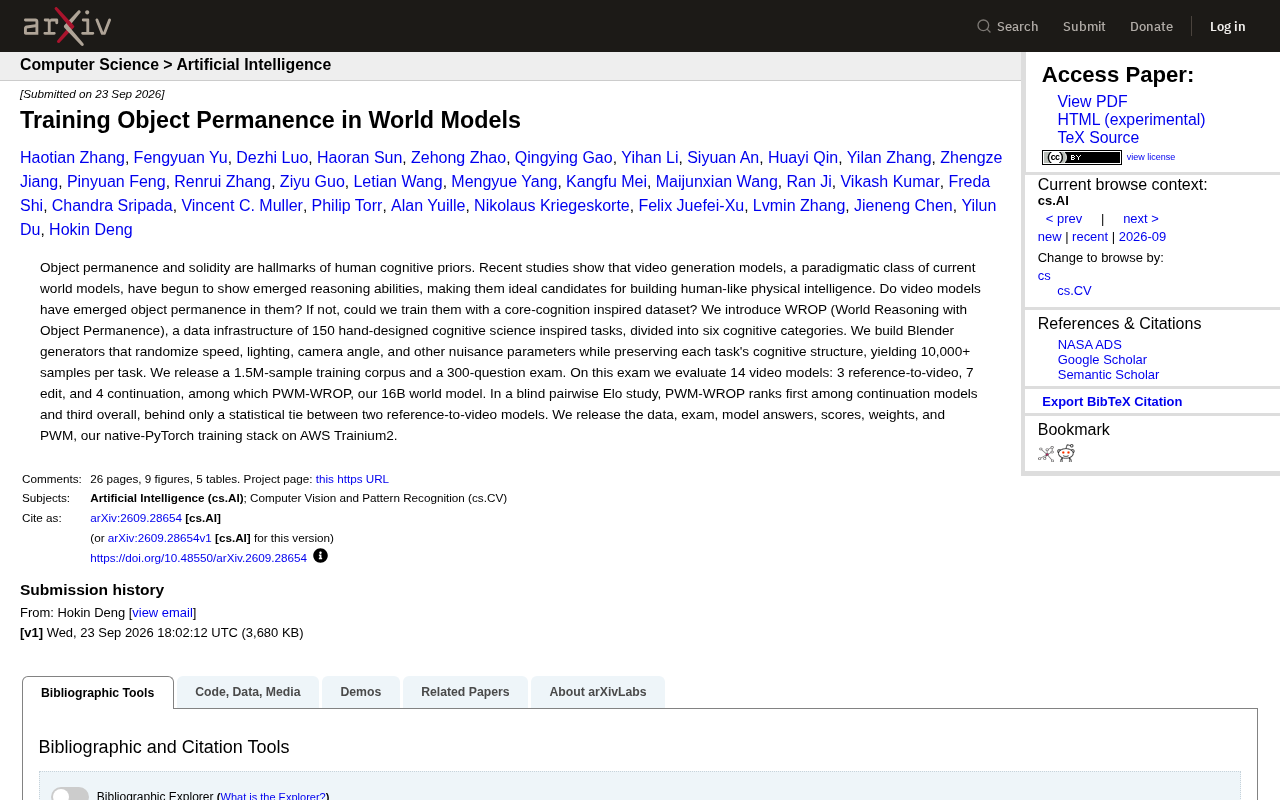
A new paper on arXiv (arXiv:2609.28654) tackles exactly this question, introducing a data infrastructure called WROP (World Reasoning with Object Permanence) and a 16B-parameter world model trained on it: PWM-WROP.
The concept of object permanence was systematically formalized by Swiss psychologist Jean Piaget, who identified it as a central milestone in the sensorimotor stage (ages 0–2) of infant cognitive development. Before this stage, infants operate on an "out of sight, out of mind" basis; as their nervous systems mature, they come to understand that objects continue to exist when hidden, and will actively search for a disappeared toy. Solidity is a closely related core prior: objects cannot pass through each other, and two physical entities cannot occupy the same space simultaneously. In cognitive science, these capacities are called "Core Knowledge" — believed to be evolutionary modules for understanding the physical world, not learned from extensive data but rather built-in inference mechanisms that can be activated from very few examples. Bringing these capacities into the evaluation framework for world models is precisely what distinguishes "statistically plausible video generation" from "genuine understanding of physical causality."
WROP: A Cognitively-Grounded Data Infrastructure
WROP's design philosophy differs fundamentally from data-at-scale approaches. Instead, it draws from cognitive science task paradigms to construct 150 hand-designed tasks organized into six cognitive categories. These tasks are not arbitrarily generated — they deliberately map onto classical experimental structures used in cognitive research to test physical intuitions like object permanence and solidity.
To increase diversity while preserving cognitive structure, the research team built a Blender-based generator that randomizes nuisance parameters such as speed, lighting, and camera angle. The value of this approach is significant: models must genuinely learn the underlying physical rules of each task rather than memorizing a fixed visual appearance. Each task can thus generate over 10,000 samples.
The team ultimately released a training corpus of 1.5 million samples, along with an exam set of 300 questions for systematic evaluation of physical reasoning capability.
Why Randomizing Nuisance Parameters Matters
When evaluating physical intuition, the greatest risk is that models "cheat" via surface-level statistical patterns. If all test scenarios share consistent lighting, viewpoints, and speeds, a model might simply learn pixel-pattern matching rather than genuinely understanding that "an occluded object still exists." By randomizing appearance parameters while preserving cognitive structure, WROP forces models to extract invariant physical rules from varying surface appearances — which is precisely the right methodology for measuring whether object permanence has truly emerged.
PWM-WROP: Real-World Performance of a 16B World Model
The research team evaluated 14 video models on the 300-question exam set, spanning three paradigms:
- Reference-to-video: 3 models
- Video editing (edit): 7 models
- Video continuation: 4 models
This includes the team's own 16B world model, PWM-WROP.
Evaluation used a blind pairwise Elo scoring methodology — a relatively objective ranking approach that avoids biases inherent in single absolute metrics. Results showed:
- PWM-WROP ranked first among all continuation-paradigm models;
- Ranked third overall across all 14 models;
- Trailing only two reference-to-video models (which were statistically tied with each other).
This result is quite compelling: video continuation is inherently the harder paradigm, requiring models to extrapolate future physical evolution from existing clips, whereas reference-to-video benefits from stronger conditioning constraints. PWM-WROP's top ranking in the continuation paradigm demonstrates that training specifically for object permanence yields meaningful gains in physical reasoning.
The Elo rating system originated in chess rankings, designed by physicist Arpad Elo in the 1960s. Its core principle is to dynamically update relative scores through pairwise win-loss records rather than relying on absolute scores. Its advantage in model evaluation is that when it's difficult to define a unified absolute scoring standard across models, pairwise comparisons effectively capture relative merit and smooth random noise through large volumes of comparisons. In video generation, where dimensions like visual quality and physical plausibility are hard to quantify, blind pairwise comparison (where evaluators don't know which video came from which model) combined with Elo ranking has become a reliable evaluation paradigm — also widely adopted by platforms like LMSYS Chatbot Arena. The method's limitation is that rankings depend on evaluators' judgment criteria, and different evaluator groups may produce different orderings.
Fully Open Resources and Training Stack
Another highlight of this work is its thoroughgoing commitment to openness. The team released not just the dataset, but also:
- The 300-question exam set and all models' responses
- Scoring results for all models
- Model weights for PWM-WROP
- PWM: a native PyTorch training stack running on AWS Trainium2
The release of the training stack is particularly noteworthy. Trainium2 is AWS's custom AI training chip, and building a native PyTorch training stack around it means researchers now have access to a world model training pathway that doesn't fully depend on the mainstream GPU ecosystem. For teams hoping to reproduce or extend this research, this substantially lowers the barrier to entry.
AWS Trainium2 is Amazon's second-generation custom machine learning training chip, based on the NeuronCore-v3 architecture and optimized for large-scale deep learning training. It is positioned as a cost-competitive alternative to NVIDIA H100. Trainium2 integrates with PyTorch through the AWS Neuron SDK, but since its instruction set differs fundamentally from the CUDA ecosystem, migrating existing training code to Trainium2 typically requires adaptation work. By open-sourcing a native PyTorch training stack built on Trainium2, the team has effectively provided a validated reference implementation for this migration — highly valuable for research institutions exploring non-NVIDIA compute paths. This is also a relatively rare example in academia of proactively reducing dependence on GPU monopolies through open-source practices.
Implications for World Model Research
This work delivers value on at least three levels.
First, it introduces cognitive science task paradigms into world model evaluation, providing a more fundamental metric than "does the generated video look good" — specifically, whether the model understands basic physical intuition.
Second, it validates a hypothesis: core cognitive capabilities like object permanence can be explicitly trained into video models through carefully designed data, without having to rely entirely on spontaneous emergence from large-scale data.
Third, the comprehensive release of data, exam sets, weights, and training stack gives the community a reproducible, comparable benchmark — helping move vague discussions about "whether world models possess physical intelligence" toward quantifiable empirical research.
For researchers working on embodied intelligence, physical simulation, and general-purpose world models, WROP and PWM-WROP are worth putting on your radar. They serve as a reminder: the path toward human-like physical intelligence may require systematically teaching models the very cognitive priors that human infants master first.
Related articles

JobRunner MCP Server: AI Agents Can Now Fix Failed Java Jobs
JobRunner launches an open-source MCP server enabling AI agents to view cluster status, diagnose failures, and recover Java jobs—incident response from any cloud coding environment or existing agent.

MLAI Digital Launches 9 Security Agents: MCP Server Safeguards the Full Lifecycle of Agentic AI
MLAI Digital launches Security MCP Server with nine built-in specialized security agents covering vulnerability discovery, attack simulation, prompt injection detection, API and infrastructure assessment, and accelerated remediation—embedding security validation across the full Agentic AI lifecycle from development to production.

Running Isaac Lab on H100 GPUs: Exploring Better Approaches
Exploring optimization methods for running Isaac Lab on NVIDIA H100 GPUs, including MIG configuration, mixed precision, TensorRT acceleration, and community experience to improve robotics simulation and reinforcement learning efficiency.