Training Reinforcement Learning on Nuzlocke Data: An Overlooked RL Environment Gold Mine

Pokémon Nuzlocke's permadeath rules and player input logs make it a natural fit for RL training environments.
A Reddit discussion proposed using Pokémon Nuzlocke challenge runs as reinforcement learning training environments. Nuzlocke's permadeath and one-catch-per-route rules impose high stakes on every decision, naturally demanding long-term planning and risk aversion — core RL training objectives. Pokémon battles offer structured state spaces, discrete action spaces, and clear rewards, while hardcore hacks like Emerald Kaizo raise difficulty to prevent trivial solutions. Years of player input logs serve as expert demonstration data for behavioral cloning and offline RL cold-starts. The idea remains conceptual, with open engineering challenges around state extraction and reward design, but offers genuine inspiration for researchers at the game AI and RL intersection.
A Reddit Shower Thought: Pokémon Nuzlocke as an RL Training Ground
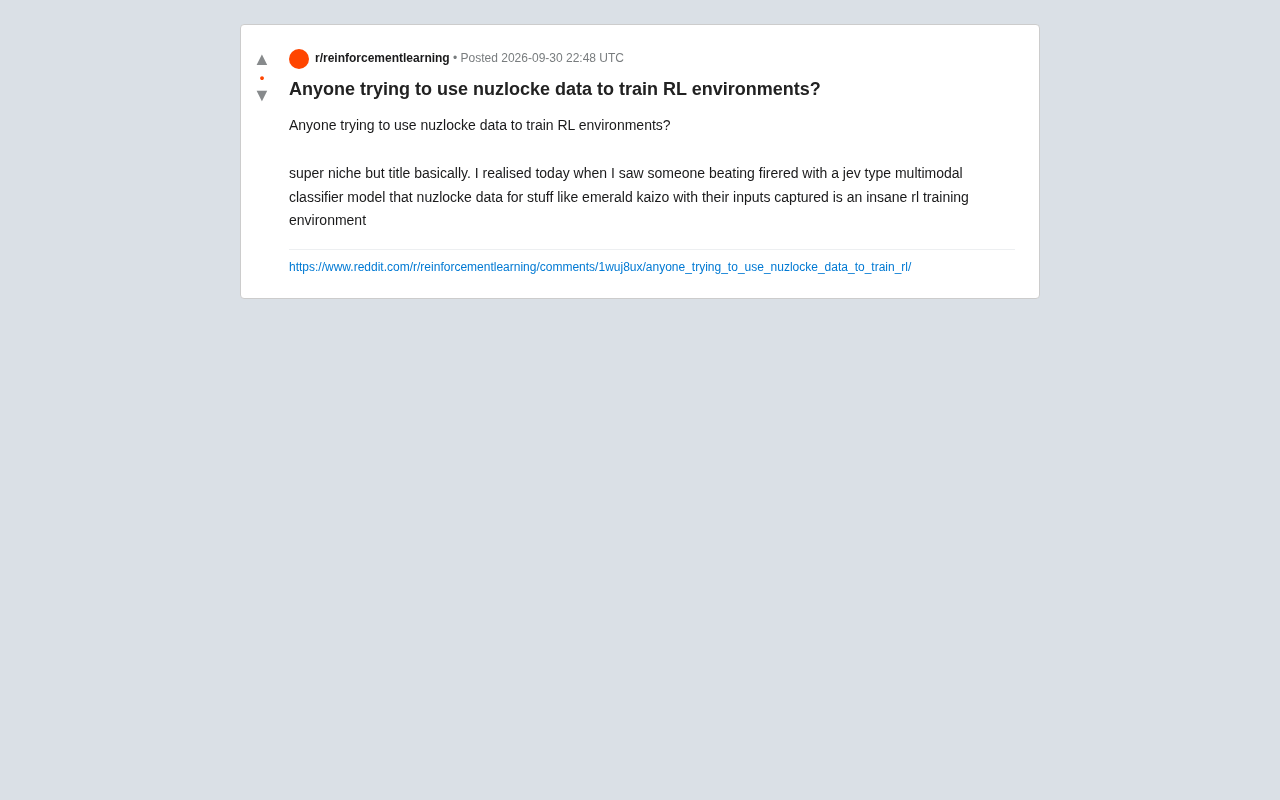
A recent Reddit discussion floated a niche but genuinely thought-provoking idea: could Nuzlocke run data — from Pokémon's beloved self-imposed hardcore challenge format — be used to train reinforcement learning (RL) environments? The poster admitted upfront that this was a "super niche" topic, but the underlying logic is worth unpacking.
The idea stemmed from seeing someone complete FireRed using what was described as a "jev type multimodal classifier model." From there, the poster realized that hardcore ROM hacks like Emerald Kaizo, paired with fully captured player input logs, essentially constitute an "insane RL training environment" — one with exceptionally high information density.
Why Nuzlocke Data Works Well for RL
The core constraints of the Nuzlocke ruleset — permanent death when a Pokémon faints, and only catching the first encounter on each route — mean every decision carries significant risk. This "high-penalty, irreversible" structure is exactly the kind of signal reinforcement learning thrives on.
In a standard RL framework, an agent learns a policy across states, actions, and rewards. Pokémon battles naturally provide a structured state space (party stats, HP, move PP, opponent info), a discrete action space (attacks, switches, item use), and clear win/loss rewards. The Nuzlocke permadeath mechanic, however, elevates long-term planning and risk aversion from optional strategies to absolute necessities — far beyond simple greedy optimization.
ROM hacks like Emerald Kaizo amplify this further. The base game may be too easy to elicit complex strategies from an AI, but Kaizo's unforgiving trainer configurations and razor-thin margins for error create a naturally challenging curriculum for training.
Player Input Logs: Ready-Made Expert Demonstration Data
The original poster specifically highlighted "their inputs captured" — and this is where things get interesting. The action sequences generated by human players completing a Nuzlocke challenge are, in essence, a collection of high-quality expert demonstrations.
This kind of data is valuable for two training paradigms:
- Imitation Learning / Behavioral Cloning: Learn a policy directly from human actions as a cold-start for RL training, bypassing the inefficiency of learning from scratch through random exploration.
- Offline Reinforcement Learning (Offline RL): Learn from pre-recorded trajectories without real-time environment interaction — especially valuable for games like Pokémon where individual runs are long and interaction costs are high.
In other words, the years of challenge run footage and input logs accumulated by the Nuzlocke community may represent an untapped data gold mine.
Behavioral Cloning is the most straightforward imitation learning approach: treat human action sequences as supervised input-output pairs and train a model to reproduce expert actions given a particular state. Its main limitation is distributional shift — once the agent enters states not covered by the training data, errors compound rapidly. Offline RL addresses this by introducing constraints (e.g., CQL, IQL algorithms) that penalize the agent for deviating too far from the dataset's distribution, though at the cost of limited exploratory capability. Nuzlocke data has a unique advantage here: because of permadeath, players deliberately avoid high-risk states, meaning the dataset is naturally skewed toward conservative strategies — perfectly aligned with Offline RL's optimization objectives, making it a better offline training foundation than typical gameplay recordings.
The Gap Between "Multimodal Completion" and "RL Environment"
It's worth distinguishing the two cases here. The FireRed completion mentioned in the post used a multimodal classification model — one that identifies game state from screen pixels and selects actions accordingly. That's quite different from end-to-end reinforcement learning training.
Turning Nuzlocke into a reusable RL environment would require solving several engineering challenges: extracting structured state representations from a game emulator, designing a sensible reward function (pure win/loss rewards are too sparse and likely need shaping), and handling differences between ROM hacks. None of these are trivial.
Still, the value of the idea lies in the perspective itself: gameplay formats with explicit rule constraints and human decision records — scattered across gaming communities — may already contain everything needed for RL research. Nuzlocke is just one example that happened to get pointed out.
Reward Shaping is the standard approach to sparse reward problems. In a game like Pokémon, using only the final win/loss as the reward signal can require tens of thousands of episodes before the agent receives any meaningful feedback — extremely inefficient. Common intermediate rewards include positive signals for knocking out opponent Pokémon, negative penalties for HP loss, and bonuses for successful captures. However, poorly designed shaping can trigger reward hacking, where the agent exploits loopholes in the reward function rather than learning genuine strategy. For the Nuzlocke context, translating the soft goal of "keep your Pokémon alive" into a mathematically principled reward term is itself a non-trivial research design question. Fortunately, emulators like PyBoy and mGBA already offer open memory-reading interfaces that can extract structured data like HP and party status, providing a solid technical foundation for this kind of reward design.
Takeaway
This discussion remains at the conceptual stage — no implementation or experimental results were provided. But it points toward an interesting direction: hardcore gameplay formats combined with human action records naturally possess the ingredients for building reinforcement learning environments. For researchers and developers at the intersection of game AI and RL, these kinds of "niche shower thoughts" are often where new projects begin.
Related articles

Python 3.15 New Feature: Is the sentinel Type Better Than None?
Python 3.15 adds the sentinel type, using named unique sentinel objects to replace None and bare object(), resolving confusion among missing values, explicit emptiness, and invalid input while avoiding type hint failures.

Deep Learning's Three Architectures and the Universal Approximation Theorem: A Complete Guide to MLPs, CNNs, and Transformers
Explaining the inductive bias differences among MLP, CNN, and Transformer, the existence meaning of the Universal Approximation Theorem (UAT), and the role of Taylor expansion in approximation analysis, while clearing up common misconceptions.

GitLab Emergency Patch Release: Analysis of Critical Security Fixes
GitLab releases critical patch 19.5.1, sparking 355 points of discussion on Hacker News. This article analyzes the background, upgrade steps for self-hosted instances, and verification points to help DevOps teams respond quickly to security updates.