Training Search-R1 Agents with Flame: Incremental Weight Sync Boosts GPU Efficiency

Flame open-source engine adds Search-R1-style training example with efficient agent architecture and incremental weight sync.
Flame released a Search-R1-style training example that trains a search-capable agent via Python service orchestration. The architecture splits the training loop into warm executors, elastic rollout, and gang-scheduled trainers, keeping models and indices resident in memory. Incremental weight sync reduces per-step weight publish from 6.17GB to about 165MB. On 14 rollout GPUs plus 2 trainer GPUs, 100 steps improved HotpotQA held-out exact match from 14.5% to 47%, averaging 24.3s per step. Results are limited by a single seed, a 200-question eval set, and a self-built corpus, with GPU idle time still present.
Open-source distributed engine Flame recently added a Search-R1-style training example, demonstrating how to train a search-capable agent using Python service orchestration. According to discussions in the Reddit community, this example teaches Qwen2.5-3B-Instruct to answer HotpotQA questions while learning to retrieve from a BM25 corpus. Its infrastructure design offers valuable reference for teams building agent training systems.
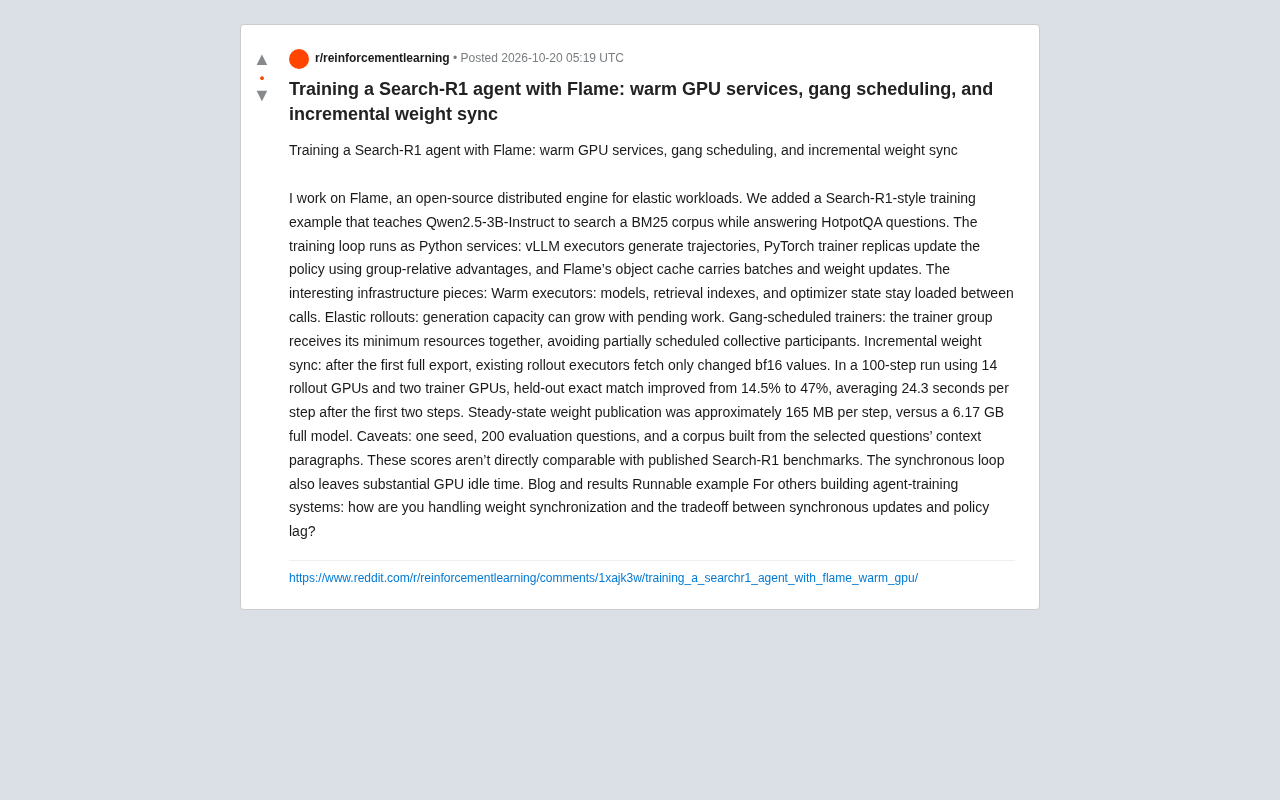
Training Architecture: Breaking the Training Loop into Services
Flame abstracts the training loop into multiple independently scalable Python services. vLLM executors generate trajectories, PyTorch trainer replicas update the policy using group-relative advantages, and Flame's object cache handles the transfer of batches and weight updates. This separation decouples generation from training, making it easy to allocate GPU resources on demand.
Warm Executors
Models, retrieval indices, and optimizer states remain resident in memory across multiple invocations. In traditional approaches, each rollout may reload the model or rebuild the index, which is especially expensive in agent training. Flame's warm executors avoid repeated initialization overhead, making small-batch, high-frequency generation requests more cost-effective.
When training large language models with reinforcement learning, the rollout phase requires the model to generate a large number of trajectories. If model weights are reloaded into GPU memory and retrieval indices rebuilt for each generation, initialization overhead can severely slow down training. The core idea of warm executors is to keep these resources resident in memory and pass batch data between services via object caches (such as Ray's object store), enabling low-cost scheduling of high-frequency, small-batch generation.
Elastic Rollout and Gang-Scheduled Trainers
Generation capacity can scale elastically with pending tasks—when rollout requests pile up in the queue, the system can temporarily increase the number of executors. Trainers use gang scheduling (a group of trainers simultaneously receives its minimum resource quota), avoiding the "partial scheduling" deadlock where some participants are ready while others are still waiting, thereby ensuring synchronization of collective communication.
Gang scheduling is a cluster scheduling strategy that requires a group of tasks to simultaneously obtain their required minimum resource set, or all wait. In distributed training, processes for data parallelism or model parallelism need to synchronize gradients through collective communication (such as AllReduce). If some processes are not started, communication cannot proceed, wasting resources. Flame uses gang scheduling to ensure all trainer replicas are ready simultaneously, avoiding "partial scheduling" deadlocks and ensuring the synchronous training loop runs smoothly.
Incremental Weight Sync: From 6.17GB to 165MB
This is the most engineering-highlighted part of the entire solution. After the first full weight export, existing rollout executors only pull the bf16 values that have changed. In the measured 100-step training, the steady-state weight publish volume per step is only about 165MB, while the full model size is 6.17GB.
This incremental sync significantly reduces communication bandwidth pressure between trainers and generators, and also makes rolling updates faster between steps. For models with tens of gigabytes of parameters, the impact of this optimization on overall throughput will be even more considerable.
The core of incremental weight sync is transmitting only the parameter values that change between two updates. In reinforcement learning training, policy updates often affect only some parameters, and the magnitude of change is small. By comparing the bf16 values of old and new weights, the system can generate sparse difference tensors, broadcast only these differences to rollout executors, and the executors apply them to local model replicas. This approach greatly reduces communication volume, but requires maintaining weight versions and difference computation mechanisms, increasing system complexity.
Measured Results and Limitations
With a configuration of 14 rollout GPUs plus 2 trainer GPUs, after running 100 training steps, the exact match rate on the held-out set improved from 14.5% to 47%. After the first two steps, the average time per step is 24.3 seconds.
The authors also candidly list several caveats: only a single random seed was used, the evaluation set contains only 200 questions, and the corpus was constructed from context paragraphs of the selected questions. Therefore, these scores cannot be directly compared with published Search-R1 benchmark results. In addition, the synchronous training loop still causes significant GPU idle time.
Exact Match (EM) is a commonly used evaluation metric in question answering tasks, requiring the model-generated answer to be exactly identical to the reference answer (usually after normalization). HotpotQA is a multi-hop question answering dataset where questions require reasoning across multiple document paragraphs. In Search-R1-style training, the agent needs to learn to invoke retrieval tools to obtain relevant information before generating answers. Therefore, the improvement in EM reflects the model's progress in combining retrieval and reasoning, but due to the limited evaluation set size and single seed, results should be interpreted with caution.
Implications for Agent Training Systems
Flame's example answers a common confusion in the community: for weight synchronization in agent training, should one choose synchronous updates or tolerate policy lag?
Its approach is to minimize synchronization cost under a synchronous loop—replacing full broadcast with incremental transfer. But the authors also acknowledge that the GPU idle problem still exists, leaving room for exploring asynchronous or semi-asynchronous solutions. For teams building similar systems, a worthwhile trade-off question is: is the complexity introduced by incremental sync worth it compared to relaxing synchronization constraints for higher GPU utilization?
The original article ends by asking the community: how do other teams building agent training systems handle weight synchronization and the trade-off between synchronous updates and policy lag? This may well be the next engineering topic worth watching in this field.
One-line Summary
Flame open-source distributed engine adds a Search-R1-style training example, demonstrating an efficient agent training architecture and incremental weight sync optimization.
Paragraph Summary
The Flame engine released a Search-R1-style training example that trains a search-capable agent through Python service orchestration. Its architecture splits the training loop into warm executors, elastic rollout, and gang-scheduled trainers, with models and indices kept resident in memory to avoid repeated loading. Incremental weight sync reduces per-step weight publish volume from 6.17GB to about 165MB, significantly lowering communication overhead. On 14 rollout GPUs plus 2 trainer GPUs, 100 training steps improved exact match on the HotpotQA held-out set from 14.5% to 47%, averaging 24.3 seconds per step. However, results are limited by a single seed, a 200-question evaluation set, and a self-built corpus, and synchronous training still suffers from GPU idle time.
Related articles

DeepCell: One-Click AI Generation of Documents, Spreadsheets, and Slides
DeepCell tops Product Hunt with one-click generation of documents, spreadsheets, and slides, using the .deepcell format for linked updates, designed for System 2 tasks like modeling and sales reviews.

Doneas: 15-Minute Daily Accountability Calls That Keep Indie Developers From Procrastinating
Doneas is a daily accountability tool for indie developers: plan tasks on Monday, join a 15-minute call with five builders each day, and log deliveries on a public progress page. This article analyzes its core mechanics, effectiveness, and potential issues around retention and matching.

Fastlane 2.0: Fully Automated AI Ad Campaigns, From Creative to Optimization
Fastlane 2.0 is an AI ad automation tool: enter your website and it learns your brand, generates video and image ads, and runs and optimizes them on Meta, TikTok, Instagram, and YouTube.