Training VLMs on Millions of Industrial Images: Optimal Strategies Under Label Noise

When label quality of million-scale industrial images is uncertain, train VLMs via denoising, robust training, and clean-data anchoring.
The article addresses how to train a vision-language model on roughly 1 million industrial images with uncertain label quality. It outlines sources and particularities of industrial label noise—annotation subjectivity, equipment error, and ambiguous semantic boundaries like 'minor scratch' vs. 'normal texture'—and provides strategies at three levels: data-level confidence learning, multi-source label cross-validation, and self-supervised pre-training; training-level robust losses like symmetric cross-entropy, sample reweighting, and curriculum learning with clean-data anchoring; and evaluation-level independent high-quality test sets and closed-loop data-model iteration. It recommends starting with a clean validation set and gradually introducing self-supervised pre-training and robust losses.
In the field of industrial vision, training vision-language models (VLMs) often runs into a real-world dilemma: you have massive amounts of image data on hand, but label quality is inconsistent. Recently, a developer on Reddit raised exactly this question—how to train a VLM using roughly 1 million industrial images whose label quality is uncertain.
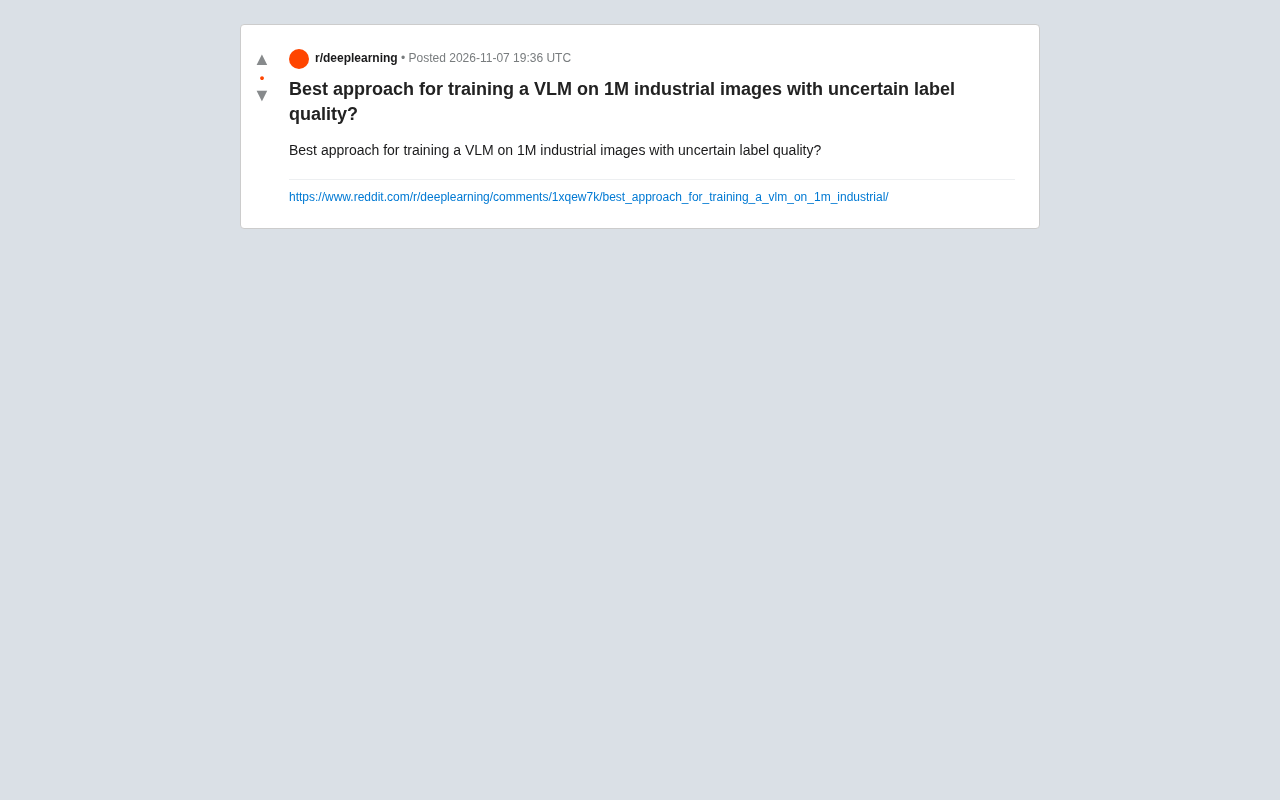
This question touches on the core pain point of deploying industrial AI: the trade-off between data scale and annotation quality. In industrial settings, images are often captured automatically by production-line cameras, and labels may come from manual spot checks, equipment logs, or semi-automated processes—errors and omissions are hard to avoid. Training a large-scale VLM directly on such data makes it easy for the model to overfit to noise, leading to degraded generalization.
The Particularities of Industrial Images and Label Noise
Industrial images typically have characteristics such as high resolution, many repetitive patterns, and simple backgrounds, while label noise can stem from multiple causes: subjectivity in manual annotation, errors from equipment sensors, and subtle differences between product batches. Unlike general domains, the semantic boundaries of industrial labels are sometimes inherently ambiguous—for example, there may be no absolute standard distinguishing a "minor scratch" from "normal texture."
With million-scale data, fully re-annotating is prohibitively expensive, so a robust training strategy is needed that leverages the advantages of data scale while suppressing the impact of noise.
Data-Level Denoising Strategies
1. Confidence Learning and Noise Detection
You can first train a baseline model on a small clean dataset, then predict label confidence for the million-scale data. Low-confidence samples may correspond to incorrect labels and can be down-weighted, discarded, or re-annotated. This approach has been practiced in industrial defect detection and can effectively identify images with incorrect labels.
2. Multi-Source Label Fusion
If labels come from multiple channels (such as manual spot checks, equipment logs, and historical model predictions), you can cross-validate these sources. Consistent labels are given high weight, while conflicting labels are marked as uncertain. This resembles the idea of ensemble learning, but applied at the data cleaning stage.
3. Semi-Supervised and Self-Supervised Pre-training
Even if the labels of million-scale images are unreliable, the images themselves still contain rich visual information. You can first use self-supervised learning (such as contrastive learning or masked image modeling) to pre-train a visual encoder on large-scale unlabeled data, then fine-tune the VLM on a small amount of high-quality labeled data. This fully leverages data scale while reducing dependence on label quality.
Label noise in machine learning is typically divided into two categories: symmetric noise (labels are randomly flipped to any other class with a certain probability) and asymmetric/class-conditional noise (labels tend to flip to specific easily confused classes). Industrial scenarios mostly involve the latter—for example, a "minor scratch" being mislabeled as "normal texture"—which is systematic and directional.
This distinction directly affects method selection: loss functions such as symmetric cross-entropy have theoretical tolerance for symmetric noise but limited effectiveness against asymmetric noise; in such cases, methods based on modeling noise transition matrices or exploiting inter-class similarity structures are more effective. Understanding the noise type helps design targeted denoising and training strategies.
Training Strategies and Loss Design
1. Robust Loss Functions
To address label noise, robust loss functions such as symmetric cross-entropy and generalized cross-entropy can be used to reduce the model's sensitivity to incorrect labels. These loss functions have theoretical noise tolerance and are particularly suited to the systematic annotation biases that may exist in industrial scenarios.
2. Sample Reweighting and Curriculum Learning
Dynamically adjust weights based on sample confidence or loss values, letting the model first learn simple, clean samples before gradually introducing noisier samples. Curriculum learning strategies have been shown to improve model stability in industrial image classification.
3. The Anchoring Role of Small-Scale Clean Data
Even a few thousand high-quality annotated images can serve as a validation set and fine-tuning set, helping monitor the training process and prevent the model from being led astray by noise. In VLM training, clean data can be used to align visual and linguistic representations, ensuring that model outputs conform to professional semantics in the industrial domain.
Evaluation and Iteration
In label-noise environments, traditional accuracy metrics may be distorted. It is necessary to build an independent high-quality test set, or combine human evaluation with automated metrics. At the same time, pay attention to model performance on minority classes and edge cases—these are often where noise has the most obvious impact.
During iteration, you can periodically re-evaluate the training data with the current model to discover and correct potential label errors, forming a closed loop in which data and model co-evolve.
Conclusion
When training VLMs on million-scale industrial images, uncertain label quality is not an insurmountable obstacle. Through a combined strategy of data denoising, robust training, and clean-data anchoring, you can leverage the advantages of data scale while maintaining model reliability. Deploying industrial AI often requires finding a balance between data quality and scale, and the methods above provide a viable path.
For the developer who raised the question, the recommendation is to start by building a small clean validation set, gradually introduce self-supervised pre-training and robust losses, and then iterate and optimize based on evaluation results. This controls risk while maximizing the value of million-scale data.
Background Notes
Contrastive learning is a class of self-supervised methods whose core idea is to teach the model that "similar samples should be close in representation space, and dissimilar samples should be far apart." A typical approach applies different augmentations (cropping, color jitter, etc.) to the same image to obtain positive pairs, while other images in the batch serve as negatives, optimizing the encoder via losses such as InfoNCE. On industrial images, augmentation strategies need to be designed carefully to avoid destroying key semantics such as defects.
Masked image modeling (MIM) randomly masks parts of an image and asks the model to reconstruct the masked content based on visible context; representative methods include MAE and BEiT. It forces the model to learn the structural and textural patterns of images, making it particularly well suited to industrial images with simple backgrounds and many repetitive patterns—and it requires no labels at all.
Curriculum learning draws on the human learning process of going from easy to hard: first train the model on "simple" samples, then gradually introduce "hard" samples. In label-noise scenarios, sample difficulty is usually measured by the model's current loss value or prediction confidence—samples with low loss and high confidence are considered clean and simple and enter training first; samples with high loss may contain noise or be hard examples themselves, so they are introduced later with lower weight.
In practice, care must be taken to distinguish "hard examples" from "noise": sorting purely by loss may misclassify genuinely valuable edge cases as noise. Common improvements include setting a warm-up phase, adopting the soft-weighting mechanism of self-paced learning, or combining multi-model consistency to judge sample reliability.
Symmetric cross-entropy (SCE) is composed of cross-entropy and reverse cross-entropy (RCE). Standard cross-entropy penalizes incorrect labels too heavily and can easily lead the model to memorize noise; RCE penalizes overconfident predictions on incorrect labels more strongly, and the combination makes SCE more stable in the presence of noise.
Generalized cross-entropy (GCE) introduces a parameter q (usually 0<q≤1) to generalize cross-entropy into a form that nonlinearly compresses the loss: when q→1 it degenerates to standard cross-entropy, and smaller q is more robust to noise. These loss functions are not a panacea—they need parameter tuning based on noise ratio and data characteristics, and usually work best in combination with sample reweighting and clean-data validation.
One-line Summary
When label quality of million-scale industrial images is uncertain, VLMs can be trained via denoising, robust training, and clean-data anchoring.
Paragraph Summary
The article addresses the developer's question of "how to train a vision-language model on roughly 1 million industrial images with uncertain label quality," systematically outlining the sources and particularities of label noise in industrial scenarios, including subjectivity in manual annotation, equipment error, and ambiguous semantic boundaries such as between "minor scratches" and "normal texture." It offers strategies at three levels: at the data level, using confidence learning to identify low-quality labels, cross-validating multi-source labels, and leveraging self-supervised pre-training to fully exploit unlabeled images; at the training level, adopting robust losses such as symmetric cross-entropy, sample reweighting, and curriculum learning, with small-scale clean data serving as validation and fine-tuning anchors; at the evaluation level, emphasizing the construction of an independent high-quality test set and forming a closed loop of joint data-model iteration. The final recommendation is for developers to start with a clean validation set, gradually introduce self-supervised pre-training and robust losses, and strike a balance between data scale and annotation quality.
Related articles
 Tech Frontiers
MuJoCo: An Analysis of DeepMind's Open-Source General-Purpose Physics Simulator
An in-depth analysis of Google DeepMind's open-source physics simulator MuJoCo: high-performance C++ kernel, MJCF modeling format, contact solving principles, MJX GPU acceleration, and robot reinforcement learning use cases.
 Tech Frontiers
Claude API Quick Start: The Official Quickstarts Project Collection
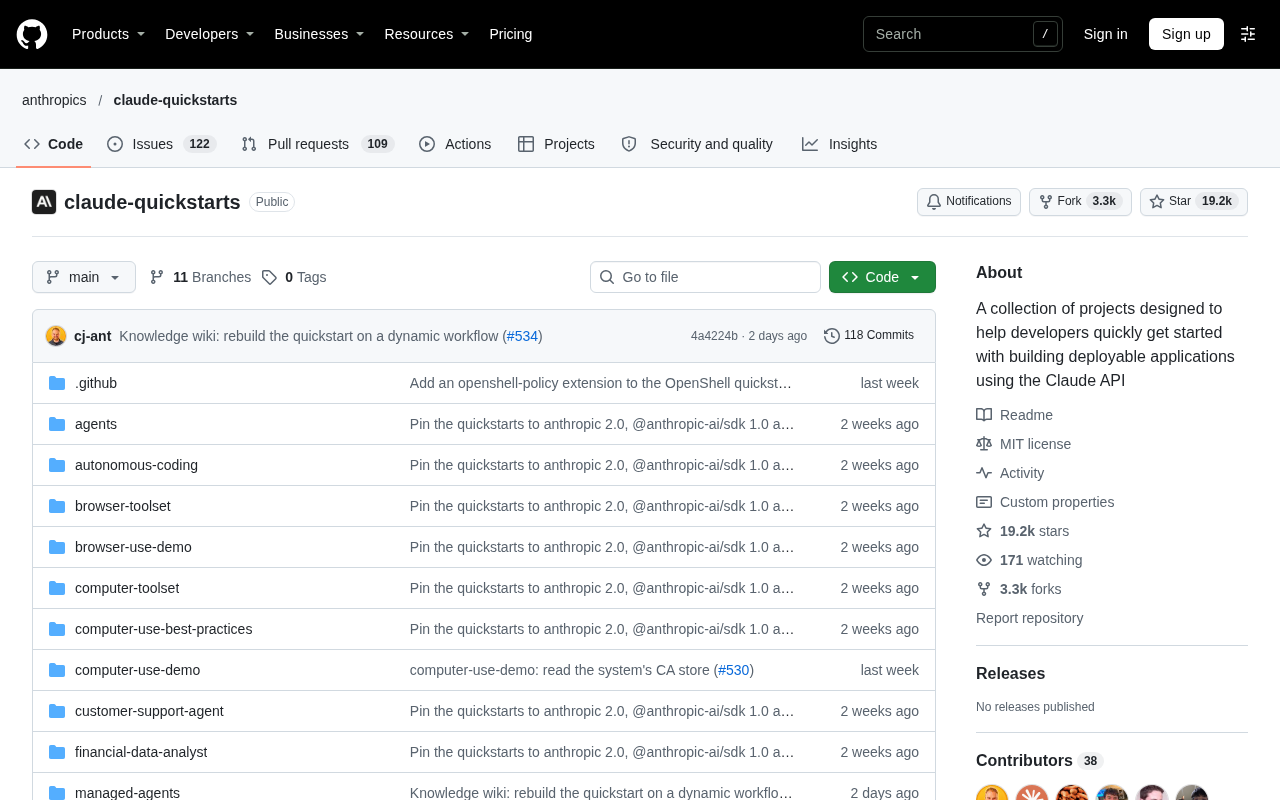
Anthropic's official claude-quickstarts project collection helps developers quickly build deployable apps with the Claude API. Nearly 20k stars, Python-based, great for beginners and prototyping.
 Tech Frontiers
AI Agents Connecting Directly to APIs: Which Calls Can Be Safely Allowed?
AI agents can call any API, but the real challenge is deciding which calls can be safely allowed. This article analyzes allowance decisions from three dimensions—intent matching, least privilege, and controllable impact—and argues that the control layer should sit outside the agent, combined with audit traceability to build a trustworthy API call governance mechanism.