Transfer Learning + Visible Light Communication: A New Approach to Energy-Efficient Indoor Positioning

Transfer learning boosts VLC indoor positioning accuracy by 47% at a BOSCH factory and quantifies energy efficiency with the ME metric.
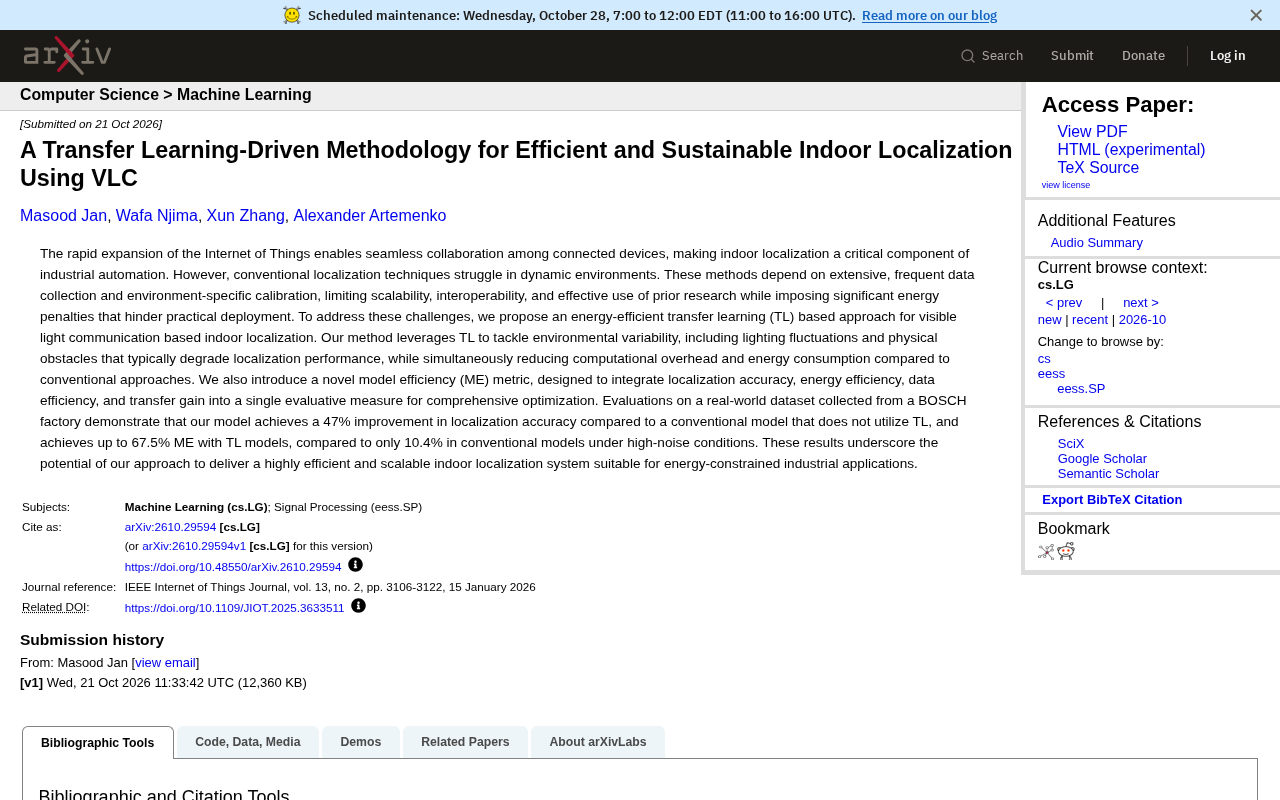
To address the high energy consumption and reliance on frequent data collection and environmental calibration of conventional indoor positioning in dynamic industrial environments, a study proposes a VLC positioning scheme based on transfer learning. It transfers features learned in a source environment to a new environment, requiring only a small amount of target-domain data for adaptation, thereby reducing collection and compute overhead. The study also proposes a composite Model Efficiency (ME) metric integrating positioning accuracy, energy efficiency, data efficiency, and transfer gain. On a real BOSCH factory dataset, the TL model improved positioning accuracy by 47% over the traditional model; under high noise, ME reached up to 67.5% versus only 10.4% for the traditional model. The scheme suits energy-constrained industrial scenarios, but cross-scenario generalization still needs validation.
Indoor positioning is a key enabler of industrial automation, but conventional methods struggle in dynamic environments. A recent study proposed a visible light communication positioning scheme based on transfer learning, achieving a 47% accuracy improvement on a real dataset from a BOSCH factory while significantly reducing energy consumption.
The Bottlenecks of Conventional Indoor Positioning
The large-scale rollout of IoT devices has driven a surge in demand for indoor positioning, but existing technical approaches generally face two persistent problems. The first is environmental dependence: lighting fluctuations and changes in physical obstacles can cause positioning models to lose accuracy, forcing systems to repeatedly re-collect data and perform environment-specific calibration. The second is energy cost: continuous data collection and computation overhead is highly unfriendly to energy-constrained industrial scenarios.
The study points out that these methods "rely on extensive and frequent data collection and environment-specific calibration," which directly limits scalability and interoperability and makes it difficult to reuse prior research results. In other words, every time you move to a different workshop or warehouse, the positioning system has to start almost from scratch.
Visible Light Communication (VLC) is a wireless communication technology that uses high-speed flickering of LED luminaires to transmit data. The flicker frequency is far above the range perceptible to the human eye, so the lighting function is unaffected. In positioning applications, VLC typically infers the spatial position of a receiver by measuring the received signal strength (RSS), angle of arrival, or time of flight of optical signals received from multiple luminaires. Compared with Wi-Fi or Bluetooth positioning, VLC's advantages are: luminaires are already widely deployed indoors, requiring no additional infrastructure; optical signals do not penetrate walls, providing inherent physical isolation and freedom from electromagnetic interference, making it suitable for electromagnetically sensitive environments (such as hospitals and chemical plants). But its shortcomings are equally obvious: optical signals are easily blocked by obstacles, ambient light changes and luminaire aging introduce noise, and the receiver must be exposed within the line of sight of the light source. These characteristics are precisely the sources of environmental variation that transfer learning is meant to address.
How Transfer Learning Breaks the Deadlock
The core idea of the study is to use transfer learning (TL) to absorb environmental differences. Specifically, the feature representations learned by the model in a source environment are transferred to a new environment, and adaptation can be completed with only a small amount of target-domain data, thereby avoiding the data and compute waste of training from scratch.
This approach is also optimized for the signal characteristics of visible light communication (VLC). VLC uses luminaires for communication and positioning, inherently offering the advantages of low deployment cost and no electromagnetic interference, but it is sensitive to illumination changes. Transfer learning can precisely mitigate the performance degradation caused by lighting fluctuations and obstacle blockage, compressing computation overhead and energy consumption while maintaining accuracy.
Transfer learning is a branch of machine learning whose core assumption is that knowledge learned on a source task or source domain can be reused on a target task or target domain. Traditional supervised learning requires training data and test data to be identically distributed; once the deployment environment changes (for example, lighting layout changes or shelf positions are adjusted), model performance drops significantly, requiring large amounts of data to be re-labeled and the model to be retrained. Transfer learning completes adaptation with a very small number of target-domain samples by freezing some pre-trained layers, fine-tuning high-level parameters, or aligning feature distributions. In indoor positioning scenarios, the source domain can be a workshop with abundant data and the target domain a newly built warehouse; the general parts of the signal-to-position mapping learned by the model (such as signal attenuation patterns) are retained, while environment-specific parts are corrected through a small number of calibration samples. This directly reduces data collection costs and training compute requirements, and also explains why this method is attractive for energy-constrained industrial IoT.
A New Metric: Model Efficiency (ME)
The study introduces a composite metric called "Model Efficiency" (ME), which integrates four dimensions—positioning accuracy, energy efficiency, data efficiency, and transfer gain—into a single evaluation value. The value of this design is that it avoids one-sided optimization focused solely on accuracy—a model with very high accuracy but staggering power consumption is often impractical in industrial scenarios. ME makes trade-offs between different schemes quantifiable and comparable.
Composite metrics are not uncommon in engineering evaluation, such as energy efficiency ratio (bit/J) in communications and FLOPs-versus-accuracy trade-off curves in computer vision. ME integrates four dimensions into a single evaluation value, and its methodological significance lies in transforming a multi-objective optimization problem into a sortable scalar. Specifically, positioning accuracy reflects task completion quality, energy efficiency reflects effective output per unit of energy consumption, data efficiency measures the number of labeled samples required to reach a target accuracy, and transfer gain quantifies the benefit of cross-environment reuse. The weighting of the four directly affects rankings, so ME's weight settings need to be aligned with the energy budget and accuracy tolerance of specific industrial scenarios. Compared with the traditional practice of reporting only root mean square error (RMSE) or percentile error, ME forces researchers to pay attention to cost while improving accuracy, avoiding schemes such as "1% accuracy improvement but doubled power consumption" that are unacceptable on a production line.
Measured Data: Validation at the BOSCH Factory
On a real dataset collected at a BOSCH factory, the transfer learning model achieved a 47% improvement in positioning accuracy compared with a traditional model without TL. Under high-noise conditions, the TL model's ME reached as high as 67.5%, while the traditional model reached only 10.4%. This comparison shows that the gain brought by transfer learning is particularly significant in harsh environments—which are precisely the most common operating conditions on industrial sites.
The research team believes that this scheme is suitable for energy-constrained industrial applications and has the potential for high energy efficiency and scalability. However, it should also be noted that the experiments are currently based on a single factory dataset, and generalization capability across scenarios and devices still requires more validation. Whether transfer learning can transfer stably between vastly different lighting conditions and spatial layouts is a key question on the path to deployment.
Significance for Industrial IoT
From a broader perspective, this work responds to a real contradiction in industrial IoT: devices are becoming increasingly intelligent, but energy budgets have not grown in tandem. Introducing transfer learning into VLC positioning essentially replaces "data accumulation" with "knowledge reuse," which is in line with energy-saving approaches such as edge computing and federated learning.
The proposal of the ME metric is also noteworthy. As the industry shifts from pursuing a single performance metric to comprehensive efficiency evaluation, it means that positioning technology is moving from the laboratory to the production line. For teams that need to deploy positioning systems in scenarios such as warehousing, manufacturing, and hazardous environments, this methodology provides an evaluation framework worth learning from.
One-line Summary
Transfer learning improves visible light communication indoor positioning accuracy by 47% at a BOSCH factory and uses the ME metric to quantify energy efficiency.
Paragraph Summary
To address the problem that conventional indoor positioning relies on frequent data collection and environmental calibration in dynamic industrial environments and consumes high energy, a study proposes a visible light communication positioning scheme based on transfer learning. The method transfers features learned in a source environment to a new environment and requires only a small amount of target-domain data for adaptation, thereby reducing collection and compute overhead. The study also proposes a composite Model Efficiency (ME) metric that integrates positioning accuracy, energy efficiency, data efficiency, and transfer gain. On a real dataset from a BOSCH factory, the TL model's positioning accuracy improved by 47% over the traditional model; under high-noise conditions, ME reached as high as 67.5%, compared with only 10.4% for the traditional model. The scheme is suitable for energy-constrained industrial scenarios, but cross-scenario generalization capability still needs validation.
Related articles

Chain of Thought Isn't Just for AI: How Humans Can Use CoT to Improve Thinking Quality
Chain of Thought isn't just a prompt trick for large models. Starting from a Hacker News discussion, this article analyzes why CoT works for human thinking too, breaks down actionable ways to transfer it, and highlights the key differences between human CoT and machine CoT.
Cloudflare Teams Up with OpenAI: Closi…
Cloudflare Teams Up with OpenAI: Closing the Loop from Vulnerability Discovery to Defense with AI
Cloudflare uses OpenAI Daybreak to investigate security vulnerabilities and generate reviewable remediation plans, while developers use Codex to boost coding efficiency and quality.

Orca Multi-Agent Orchestration in Practice: A Guide to Parallel Collaboration with Claude and Codex
Orca is Stable AI's free open-source agent workbench supporting 34 agents like Claude Code and Codex in parallel. Learn its Git worktree isolation, multi-model orchestration, and mobile management.