Transformer.gg: Rebuilding the Influencer Marketing Market with AI Agents
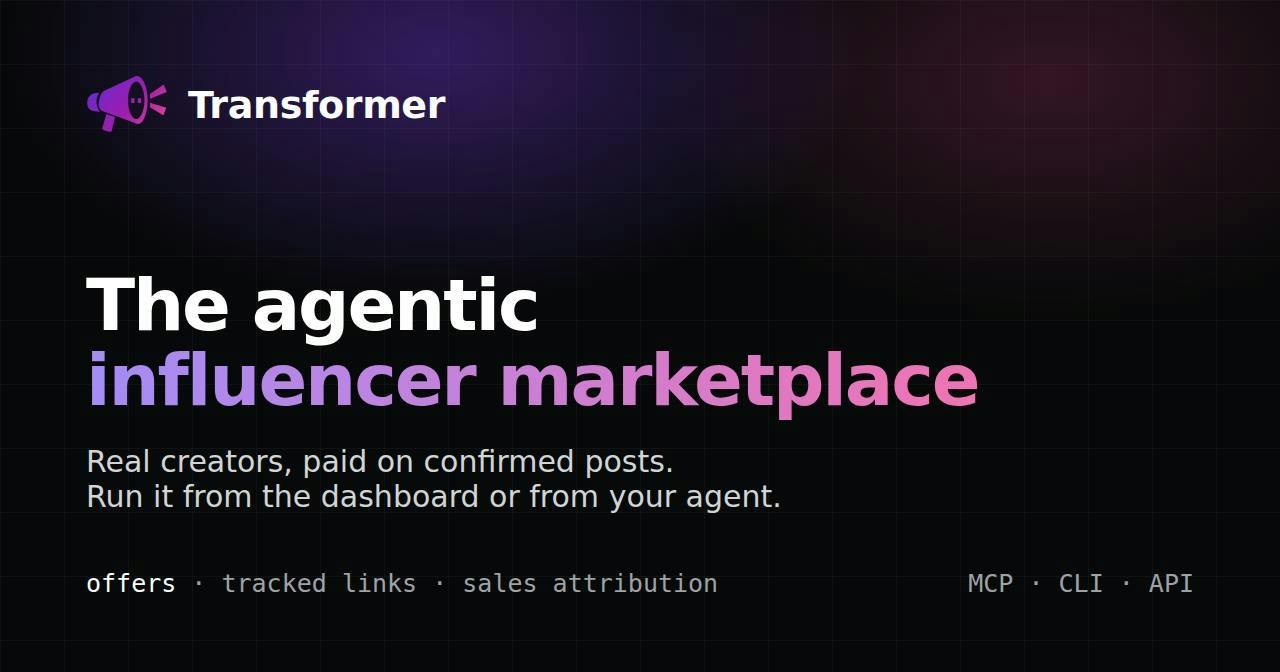
Transformer.gg reshapes influencer marketing transactions with AI Agents and pay-upon-confirmation.
Transformer.gg is an agentic influencer marketplace built by Jon Oringer that uses AI Agents and on-chain confirmation to solve untrackable effectiveness and opaque collaborations in influencer marketing. Brands send paid offers via dashboard or their own Agent; creators post on X, and tracking links attribute clicks and sales, with payment only after confirmed publication. Currently X-only, with Agent capabilities still undefined and early Product Hunt traction.
Influencer marketing has long struggled with tracking effectiveness and opaque collaborations. Transformer.gg aims to change this with AI Agents and an on-chain confirmation mechanism, making transactions between brands and creators more automated and verifiable.
Product Positioning: Agentic Influencer Marketplace
Transformer.gg is described on Product Hunt as an "agentic influencer marketplace," with its core being an AI Agent-driven transaction platform connecting brands and creators. Brands can send paid collaboration offers through a dashboard or their own Agent, and after creators publish content on X, the system attributes every click and sale via tracking links.
Unlike traditional influencer marketing platforms, Transformer.gg emphasizes "Real creators, paid on confirmed posts"—creators only get paid after their posts are confirmed as published. This means the platform attempts to solve fake traffic and fulfillment disputes through technical means, directly tying payment to content publication.
The product is built by Jon Oringer, with category tags including Twitter, artificial intelligence, and influencer marketing, indicating its focus on combining social media scenarios with AI automation.
Jon Oringer is an American serial entrepreneur, best known as the founder and former CEO of the stock photo website Shutterstock. He founded Shutterstock in 2003, grew it into one of the world's largest royalty-free image platforms, and took the company public. After leaving Shutterstock, Oringer has been active in early-stage tech startups as an individual or through investment firms, focusing on AI-driven tools and marketplace platforms. Transformer.gg being his creation means the project carries the resources and industry network backing of a serial entrepreneur, but also suggests the product may still be in an early experimental stage rather than a core business line of a mature company.
How It Works: A Closed Loop from Offer to Attribution
Based on currently public information, Transformer.gg's process can be broken down into three stages:
Brand initiates offer: Brands set collaboration terms in the dashboard or send paid offers directly through an AI Agent. The Agent's involvement means brands can manage multiple creator collaborations at scale, reducing manual communication costs.
Creator publishes content: Creators post on X, and the platform records clicks and sales conversions driven by the content through tracking links. All data is attributed to specific posts.
Payment upon confirmation: Creators only receive payment after posts are confirmed as published. This mechanism is more brand-friendly and also forces creators to ensure content actually goes live.
This "pay upon confirmation" model is uncommon in influencer marketing—most platforms still use prepayment or installment payments. Transformer.gg's approach is more like writing payment conditions into smart contracts or automated workflows.
Tracking links are a fundamental technical tool in performance marketing: the platform generates a short link or redirect link with a unique identifier parameter for each post. When users click, the platform's server records the source before redirecting to the brand's landing page. Subsequent user actions such as registration, add-to-cart, and purchase are associated with the original click through cookies or device identifiers, thereby attributing sales back to specific posts. Attribution accuracy is affected by browser privacy policies, cross-device behavior, and cookie expiration, and typically involves a time window between click and conversion (e.g., 7 or 30 days). For Transformer.gg, tracking links are the data foundation that makes "pay upon confirmation" executable—without reliable conversion feedback, performance-based settlement is impossible.
The Imagined Potential and Limitations of the Agent Role
The "agentic" in the product name is its biggest selling point. Brands can participate in the marketplace through their own Agents, suggesting that fully automated advertising strategies may emerge in the future: Agents screening creators based on budget and goals, sending offers, monitoring data, and adjusting bids.
However, currently disclosed information does not specify the Agent's exact capability boundaries. For example, can the Agent negotiate prices autonomously? Can it recommend creators based on historical data? The absence of these details makes "agentic" more of a directional concept than a mature feature.
Another detail worth noting is that the platform currently only supports X. This reduces attribution difficulty but also limits the diversity of the creator ecosystem. For influencers accustomed to operating across multiple platforms, a single channel has limited appeal.
Agentic refers to a system's ability to autonomously perceive, decide, and execute actions within a certain authorized scope, rather than merely responding passively to single instructions. In marketing scenarios, agentic systems typically include four stages: goal setting, candidate screening, action execution, and performance feedback, theoretically enabling closed-loop optimization. However, the industry has no unified definition of "agentic," and products can use the label while implementing only a small portion of these capabilities. The key to judging whether a product is truly agentic is whether it has autonomous decision-making authority (such as autonomous bidding or autonomously selecting collaboration partners) and whether it has feedback-based iteration capabilities—not merely packaging traditional workflows into a conversational interface.
Market Opportunities and Questions to Be Validated
The influencer marketing market is massive, but the pain points are obvious: brands struggle to assess campaign effectiveness, and creators struggle to get fair pricing. Transformer.gg enters with "pay upon confirmation" and AI Agents—a differentiated approach.
However, the product received 10 votes and 2 comments on Product Hunt, ranking 20th, indicating attention is still at an early stage. Whether the platform can attract enough quality creators and brands to form bilateral network effects is key to its success. Additionally, the attribution accuracy of tracking links, dispute resolution mechanisms for payments, and the intelligence level of the Agent all need to be validated in actual operations.
For practitioners interested in AI applications and marketing automation, Transformer.gg offers a sample for observing "how Agents intervene in commercial transactions," but its actual value still needs time to be tested.
Bilateral network effects refer to the phenomenon where the value of users on one side of a platform increases as the scale of users on the other side grows: the more creators there are, the more willing brands are to invest; the more brands and budgets there are, the more willing creators are to join. Influencer marketing platforms are typical bilateral markets and often face the cold-start problem of "which comes first, the chicken or the egg" in their early stages. To break through this bottleneck, platforms typically need to establish density on one side first (e.g., focusing on a specific vertical category or a single social platform) before expanding to the other side. Transformer.gg currently only supports X, which to some extent trades channel focus for attribution precision and initial density—but this also means its network effect ceiling is deeply tied to X's creator ecosystem.
One-line Summary
Transformer.gg reshapes the influencer marketing transaction process with AI Agents and a pay-upon-confirmation mechanism.
Paragraph Summary
Transformer.gg is an agentic influencer marketplace built by Jon Oringer, designed to solve the problems of untrackable effectiveness and opaque collaborations in influencer marketing through AI Agents and an on-chain confirmation mechanism. Brands can send paid collaboration offers to creators through a dashboard or their own Agents; after creators publish posts on X, the platform attributes clicks and sales via tracking links, and creators are only paid after posts are confirmed as published. The product currently only supports X, the Agent's specific capability boundaries remain unclear, and Product Hunt attention is at an early stage. Its differentiation lies in directly tying payment to content publication, but bilateral network effects, attribution accuracy, and dispute resolution mechanisms still need to be validated through actual operations.
Related articles

The 15-Year Programmer Who's Been Unemployed for Two Years: The Tech Worker's Dilemma in the AI Era
A US senior software engineer with 15 years of experience has been unemployed for two years, exhausted his savings, and sought help on Hacker News. This article analyzes the structural causes of long-term unemployment among tech workers, strategies for addressing resume gaps, and the redefinition of experience value in the AI era.

Soundcore Liberty 5 Pro Drops to All-Time Low: The Go-To True Wireless Earbuds for Commutes and Calls
Soundcore Liberty 5 Pro drops to an all-time low of $129.99 (from $169.99). These Anker true wireless earbuds excel at call quality and are on sale at Amazon, Best Buy, and Walmart in four colors—ideal for commutes and online meetings.

After Anthropic's IPO, How Far Can Safety-First Go?
The Verge podcast explores Anthropic's post-IPO core tension: can a public company stay safety-first? How public market pressure reshapes AI lab safety decisions.