Transformer Models Break New Ground in Uzbek Machine Translation
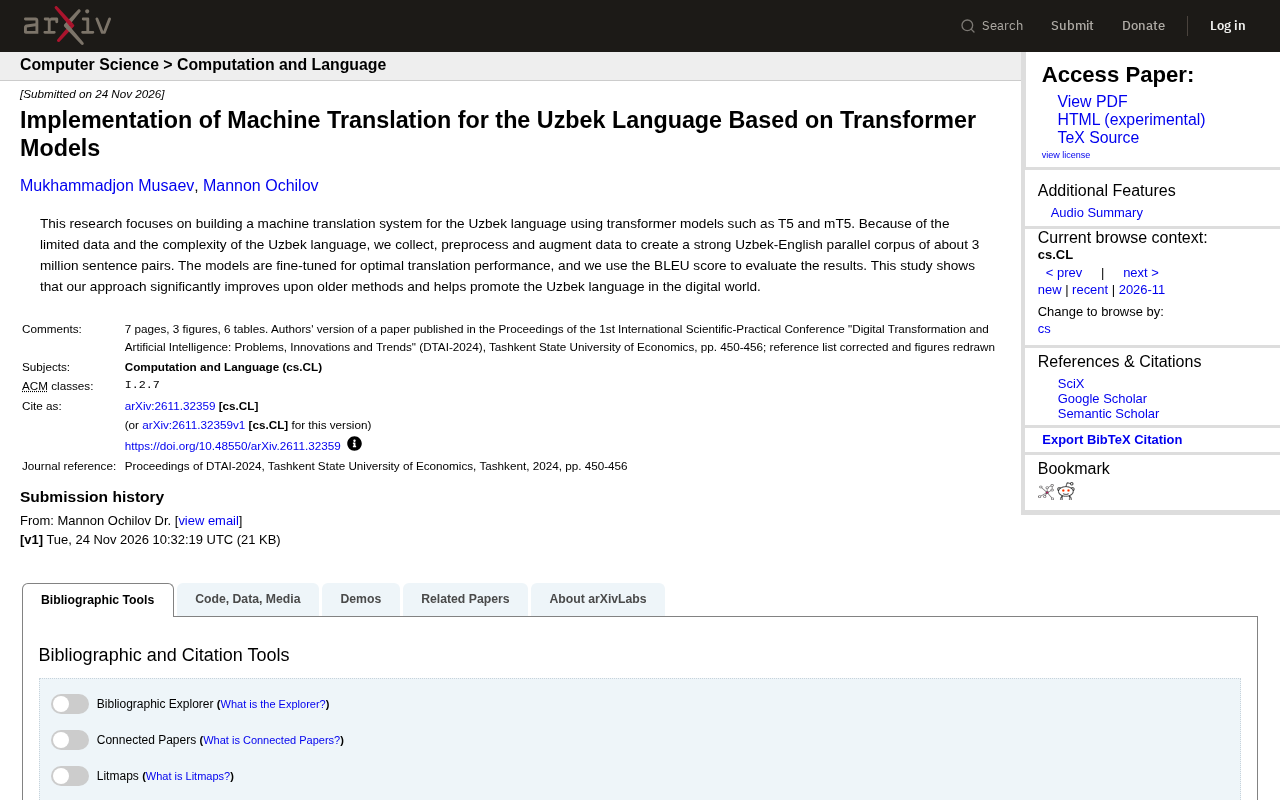
Researchers built a 3M-sentence-pair Uzbek-English corpus and fine-tuned T5/mT5 models to significantly improve translation quality.
This study tackles machine translation for low-resource Uzbek by building an Uzbek-English parallel corpus of ~3 million sentence pairs and augmenting training data via back-translation. T5 and mT5 Transformer models are fine-tuned for Uzbek-English translation. BLEU evaluation shows Transformer-based models significantly outperform traditional statistical methods, especially on long and complex sentences, offering a replicable paradigm for other low-resource languages.
Why Does Uzbek Machine Translation Need Transformers?
Uzbek, a Turkic language, has long suffered from a shortage of machine translation resources in the digital world. Traditional statistical machine translation methods struggle to handle its complex morphological structure and word order, resulting in unsatisfactory translation quality. In recent years, models based on the Transformer architecture, such as T5 and mT5, have demonstrated strong potential across numerous natural language processing tasks, bringing new hope to machine translation for low-resource languages.

According to a recent study, researchers built a Transformer-based machine translation system for Uzbek. Through data collection, preprocessing, and augmentation, they created an Uzbek-English parallel corpus of approximately 3 million sentence pairs and fine-tuned T5 and mT5 models to achieve optimal translation performance. The study used BLEU scores to evaluate results, showing that the new method significantly outperforms previous approaches and strongly promotes the dissemination of Uzbek in the digital world.
Transformer is a neural network architecture based on the self-attention mechanism, proposed by Vaswani et al. in 2017, which fundamentally changed the paradigm of natural language processing. Unlike traditional recurrent neural networks (RNNs) and convolutional neural networks (CNNs), Transformer captures long-range dependencies through parallel computation and global attention, giving it an advantage in handling complex word order and morphological variation. Its core components include multi-head self-attention layers and feed-forward networks, enabling the model to attend to all positions in the input sequence simultaneously and thereby learn language structure more effectively. For morphologically rich languages with flexible word order like Uzbek, Transformer's parallelism and long-range modeling capabilities are particularly critical — which is an important reason the study chose T5 and mT5 as base models.
Data Construction: Challenges and Responses for Low-Resource Languages
The core challenge facing Uzbek machine translation is the scarcity of parallel corpora. Compared with high-resource languages, publicly available bilingual data for Uzbek is very limited, and the language itself has complex agglutinative characteristics that increase modeling difficulty. Through three steps — collection, preprocessing, and augmentation — researchers built a high-quality Uzbek-English parallel corpus of approximately 3 million sentence pairs.
Data augmentation played a key role in this process. Through techniques such as back-translation and random substitution, the research team expanded training samples on the basis of limited data, improving the model's generalization ability. This data-driven strategy is especially important for low-resource languages, enabling models to learn richer language patterns from limited data.
Back-translation is a commonly used data augmentation technique in low-resource machine translation. Its basic workflow is: first use an existing reverse translation model (e.g., English-Uzbek) to translate target-language monolingual data into the source language, generating synthetic parallel sentence pairs, and then add them to the training set. This method can effectively expand training data and improve model robustness and generalization. Random substitution increases data diversity by randomly replacing words or segments in sentences, forcing the model to learn more robust representations. These augmentation techniques are particularly important when parallel corpora are scarce, as they can alleviate overfitting and help the model extract more language patterns from limited data.
Model Fine-Tuning: Adapting T5 and mT5 in Practice
The study selected T5 and mT5 as base models. T5 (Text-to-Text Transfer Transformer) unifies various NLP tasks into a text-to-text format, while mT5 is its multilingual version, pretrained on corpora covering multiple languages and more friendly to low-resource languages.
Researchers fine-tuned these two models to adapt them to the Uzbek-English translation task. During fine-tuning, the models learned translation mapping relationships from the constructed parallel corpus and were optimized for BLEU scores. Experiments showed that the fine-tuned Transformer models significantly surpassed traditional statistical machine translation methods in translation quality, performing especially well when handling long sentences and complex structures.
T5 (Text-to-Text Transfer Transformer) was proposed by Google Research. Its core idea is to unify all natural language processing tasks into a "text-to-text" format — for example, expressing a translation task as "translate English to Uzbek: ..." — thereby using a single model to solve multiple tasks. T5 is pretrained on large-scale English corpora and has strong language understanding capabilities. mT5 is the multilingual version of T5, pretrained on corpora covering 101 languages and more friendly to low-resource languages. Fine-tuning refers to continuing training a pretrained model with task-specific data, adjusting model parameters to adapt to downstream tasks. For Uzbek-English translation, fine-tuning enables the model to learn the mapping relationship between the two languages and optimize for translation quality, thereby significantly improving performance.
Evaluation Results and Significance
The study used BLEU scores as the primary evaluation metric — a widely used automatic evaluation standard for machine translation that measures translation quality by comparing the n-gram overlap between model output and reference translations. Results showed that Transformer-based models achieved significant improvements on the Uzbek-English translation task, validating the effectiveness of this approach in low-resource language scenarios.
The significance of this work lies not only in technical improvements but also in the protection of linguistic diversity. As an important language in Central Asia, Uzbek has lagged in digital development. By building high-quality parallel corpora and fine-tuning advanced Transformer models, this research provides a practical tool for the dissemination of Uzbek in the digital world and offers a replicable paradigm for machine translation of other low-resource languages.
BLEU (Bilingual Evaluation Understudy) is one of the most commonly used automatic evaluation metrics in machine translation, proposed by Papineni et al. in 2002. It measures translation quality by calculating the precision match rate of n-grams (consecutive n words) between model output and reference translations, typically taking the geometric mean of 1-gram to 4-gram scores and introducing a brevity penalty to penalize overly short translations. BLEU scores range from 0 to 1 (or 0 to 100), with higher scores indicating closer similarity to reference translations. However, BLEU mainly focuses on lexical overlap and has limited ability to reflect semantic accuracy and fluency, so in practice it often needs to be combined with human evaluation. This study used BLEU as the primary metric, which allows objective comparison of different models' performance but also has certain limitations.
Future Directions and Implications
Although this study achieved positive results, Uzbek machine translation still faces many challenges. There is room for improvement in both the scale and quality of the corpus, the model's ability to handle domain-specific terminology needs strengthening, and although BLEU scores can reflect overall quality, they cannot fully measure translation fluency and semantic accuracy.
In the future, researchers can explore more efficient data augmentation techniques, introduce domain adaptation methods, and combine human evaluation to assess translation quality more comprehensively. In addition, deploying such systems in practical applications — such as cross-lingual information retrieval and social media translation — will help further validate and optimize the models. For low-resource language communities, this type of research offers a feasible path for technology-empowered language preservation.
One-line Summary
Researchers built a 3-million-sentence-pair Uzbek-English corpus and fine-tuned T5/mT5 models to significantly improve translation quality.
Paragraph Summary
This study addresses machine translation for the low-resource language Uzbek by constructing an Uzbek-English parallel corpus of approximately 3 million sentence pairs and expanding training data through data augmentation techniques such as back-translation. The study fine-tunes T5 and mT5 Transformer models to adapt them to the Uzbek-English translation task. Using BLEU scores for evaluation, results show that Transformer-based models significantly outperform traditional statistical machine translation methods, especially in handling long sentences and complex structures. This work not only improves Uzbek machine translation performance but also provides a replicable paradigm of data construction and model fine-tuning for machine translation of other low-resource languages, with positive implications for linguistic diversity preservation.
Related articles

Bin's Live Stream Highlights: Hilarious Interactions from "You Came at the Right Time" to "I'll Support You From Now On"
Bin's hilarious live stream highlights: from "You came at the right time" to "I'll support you from now on," featuring Championship skins, wigs, and other game memes that showcase Bilibili's unique streaming culture.

Hunter Rescues Educated Youth: The Mountain-Chasing System Launches a New Warm-Hearted Viral Drama Formula
Bilibili's early-access period short drama *Everyone Thinks I'm a Poor Hunter* opens with a snowy-night rescue of an educated youth. Hunter Chen Shan activates the mountain-chasing system, using realistic hypothermia first-aid details and mutual-probing character dynamics to deliver a warm-hearted period drama without the sleaze.

Riemann Hypothesis Proven by AI? The Truth Has Nothing to Do With Your Reality
34-year-old mathematician Levent Alpöge claims to have proven the Riemann Hypothesis and Generalized Riemann Hypothesis with Claude, releasing 17 million lines of formal verification code. This article sorts out the facts, debunks myths about RSA collapse and new material revolutions, and analyzes the true significance of mathematics-AI collaboration.