Transitioning from Bioinformatics to AI Engineering: A Complete Self-Study Roadmap with Timeline
A complete roadmap for bioinformatics professionals transitioning to AI engineering careers.
This article provides a comprehensive self-study roadmap for bioinformatics professionals looking to transition into AI engineering. It outlines three key advantages of a bioinformatics background, a phased learning plan from math foundations through deep learning and MLOps, realistic timelines (6–18 months), and practical advice on building portfolios and focusing on production engineering.
The Starting Point: Why Bioinformatics Professionals Are Flocking to AI Engineering
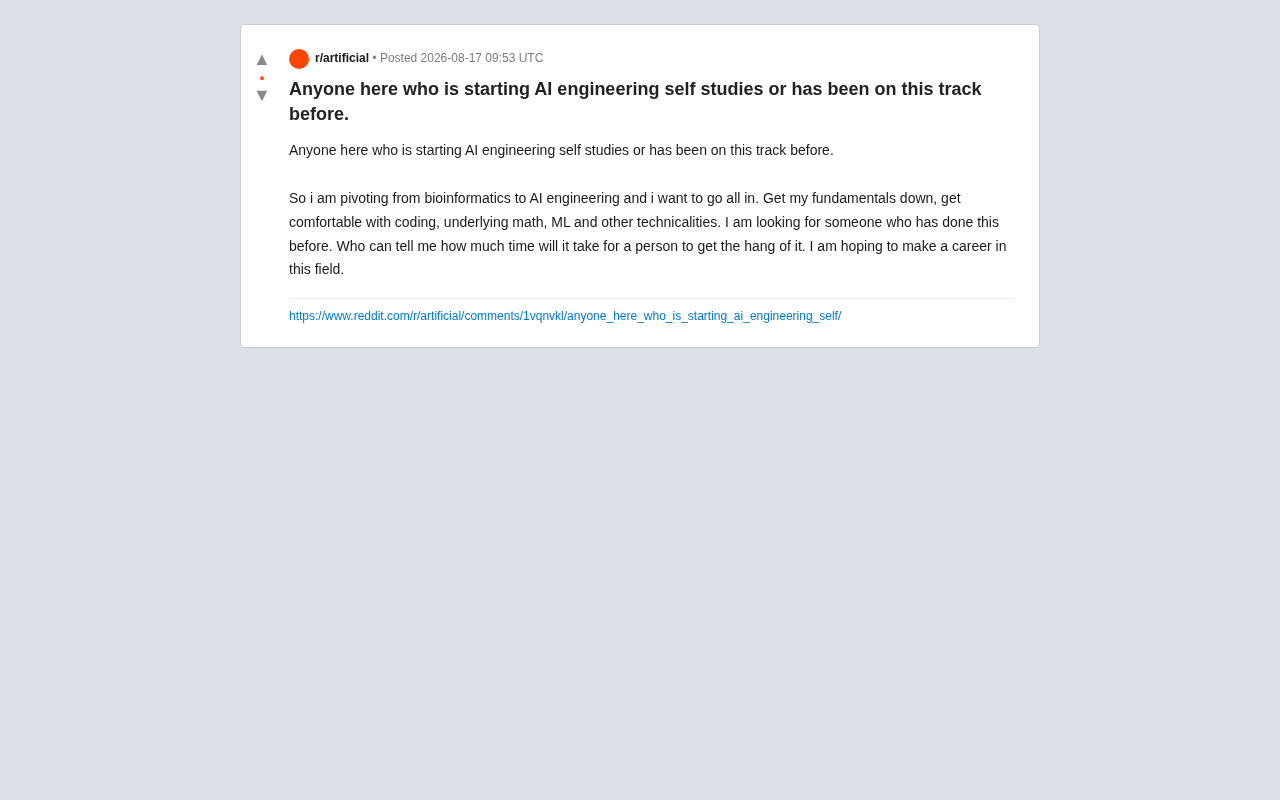
In Reddit's tech communities, a developer with a bioinformatics background posted asking for help, explaining that they were preparing to go all in on AI Engineering. They wanted to build a solid foundation, become proficient in programming, master the underlying math and machine learning technical details, and ultimately pursue this as a long-term career. Their core question is one shared by countless others making the same transition: "How long does it actually take to get up to speed?"
This seemingly simple question reflects an important trend in today's tech talent market — a massive migration of STEM professionals into the AI field. Bioinformatics is inherently interdisciplinary, and its practitioners typically already possess programming skills, a statistics foundation, and data processing experience, all of which provide a natural advantage for transitioning into AI engineering.
Bioinformatics combines biology, computer science, and statistics, focusing on how to use computational methods to analyze and interpret biological data. The field has boomed over the past two decades as the cost of genome sequencing has plummeted — from the Human Genome Project's $2.7 billion to under $1,000 today. Day-to-day work includes genome assembly, sequence alignment, variant calling, and transcriptome analysis, all of which are fundamentally large-scale computational data problems. In recent years, as AI has achieved breakthroughs in protein structure prediction (such as DeepMind's AlphaFold), drug discovery, and genomics, more and more bioinformatics professionals have realized that deep learning isn't just a research tool — it represents a much broader career horizon.
Three Key Advantages Bioinformatics Brings to an AI Transition
Many people underestimate their existing skill set when planning a career transition. For those with a bioinformatics background, there's actually substantial overlap with AI engineering:
Extensive Experience with Massive Datasets
Bioinformatics professionals deal with massive datasets on a daily basis — genomic sequences, protein structures, clinical data, and more. A single whole-genome sequencing run generates approximately 200GB of raw data, and large cohort studies can reach petabyte scale. This intuition for data cleaning, feature extraction, and large-scale data analysis is one of the core competencies of machine learning engineering. Experience accumulated from handling biological data — dealing with missing values, batch effect correction, dimensionality reduction (such as PCA and t-SNE) — translates directly to the data preprocessing stage of machine learning engineering.
Solid Statistics and Math Foundation
Biostatistics involves extensive probability theory, hypothesis testing, regression analysis, and more — all of which are essential components of the mathematical foundations of machine learning. Concepts like Bayesian inference, maximum likelihood estimation, and multiple hypothesis testing correction (such as Bonferroni and FDR) are core methodologies in both biostatistics and machine learning. Compared to someone starting from scratch, this background can save months of math catch-up time.
Python Programming Proficiency
Python is widely used in bioinformatics (Biopython, Scanpy, Python interfaces for DESeq2, etc.), and it's also the primary language for AI engineering. This means career changers don't need to start from "Hello World" — they can jump straight into learning ML libraries like PyTorch, TensorFlow, and scikit-learn. More importantly, experience with script automation and pipeline construction (such as Snakemake and Nextflow) from bioinformatics work is highly consistent with the mindset of building training pipelines in AI engineering.
AI Engineer Self-Study Roadmap: Three Stages from Fundamentals to Practice
For those planning to go all in, the recommended approach is to progress through the following stages systematically, rather than blindly chasing the latest large model hype.
First, it's important to clarify that AI Engineering and AI Research are two distinct paths. AI Research focuses on pushing algorithmic frontiers, publishing papers, and proposing new model architectures or theoretical frameworks — typically requiring a PhD and deep mathematical expertise. AI Engineering, on the other hand, focuses on transforming existing AI technologies into reliable production systems — including building model training pipelines, optimizing inference services, designing for scalability, and establishing monitoring and alerting mechanisms. A helpful analogy: AI researchers are like scientists designing new types of engines, while AI engineers are the ones who install the engine in a car and ensure it runs reliably under all road conditions. Understanding this distinction helps career changers plan their learning path more precisely.
Phase 1: Strengthen Math and Programming Foundations (1–3 Months)
- Math: Linear algebra, calculus, probability and statistics. Focus on understanding matrix operations, gradients, and the role of derivatives in optimization. Eigendecomposition and Singular Value Decomposition (SVD) in linear algebra are foundational for understanding dimensionality reduction and recommendation systems; the chain rule in calculus is key to understanding the backpropagation algorithm.
- Programming: Become proficient in Python, including data science libraries like NumPy and Pandas.
- Toolchain: Get comfortable with foundational engineering tools such as Git, Jupyter Notebook, and virtual environment management.
Phase 2: Core Machine Learning Algorithms (3–6 Months)
- Study classic machine learning algorithms: linear regression, logistic regression, decision trees, SVM, clustering, etc.
- Understand key concepts like model evaluation, overfitting and regularization, and cross-validation.
- Start with Andrew Ng's machine learning course, supplemented by hands-on practice projects.
- Participate in Kaggle competitions alongside your studies to reinforce what you've learned. Kaggle is the world's largest data science competition platform, with over 15 million registered users, covering areas such as image classification, natural language processing, and recommendation systems. Earning Kaggle medals serves as both proof of competence and a strong resume booster. The solutions shared by top competitors on the platform contain complete best practices spanning feature engineering to model ensembling.
Phase 3: Deep Learning and AI Engineering Practice (6–12 Months)
- Dive deep into neural networks, CNNs, RNNs, and the Transformer architecture. The Transformer is a revolutionary architecture proposed by a Google team in the 2017 paper Attention Is All You Need. Its core innovation — the Self-Attention mechanism — allows the model to attend to information from all positions in a sequence simultaneously. This architecture gave rise to the GPT series, BERT, LLaMA, and other large language models, making it the most critical technical infrastructure in the current AI landscape. Notably, the Transformer is also widely used in bioinformatics — for example, Meta's ESM protein language model is built on this architecture — giving bioinformatics professionals a natural advantage in understanding it.
- Master at least one deep learning framework (PyTorch is recommended).
- AI engineering is not the same as AI research. The engineering side emphasizes deployment, optimization, and system integration, requiring skills in model serving, API development, cloud platforms (AWS/GCP), and MLOps.
MLOps (Machine Learning Operations) applies DevOps principles to machine learning systems, aiming to solve the "last mile" problem of getting models from the lab into production. Statistics show that approximately 87% of machine learning models never actually make it into production — this is the core pain point MLOps addresses. A complete MLOps tech stack includes: data version management (DVC), experiment tracking (MLflow, Weights & Biases), model registry and version control, automated training pipelines (Kubeflow, Airflow), model serving (TensorFlow Serving, TorchServe, Triton Inference Server), containerized deployment (Docker, Kubernetes), A/B testing frameworks, and model performance monitoring with data drift detection. Mastering this toolchain is the critical leap from "being able to train a model" to "being able to maintain a model in production."
How Long Does It Actually Take to Transition to AI Engineering?
Returning to the question career changers care about most: how long until you're truly competent?
Based on the experience of numerous similar cases in the community, here's a realistic timeline:
- Career changers with programming and math backgrounds (such as bioinformatics), studying full-time, typically need 6 to 12 months to build a solid foundation and complete several projects.
- Reaching an employable level often requires 12 to 18 months of sustained effort, including building a portfolio, contributing to open-source projects, or competing on Kaggle.
- True "mastery" is a multi-year, ongoing process — because the AI field itself is evolving at breakneck speed. Take 2023–2024 as an example: from ChatGPT igniting the large model wave to the rapid iteration of RAG (Retrieval-Augmented Generation), Agent frameworks, and multimodal models, the entire tech stack has seen major updates nearly every quarter.
It's worth emphasizing that AI engineering and AI research are two different paths. Engineering roles prioritize hands-on ability and production deployment over the theoretical depth required for publishing papers. This is actually good news for career changers — you don't need to read every cutting-edge paper. What matters is being able to actually use models, deploy them to production, and solve real business problems.
Four Practical Tips for Career Changers
Learn by doing — reject pure theory. The most effective way to learn is to build around real projects. Try re-solving problems you previously encountered in bioinformatics using machine learning approaches. This reinforces new skills while leveraging your domain expertise. For example, use deep learning models to tackle gene expression data classification, or build a Transformer-based protein function prediction tool. These projects demonstrate both AI capability and a unique interdisciplinary perspective.
Build a high-quality portfolio. Hiring managers value actual projects on GitHub far more than a stack of certificates. Three to five high-quality projects with real deployments are worth more than a dozen copy-pasted beginner tutorials. An ideal project should include comprehensive README documentation, clean code structure, a model performance evaluation report, and ideally an interactive demo (deployed via Streamlit or Gradio).
Focus on production engineering, not showing off. Many beginners get drawn to the latest large models and flashy demos, but what companies actually need are engineers who can get AI systems running stably and efficiently. This means paying attention to model inference latency, memory usage, concurrency handling, failover mechanisms, and other "unglamorous" but critically important engineering concerns.
Stay patient and establish a sustainable learning rhythm. A career transition is a marathon, not a sprint. The determination to go all in is commendable, but it's even more important to build sustainable study habits and avoid burning out from chasing shortcuts. Consider adopting a Pomodoro-style study rhythm, dedicating 4–6 hours daily to deep study while leaving time for coding practice and knowledge consolidation.
Conclusion
Transitioning from bioinformatics to AI engineering isn't starting from zero — it's a migration and upgrade of existing capabilities. Your existing data analysis, math, and programming skills will significantly shorten the learning curve. With proper planning and full-time commitment, you can master the core skills in 6 to 12 months and become competitively employable within 1 to 2 years. The real key isn't "how long it takes to learn" but whether you can sustain the effort, stay project-oriented, and apply AI technology to solve real-world problems. For anyone on the fence about making the switch, now is the best time to start.
Related articles

RAG Getting Started in Practice: From Principles to Building an Enterprise Knowledge Base
Bilibili RAG course highlights: from retrieval-augmented generation principles, document chunking and vectorization, to five accuracy factors and enterprise knowledge base boundaries, with fine-tuning vs RAG selection advice.

AI Model Selection Guide: DeepSeek vs. Qwen3 in Practice
How should AI developers choose models? Based on a Bilibili tutorial, this article breaks down the Function Calling differences between DeepSeek V3 and R1, Qwen3's programmatic thinking mode switching and agent capabilities, and outlines a multi-model learning path and practical selection logic.

Anchoring, Loss Aversion, and Nudges: 5 Psychological Tactics Retailers Use to Make You Spend
Behavioral economics reveals how retailers use anchoring, framing, loss aversion, and nudge theory to manipulate your spending decisions. This article breaks down 5 common psychological tactics and offers counterstrategies like slowing down decisions and setting your own anchors to see through the pricing design behind discounts.