Transitioning from Medicine to AI: Unique Advantages and Job Strategies for Health Tech ML Positions

Medical backgrounds offer unique competitive advantages for ML roles in health tech when paired with solid technical skills.
This article explores how medical professionals transitioning to AI can leverage their clinical domain knowledge as a competitive advantage in health tech ML positions. It covers suitable role types like Clinical Data Scientist and AI Validation Engineer, discusses market demand and remote work realities, and provides practical advice on building technical skills and positioning medical expertise as a core selling point rather than a career-switch liability.
A Medical Intern's Career Transition Dilemma
Recently, a highly representative question appeared on Reddit: a medical intern who developed a strong interest in machine learning had already self-studied calculus, statistics, linear algebra, SQL, and Python, with plans to dive deeper into NumPy, PyTorch, and deep learning. Their core question was — how much of a competitive advantage does a medical background actually provide when applying for machine learning positions in health tech?
This question touches on an increasingly relevant career intersection. As AI penetrates deeply into medical diagnostics, drug development, clinical decision support, and other scenarios, professionals with dual "medicine + ML" capabilities are becoming highly sought after. But the reality is far more complex than one might imagine.
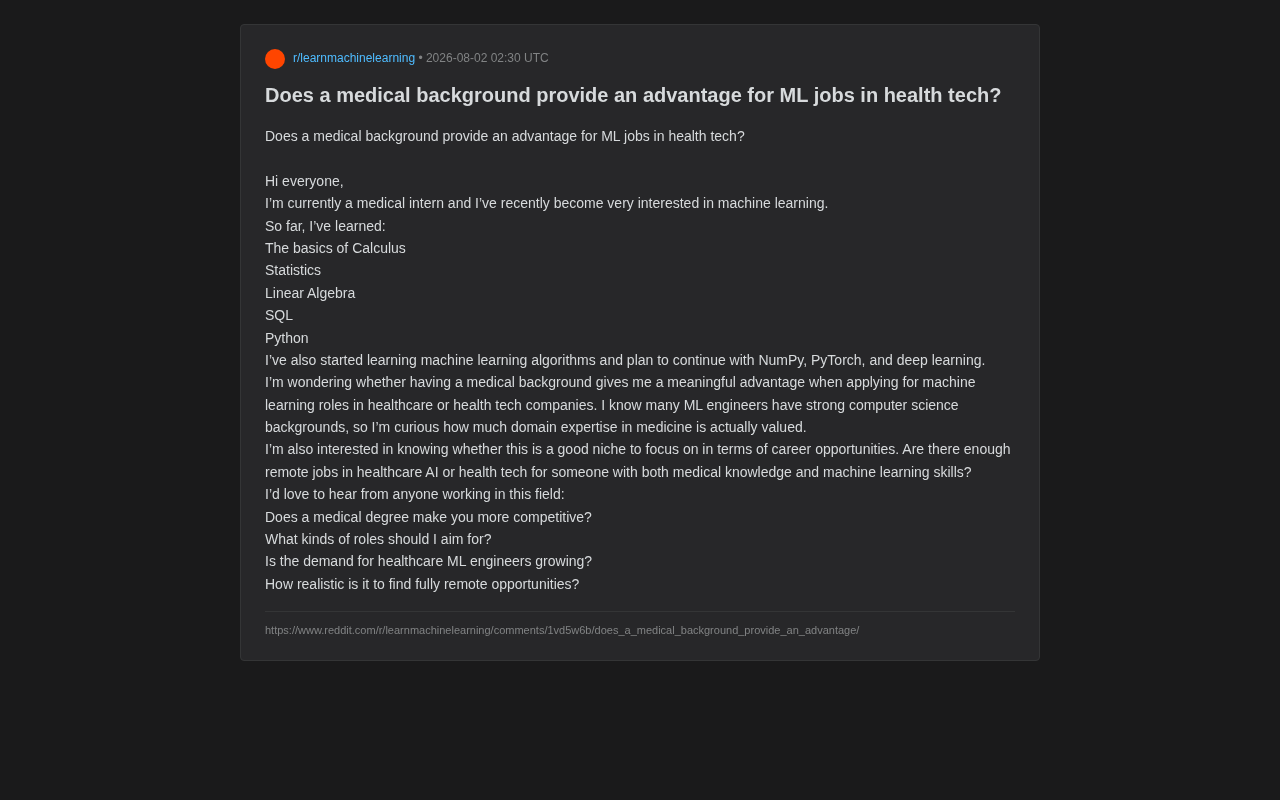
Is a Medical Background a Plus for Health Tech ML Positions?
The Scarcity Value of Domain Knowledge
The answer is yes — in health tech, a medical background is indeed a significant differentiator. The vast majority of ML engineers have solid computer science foundations but lack genuine understanding of clinical scenarios. And the biggest challenge in medical AI often isn't the algorithm itself, but correctly defining the problem.
For example, when building a disease prediction model: which features are clinically meaningful? What systematic biases exist in the data? What are the real-world costs of false positives and false negatives in actual clinical practice? These questions require someone who truly understands medicine to answer. An engineer who doesn't understand the meaning of ICU monitoring metrics will struggle to judge whether model outputs are reasonable.
Serving as a Communication Bridge Between Clinical and Technical Teams
Medical AI projects typically require constant coordination between clinicians, data scientists, and product teams. ML practitioners with medical backgrounds are natural "translators" within these teams — they can understand doctors' clinical needs while also speaking the technical language of engineers. The value of this role has been repeatedly validated in real project implementations, and it's something that purely technical backgrounds cannot easily replicate.
What Positions Should Medical-to-AI Transitioners Target?
More Suitable Role Positioning
For those transitioning from medicine, directly competing with top CS PhDs for pure algorithm research positions isn't wise. More realistic directions that better leverage their advantages include:
- Clinical Data Scientist: Responsible for transforming clinical data into modelable problems and evaluating models' clinical effectiveness.
- Medical AI Product Manager / Clinical Specialist: Serving as a domain advisor at AI product companies, guiding product design and validation.
- Clinical AI Validation Engineer: Focusing on clinical validation of models and regulatory compliance (such as FDA/CE certification).
- Bioinformatics / Medical Imaging: These fields have extremely high requirements for both medical and technical expertise.
The Core Logic of Positioning
The key is to play to your strengths while mitigating weaknesses. The moat for those with medical backgrounds is domain knowledge, not low-level algorithm engineering capability. Therefore, positioning yourself as a "medical expert who understands technology" or a "tech person who understands medicine" is more competitive than trying to become a "better ML engineer."
Medical AI Market Demand and Remote Work Opportunities
Clear Growth Trends
Medical AI is one of the fastest-growing vertical domains in AI applications today. From medical image recognition and electronic health record (EHR) analysis to drug discovery and personalized treatment, both capital and technology continue to pour in. For talent with both clinical knowledge and ML skills, demand is genuinely growing while supply remains relatively scarce.
Realistic Considerations for Remote Work
Regarding fully remote opportunities, a pragmatic view is needed. Data science and ML-related positions are inherently suited to remote work, so pure modeling and data analysis roles do offer many remote opportunities. However, positions involving clinical validation, access to real patient data, or medical equipment are often constrained by data compliance and physical environment requirements.
Additionally, healthcare data privacy regulations (such as HIPAA in the US and GDPR in Europe) are extremely strict, and many companies have rigid restrictions on remote access to sensitive data. Therefore, the recommendation is: remote opportunities exist, but shouldn't be your only filter, especially early in your career. Joining a quality team to accumulate experience is more important than pursuing fully remote work.
Practical Advice for Medical Professionals Transitioning to AI
Learning Path to Fill Technical Gaps
The intern's current learning path is correct — building up layer by layer from mathematical foundations to programming to ML algorithms. But to establish yourself in health tech, you also need to focus on:
- Medical data processing experience: Familiarity with EHR, DICOM medical imaging, clinical trial data, and other real-world data formats.
- Model interpretability: Medical scenarios demand far higher model interpretability than other domains — black-box models often struggle to gain clinical trust.
- Practical project portfolio: Using public medical datasets (such as MIMIC-III intensive care database and various medical imaging challenges) to create clinically meaningful projects is more convincing than chasing Kaggle rankings.
Turning Your Medical Background into a Core Selling Point
When job hunting, don't treat your medical background as a "career switch cost" that needs explaining — instead, make it your core selling point. A candidate who can clearly articulate "why this model is clinically useful" is far more attractive than one who can only tune hyperparameters.
Conclusion
A medical background is indeed a real and underestimated advantage for ML positions in health tech, but it needs to be combined with solid technical skills to become true competitiveness. The core of this path isn't competing head-on with traditional ML engineers, but occupying a scarce intersection — being the person who understands both disease and algorithms. For medical professionals willing to invest deeply, this may well be one of the most unique career opportunities of the AI era.
Related articles

Stateless Databases: A Detailed Guide to Lightweight Memory Solutions for AI Agents
An in-depth analysis of stateless agent memory database design principles, exploring how lightweight solutions solve AI Agent memory management challenges.
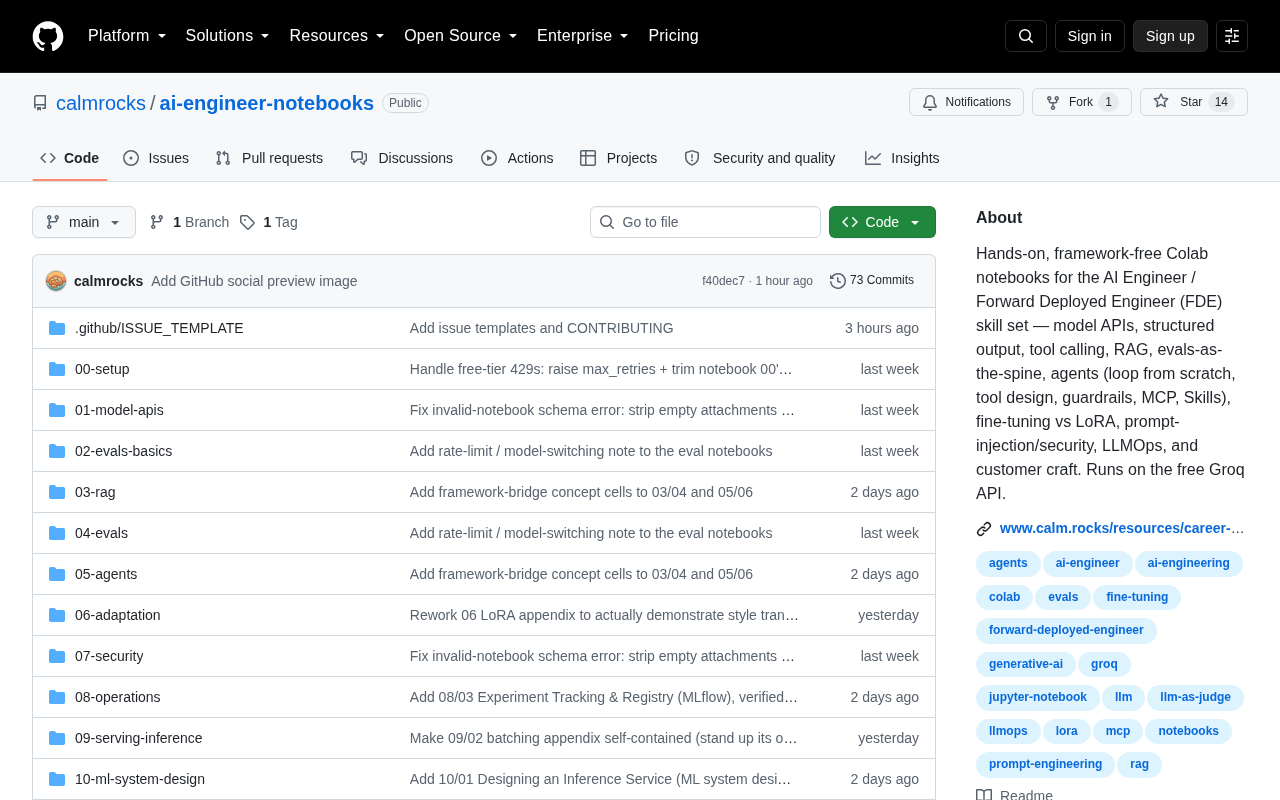
Implementing RAG and Agents Without Frameworks: An Essential Skill for AI Engineers
Explore AI Engineer Notebooks: a free, framework-free open-source project for learning RAG, Agents, and Evals from scratch with plain code on Google Colab.

Gemini Omni 1.1 Flash Deep Dive: How Omni-Modal + Ultra-Fast Inference Is Changing Real-World AI Deployment
Deep dive into Google's Gemini Omni 1.1 Flash: its omni-modal capabilities, ultra-fast inference, developer use cases, comparisons with GPT and Claude, and what it means for scalable AI deployment.