Transitioning from Public Health Academia to Data Science: A Practical Guide to Bridging the Industry Gap

A practical guide for public health academics transitioning to industry data science roles.
This article provides a comprehensive roadmap for public health researchers looking to transition into industry data science. It analyzes the misalignment between academic skills and industry needs, outlines key areas to strengthen (engineering capabilities, systematic interview preparation, and network building), and highlights how causal inference expertise can serve as a powerful differentiating advantage in today's job market.
A Typical Transition Dilemma
In the data science field, there exists a subtle yet real gap between academia and industry. A researcher with years of experience in public health recently shared their frustration on Reddit: they have approximately 4 years of academic research experience, have published papers in prestigious journals like JAMA Open, with research spanning biostatistics and machine learning for cancer and opioid use disorders, and have recently produced new work in mental health using causal inference techniques (such as doubly robust methods).
JAMA Network Open is an open-access journal under the Journal of the American Medical Association (JAMA), one of the top publications in the medical field. Publishing in this journal series means the research has undergone rigorous peer review with a high degree of methodological rigor. However, it's worth noting that the evaluation dimensions of the academic publishing system—statistical significance, methodological innovation, sample size adequacy—are fundamentally different from industry's value metrics (real-time prediction capability, scalability, direct contribution to revenue). This misalignment in evaluation systems is the deeper reason why many excellent academic researchers encounter difficulties during their transition.
Yet despite this impressive background, they've repeatedly hit walls when trying to transition to industry data science roles (particularly in healthcare or marketing). They candidly admitted that they've been cramming SQL and probability interview questions but still aren't sure what else they should be doing.
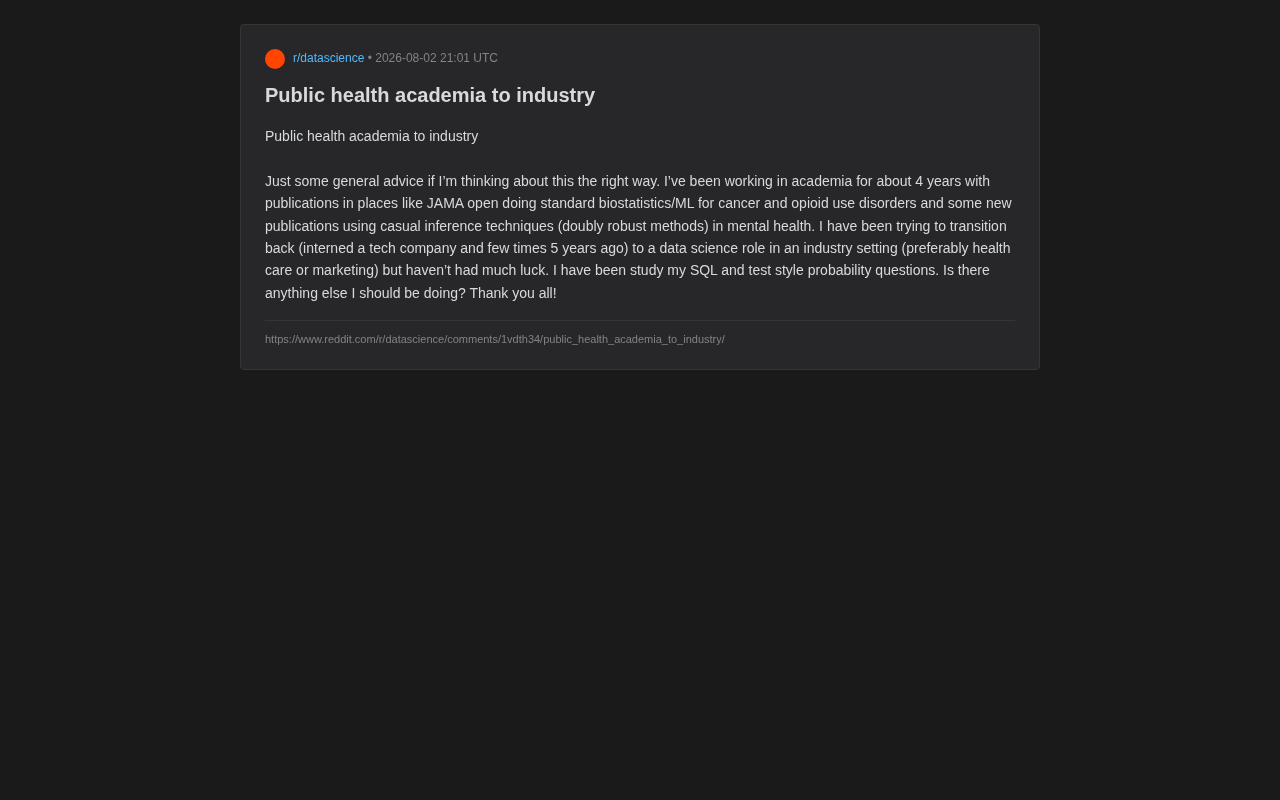
This case is highly representative. It reveals a common problem faced by many academic researchers migrating to industry: why is it so hard to gain traction in the job market when you clearly have solid statistical and modeling skills?
Analyzing the Misalignment Between Academic Skills and Industry Needs
Hidden Differences in Skill Stacks
Data work in academia typically focuses on methodological rigor—causal inference, doubly robust estimation, publication-grade statistical tests. These capabilities are highly valued in top journals, but industry data science roles evaluate candidates on entirely different dimensions.
It's worth diving deeper into the technical meaning of causal inference here. Causal Inference is a core branch of statistics and econometrics aimed at identifying causal relationships between variables from observational data, rather than mere correlations. In scenarios where randomized controlled experiments are infeasible (such as observational medical research), researchers must rely on statistical methods to control for confounding factors. Doubly robust methods combine two modeling strategies: modeling the treatment assignment mechanism (propensity score model) and modeling the outcome variable (outcome regression model). The "doubly robust" name comes from an important property—as long as one of these two models is correctly specified, the final causal effect estimate is consistent. This fault-tolerance property is extremely attractive in complex real-world data environments, but what hiring managers often care more about is: what specific business problem can this technique solve?
What companies care about is: Can you quickly extract value from messy production data? Can you deploy models into actual business processes? Can you drive business decisions with data? In other words, academia values "methodological correctness" while industry values "business implementation."
This researcher has already recognized the need to learn SQL, which is the correct first step. But merely staying at the "practice problems" level is far from enough. Industry expects candidates to demonstrate end-to-end project capabilities: from data pipeline construction and feature engineering to model deployment and performance monitoring.
Resume Narrative Mismatch
Academic CVs typically center on "published papers" as core achievements, while industry recruiters want to see "business impact." For the same model that reduces opioid abuse risk, the academic framing is "published related research in JAMA Open," while the industry framing should be "the predictive model built helped identify high-risk populations, providing data support for intervention programs."
Repackaging existing work and restating academic projects in business language is a critical step that many career changers overlook.
Three Core Dimensions Transitioners Should Strengthen
Engineering Capabilities and Toolchain Development
Beyond SQL, modern data science roles increasingly value engineering skills. Mastering Python's data science ecosystem (pandas, scikit-learn) is just the baseline. What's more important is understanding:
- Cloud platform fundamentals (AWS/GCP/Azure)
- Version control and collaboration (Git)
- Data pipelines and workflow tools
- Model deployment basics (e.g., API-ification, containerization concepts)
A causal inference background is actually an underestimated advantage. With the rise of A/B testing and incrementality measurement in tech and marketing industries, demand for techniques like doubly robust methods and propensity score matching is growing in industry.
A/B testing is the most prevalent causal inference practice in the internet industry—essentially an online randomized controlled experiment that randomly splits users into control and treatment groups, comparing differences in key metrics to evaluate the effect of product changes or strategies. But in practice it faces numerous challenges: interference between groups due to network effects, difficulty capturing long-term effects, and scenarios where randomization is infeasible. Incrementality Testing goes further, focusing on the "additional" effect of an intervention—for example, whether an ad actually caused users to purchase something they wouldn't have bought otherwise. These scenarios are natural bridges for causal inference techniques moving from academia to industry.
The key is translating this academic strength into language industry understands—for instance, "causal inference" in marketing translates to "attribution analysis" and "marketing effectiveness measurement."
Systematic Interview Preparation Strategy
The researcher mentioned preparing SQL and probability questions, which are indeed common assessment areas in data science interviews. But a complete interview typically also includes:
- Case study questions: Given an ambiguous business problem, how do you break it down, design metrics, and propose solutions
- ML system design: How to build a recommendation system or fraud detection system
- Behavioral interviews: How to narrate past projects using the STAR method
Candidates with academic backgrounds often struggle with case study questions because these require business intuition rather than pure technical ability. It's advisable to practice product thinking and understand common business metrics (retention, conversion, LTV, etc.).
These core business metrics deserve explanation. LTV (Lifetime Value) measures the expected total revenue a single customer brings to a business over the entire relationship; Retention Rate measures the proportion of users who continue using a product after a specific time window; Conversion Rate measures the proportion of users moving from one stage to the next (e.g., from browsing to purchasing). Case study questions in data science interviews typically require candidates to decompose these metrics—for example, "Your product's 7-day retention rate dropped by 5%. How would you analyze the cause?" This type of question tests not statistical technique itself, but the structured thinking ability to transform vague business phenomena into quantifiable, testable hypotheses. For researchers accustomed to rigorous academic argumentation, this mental shift from "precise problems" to "ambiguous problems" is often the biggest challenge.
Network Building and Portfolio Development
You might not have noticed, but this researcher mentioned having "interned at tech companies a few times 5 years ago." If this experience can be reactivated, it's a valuable resource. In industry job searches, referrals and networking far outweigh cold-applying with resumes.
Additionally, building a public portfolio (GitHub, personal blog, Kaggle competitions) can effectively compensate for the "no industry experience" gap, using verifiable work to demonstrate implementation capabilities.
Causal Inference: An Overlooked Differentiating Competitive Advantage
It's especially worth emphasizing that the causal inference techniques this researcher has mastered are becoming increasingly hot in today's industry. Traditional predictive modeling has been commoditized, while "how to quantify the true causal effect of an intervention" is becoming a core need for tech companies, financial institutions, and healthcare enterprises.
There's profound industry context behind this trend. As privacy regulations (such as GDPR, Apple's ATT policy) increasingly restrict user tracking, traditional attribution methods relying on cookies and pixel tracking are becoming ineffective. Companies increasingly need causal inference methods based on statistical modeling to measure the true effectiveness of marketing campaigns. Meanwhile, in healthcare, the rise of Real-World Data has created surging demand for causal effect estimation from observational data like electronic health records—the FDA has already begun accepting supplemental applications based on real-world evidence. These industry shifts are creating unprecedented employment opportunities for causal inference talent.
Taking the healthcare industry as an example, evaluating the actual effectiveness of a treatment plan or health intervention is precisely where doubly robust methods shine. In marketing, measuring the incremental value of advertising similarly relies on this methodology.
Therefore, rather than treating their causal inference background as "academic baggage," transitioners should position it as a differentiating selling point. Proactively demonstrating how to use these techniques to solve real business attribution problems in resumes and interviews can actually help stand out among homogeneous candidates.
Practical Action Checklist for Career Changers
Overall, transitioning from public health academia to industry data science requires simultaneous effort in the following areas:
- Reframe your narrative: Translate academic achievements into business impact
- Shore up engineering skills: Beyond SQL, master basic engineering and deployment capabilities
- Prepare systematically for interviews: Don't just practice problems—train case analysis and product thinking
- Activate your network: Leverage past internship connections and seek referral opportunities
- Highlight your advantages: Position causal inference as a differentiating competitive strength
The rigorous training from academia is a precious asset. The problem often isn't insufficient capability, but inadequate "translation." When researchers learn to articulate their value in industry's language, the transition gap becomes far less insurmountable.
Key Takeaways
Related articles

Choosing a Laptop for AI Studies: MacBook vs NVIDIA Laptop — An In-Depth Comparison Guide
In-depth analysis for AI students choosing laptops: MacBook Air M5 with remote GPU vs NVIDIA laptop, comparing CUDA support, portability, battery life, and value.

Self-Hosted LLM Tech Stack: A Complete Guide to Managing Your Local AI Cluster from the Terminal
A deep dive into self-hosting LLM tech stacks: inference engines, model management, vector databases, and how to manage your local AI cluster from the terminal.

How a Hugging Face Engineer Automated His Team's Entire Workflow with AI Agents
Hugging Face ML engineer Niels shares how he automated his Community Science Team's workflow using AI Agents, from deterministic Workflows to autonomous Agents.