Transitioning from the Humanities to Computational Linguistics: A Complete 6-Month Learning Path & Competency Proof Guide
A 6-month roadmap for humanities students to break into computational linguistics with quantitative proof.
This guide helps English and humanities majors transition into computational linguistics by providing a structured 6-month learning plan. It covers building math and programming foundations, mastering core NLP tasks, completing portfolio projects, and assembling quantitative evidence for graduate admissions — turning a humanities background from a perceived weakness into a unique strength in the AI era.
Introduction: When an English Major Meets Data Science
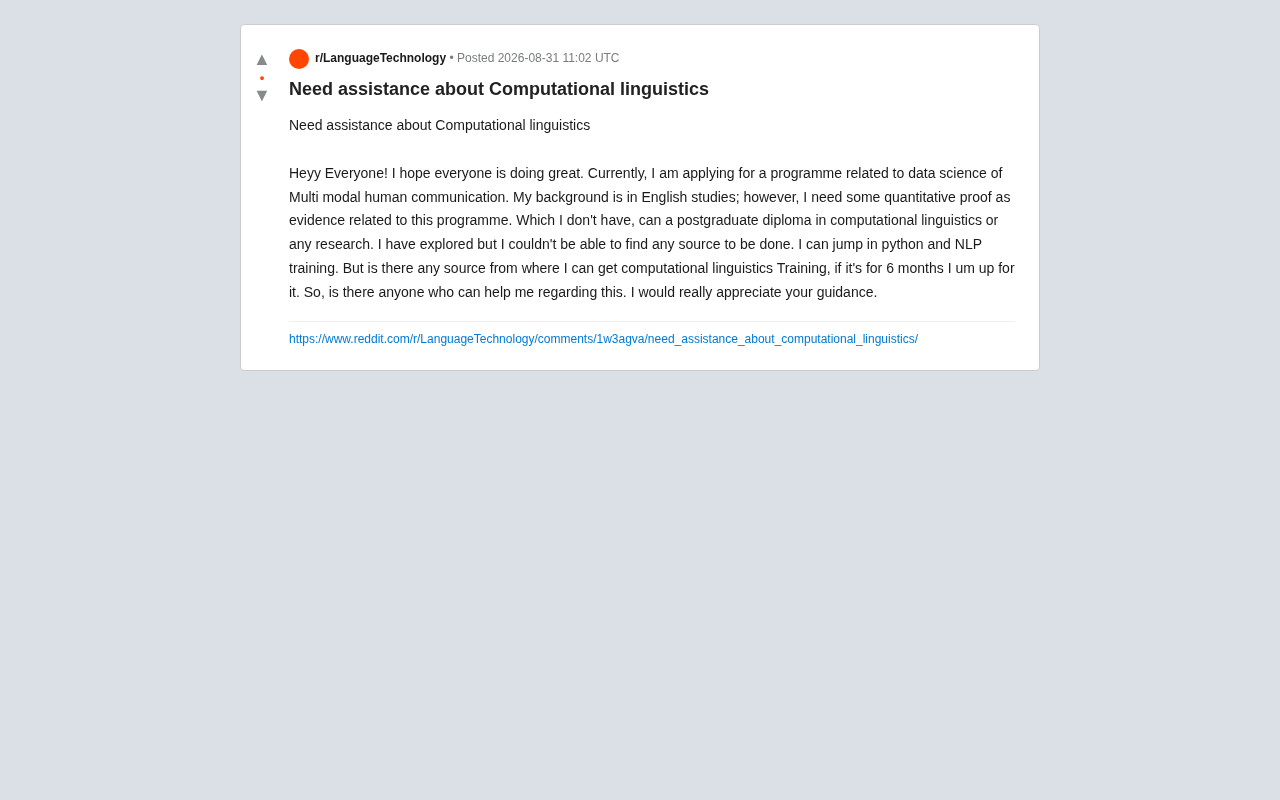
Recently, a Reddit user posed a highly relatable question: they have an academic background in English Studies and are applying to a data science program related to "Multimodal Human Communication." However, the admissions committee requires applicants to provide evidence of quantitative ability — precisely the area where students from purely humanities backgrounds tend to fall short.
In graduate admissions for data science and computational linguistics, "Quantitative Evidence" is the core criterion admissions committees use to evaluate interdisciplinary applicants. The rationale behind this requirement is that research in computational linguistics routinely involves mathematical tools such as statistical hypothesis testing (e.g., assessing whether performance differences between two models are significant), linear algebra (e.g., dimensionality reduction and similarity computation in word vector spaces), and calculus (e.g., understanding the backpropagation algorithm in neural networks). Admissions officers need to confirm that cross-disciplinary applicants can handle these quantitative analysis tasks. Common forms of evidence include formal course grades, standardized test scores, online course certificates, open-source code projects, and research papers involving quantitative methods.
The user mentioned they can already "get started with Python and NLP training" and are willing to invest 6 months in systematic study, but struggle to find suitable Computational Linguistics training resources or research pathways. Behind this question lies the growing demand for career transitions at the intersection of the humanities and artificial intelligence.
This article addresses this real-world dilemma by outlining viable pathways, learning resources, and competency-proof strategies for humanities-background learners entering the field of computational linguistics.
Why Now Is the Right Time for Humanities Students to Pivot to Computational Linguistics
Computational linguistics sits at the intersection of linguistics, computer science, and artificial intelligence. As a discipline, it originated from machine translation research in the 1950s — in 1954, Georgetown University and IBM collaborated on the first public machine translation demonstration, automatically translating Russian sentences into English, marking the formal birth of the field. Over the following decades, computational linguistics evolved from rule-based approaches (such as Chomsky's formal grammar framework) to statistical methods (such as Hidden Markov Models and n-gram language models), and finally to today's paradigm centered on deep learning and large language models. The ACL (Association for Computational Linguistics), founded in 1962, is the most authoritative academic organization in the field, and its annual conference remains the premier venue for NLP researchers to present their work.
With the explosion of Large Language Models (LLMs), the demand for processing, annotating, evaluating, and modeling language data has surged — and this work requires precisely the kind of hybrid talent that understands both language and computation. Large language models are deep neural networks based on the Transformer architecture, trained on massive text datasets. Representative products include OpenAI's GPT series, Google's PaLM/Gemini, and Meta's LLaMA. The training and optimization pipeline for LLMs contains numerous stages that require linguistic expertise: the data cleaning phase requires identifying noise and bias in corpora; the RLHF (Reinforcement Learning from Human Feedback) phase requires high-quality human annotation and evaluation; and model capability assessment requires designing test benchmarks covering multiple levels including grammar, semantics, and pragmatics. Red teaming and safety alignment work likewise depend on a deep understanding of linguistic ambiguity, implicit meaning, and cultural sensitivity.
The Unique Advantages of a Humanities Background
For learners with an English Studies background, their strengths are often underestimated:
- Linguistic intuition and understanding of grammatical structure: This is a capability that purely technical backgrounds cannot quickly develop, and it's enormously valuable in syntactic analysis, semantic annotation, and corpus construction.
- Foundation in multimodal communication research: The "Multimodal Human Communication" program the poster is applying to inherently emphasizes the integrated understanding of language, gesture, and context — humanities training is a genuine asset here. Multimodal human communication is an interdisciplinary research area that integrates linguistics, cognitive science, computer vision, and human-computer interaction. "Multimodal" refers to the fact that human communication relies not only on written and spoken language but simultaneously involves vocal prosody, facial expressions, hand gestures, eye gaze, body posture, and even spatial distance — multiple information channels working in concert. Psycholinguistic research shows that approximately 65% of information in face-to-face communication is conveyed through non-verbal channels. In recent years, with the rise of video understanding technology and multimodal large models (such as GPT-4V and Gemini), enabling machines to understand and generate multimodal information has become a frontier topic in AI research — a field that particularly needs researchers with humanities and social science training.
- Critical text analysis skills: Especially crucial in data annotation quality control and model output evaluation.
The real weakness isn't "not understanding language" — it's the lack of quantitative evidence, meaning credible credentials that demonstrate programming, statistics, and modeling capabilities.
Three Viable Paths to Fill the Quantitative Evidence Gap
Admissions committees don't want vague expressions of interest — they want verifiable proof of skills. In recent years, as applications to data science programs have surged, GitHub project portfolios are increasingly viewed as competency credentials on par with formal degrees. Here are several practical paths forward.
Path 1: Pursue a Formal Graduate Certificate or Diploma
The "Postgraduate Diploma in Computational Linguistics" the poster mentioned does exist, though resources are relatively scattered. The following types of programs are worth considering:
- University-offered computational linguistics certificate programs: Such as the University of Washington's Computational Linguistics master's and certificate programs, and Europe's Erasmus Mundus Language and Communication Technologies (LCT) program.
- Short-term professional certificates: Some universities offer 6-month to 1-year non-degree certificates, suitable as transitional credentials.
The advantage of these formal certificates is their strong authority — they serve directly as official proof of quantitative ability.
Path 2: Systematically Study NLP Courses Through MOOC Platforms
If time and budget are limited, online courses offer the best return on investment:
- NLP specialization courses on Coursera / edX (such as DeepLearning.AI's NLP Specialization)
- Stanford CS224N (Natural Language Processing with Deep Learning), a widely recognized classic in the industry. Taught by Professor Christopher Manning, this course systematically covers everything from word vectors to Transformers and pre-trained models. All course videos and assignments are freely available.
- Linguistics foundations courses, such as "Miracles of Human Language" on Coursera
Completing these courses and earning certificates, combined with hands-on projects, is sufficient to form a compelling competency portfolio.
Path 3: Let Project Work Speak Instead of Diplomas
In the data science world, demonstrable projects often carry more weight than certificates. Since the poster can already work with Python and NLP, consider:
- Building 1–2 complete NLP projects on GitHub (e.g., sentiment analysis, text classification, corpus statistical analysis).
- Participating in Kaggle competitions to earn quantifiable ranking results. Kaggle is the world's largest data science competition platform with over 15 million registered users. Its competition rankings and medal system have become widely recognized capability indicators in the data science field.
- Attempting to write a small-scale research report — even if unpublished, it demonstrates independent research capability.
A Detailed 6-Month Computational Linguistics Study Plan
Based on the poster's willingness to "invest 6 months," here is a progressive planning framework.
Months 1–2: Build a Solid Foundation in Math and Programming
- Review linear algebra and probability/statistics fundamentals (focus: distributions, hypothesis testing, regression). Linear algebra is the cornerstone for understanding word vector spaces and neural network operations — every forward pass through a model is essentially a matrix multiplication. Probability and statistics are essential tools for evaluating model performance and understanding the probability distributions of language model outputs.
- Solidify Python's data processing stack: NumPy (high-performance numerical computing library supporting multi-dimensional arrays and matrix operations), Pandas (structured data analysis library, essentially the programming world's equivalent of Excel), and Matplotlib (data visualization library).
- Master basic regular expressions and text preprocessing techniques. Regular Expressions are a tool that uses special syntax to describe text patterns. They are widely used in NLP for text cleaning, pattern matching, and information extraction — for example, extracting all email addresses or date formats from large bodies of text.
Months 3–4: Dive Deep into Core NLP Tasks and Linguistic Modeling
- Study classic NLP tasks: Tokenization (splitting continuous text into word or subword units), POS Tagging (Part-of-Speech Tagging, labeling each word with its grammatical category such as noun, verb, etc.), and NER (Named Entity Recognition, identifying proper nouns like person names, place names, and organization names in text).
- Master word embeddings, TF-IDF, and Transformer fundamentals. Word Embeddings are a technique that maps vocabulary from natural language into dense numerical vectors, enabling computers to process semantic information mathematically. Google's Word2Vec, proposed in 2013, is an early representative. Based on the distributional semantics hypothesis — "a word's meaning is determined by its context" — it uses neural networks to map each word into a vector space of typically 100–300 dimensions, where semantically similar words are closer together in vector space. TF-IDF (Term Frequency-Inverse Document Frequency) is a more classical text representation method that extracts key information by measuring how important a word is within a specific document. The core innovation of the Transformer architecture is the "Self-Attention" mechanism, which allows the model to attend to information from all other words in the input sequence when processing any given word, thereby capturing long-range semantic dependencies — this mechanism is the foundation of all mainstream NLP models today (BERT, GPT, etc.).
- Get hands-on with tool libraries such as spaCy, NLTK, and Hugging Face Transformers. These three libraries represent different levels of NLP practice: NLTK (Natural Language Toolkit), born in 2001, was one of the earliest NLP libraries in the Python ecosystem, offering foundational functions like tokenization, POS tagging, and syntactic parsing, along with extensive corpora and educational resources — a classic choice for beginners. spaCy is an industrial-grade NLP library designed for production environments, offering faster processing speeds and built-in pre-trained models suitable for building real-world applications. Hugging Face Transformers is the de facto standard for deep learning NLP today, providing a unified interface to thousands of pre-trained models covering mainstream architectures like BERT, GPT-2, RoBERTa, and T5. Users can load models with just a few lines of code to perform text classification, question answering, translation, summarization, and more.
Months 5–6: Complete Projects and Build Quantitative Evidence
- Independently complete an end-to-end NLP project and open-source it. "End-to-end" means the complete pipeline from data collection, cleaning, feature engineering, and model training to result evaluation and deployment. This kind of full-pipeline practical capability is what admissions officers and employers value most.
- Participate in a Kaggle competition or reproduce a research paper. Paper reproduction is a common learning method in academia — it involves independently implementing an algorithm based on a published paper's description and verifying the results. This process builds deep understanding of model details while demonstrating solid engineering skills.
- Organize your results and write a "Quantitative Competency Statement" for your application materials.
Practical Tips for Humanities Students Transitioning to Computational Linguistics
First, don't undervalue your humanities background. In the era of LLMs, people who understand the nature of language are actually in short supply. Your goal is not to become a programmer, but to become a "linguist who understands computation." In fact, many foundational figures in computational linguistics themselves had deep humanities backgrounds, and linguistic theory (such as morphology, syntax, and pragmatics) continues to provide irreplaceable guidance for designing better NLP systems.
Second, proof beats proclamation. Admissions officers value verifiable evidence. A GitHub project, a Kaggle ranking, or a course certificate is far more powerful than "I'm very interested in this."
Third, leverage community resources. Communities like Reddit's r/LanguageTechnology and r/MachineLearning, as well as open resources from the ACL (Association for Computational Linguistics), are treasure troves for guidance and information. Additionally, the ACL Anthology, managed by ACL, is the world's largest open-access repository of computational linguistics papers, containing tens of thousands of high-quality research papers — all freely available to read and download. It is an indispensable resource for systematically understanding the cutting edge of the field.
Conclusion
The transition from English Studies to data science in multimodal human communication is no smooth ride, but it is far from insurmountable. The key lies in systematically filling quantitative gaps through structured learning and proving your capabilities through demonstrable results. Six months of focused effort is enough for a humanities student to stand at the threshold of computational linguistics. For all learners standing at the intersection of the humanities and technology, this is both a challenge and one of the most unique opportunities of the AI era.
Related articles

Chain of Thought Isn't Just for AI: How Humans Can Use CoT to Improve Thinking Quality
Chain of Thought isn't just a prompt trick for large models. Starting from a Hacker News discussion, this article analyzes why CoT works for human thinking too, breaks down actionable ways to transfer it, and highlights the key differences between human CoT and machine CoT.
Cloudflare Teams Up with OpenAI: Closi…
Cloudflare Teams Up with OpenAI: Closing the Loop from Vulnerability Discovery to Defense with AI
Cloudflare uses OpenAI Daybreak to investigate security vulnerabilities and generate reviewable remediation plans, while developers use Codex to boost coding efficiency and quality.

Orca Multi-Agent Orchestration in Practice: A Guide to Parallel Collaboration with Claude and Codex
Orca is Stable AI's free open-source agent workbench supporting 34 agents like Claude Code and Codex in parallel. Learn its Git worktree isolation, multi-model orchestration, and mobile management.