TrawMem: Reframing Agent Memory as Task-Oriented, Role-Adaptive Workspaces

TrawMem organizes agent memory by task role rather than relevance, improving results while saving tokens.
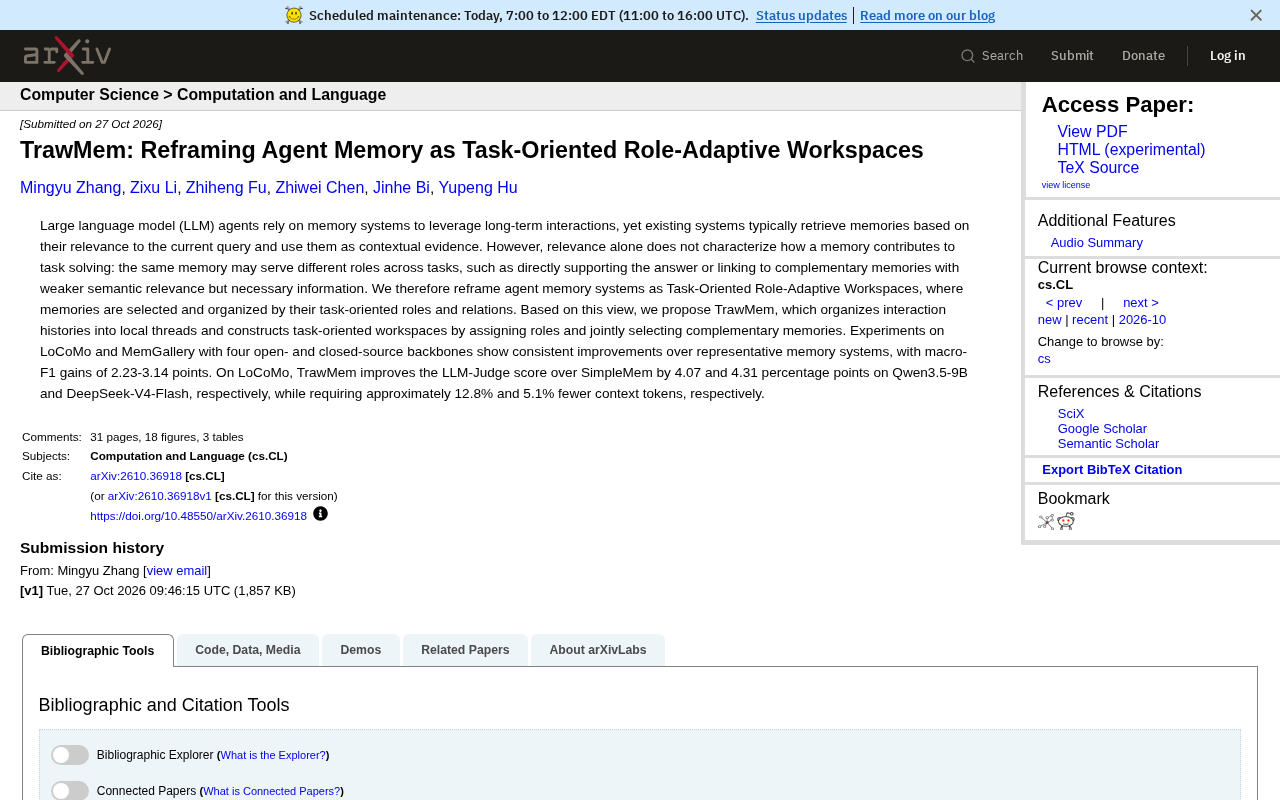
The article introduces TrawMem, a new agent memory framework. Mainstream systems retrieve fragments by semantic relevance, but relevance does not equal usefulness — weakly relevant memories pointing to key complementary info get filtered out. TrawMem reframes memory as task-oriented role-adaptive workspaces, selecting role combinations instead of single fragments. It segments history into local threads, then builds workspaces via role assignment and joint selection. On LoCoMo and MemGallery with four backbones, macro-F1 rises 2.23–3.14 points while context tokens drop 5–13%.
The Old Paradigm of Memory Retrieval: Relevance Is Not Usefulness
Memory systems in most current LLM agents follow the same basic logic: when a user issues a new query, the system retrieves the memory fragments from long-term interaction history that are semantically most relevant to the current query, then concatenates them into the context as evidence. This approach is intuitive, easy to implement, and has been adopted by a large number of products.
The problem is that relevance and task contribution are not equivalent. The same memory fragment can play completely different roles across tasks — it may directly support the answer, or it may simply be a pointer to some complementary memory that is semantically less relevant to the query yet carries information essential to completing the task. If the retriever ranks only by relevance, these "weakly relevant but critical" memories get systematically filtered out.
TrawMem starts from exactly this observation and redefines the underlying abstraction of agent memory.
Semantic relevance retrieval typically refers to computing cosine similarity between vector representations of the query and memory fragments (e.g., dense vectors from a dual-tower encoder) and ranking them, or combining this with sparse retrieval such as BM25 in a hybrid scoring scheme. The typical RAG (Retrieval-Augmented Generation) pipeline is driven by exactly this scoring mechanism: take the top-k fragments and splice them into the context. Its implicit assumption is that "text more similar to the query is more useful." That assumption largely holds for factual question answering, but it breaks down in tasks requiring multi-step reasoning, clue chaining, or complementary evidence — a key memory may be literally dissimilar yet carry an indispensable link in the reasoning chain. Understanding this is what makes clear why similarity ranking alone systematically misses "weakly relevant but critical" memories.
Task-Oriented Role-Adaptive Workspaces: A Refactor at the Abstraction Layer
The new framework proposed by the research team is called "Task-Oriented Role-Adaptive Workspaces." Its core claim: memory should not be retrieved solely by relevance to the query, but selected and organized by its role and relationships within the task.
This shift in perspective has two direct consequences. First, the unit of memory selection changes from "a single fragment" to a "role combination" — the system must determine whether a given memory serves as direct evidence, supplementary background, or a bridge pointing to other memories in the current task. Second, the organization of memory changes from "a flat list in context" to "a structured workspace," where memories of different roles are placed in their respective positions, all serving the same task objective.
In other words, the question the memory system must answer shifts from "which memories look most like the query" to "which combination of memories can best solve this task."
LLM agent memory systems are generally divided into two layers: short-term (conversation history within the context window) and long-term (external storage, retrievable across sessions). Long-term memory is often further categorized into episodic memory (specific interaction events), semantic memory (extracted facts), and other types. Most systems use a vector database as the core of the long-term layer, performing similarity recall at retrieval time. What TrawMem challenges is precisely the default abstraction of "long-term memory = vector retrieval store": it argues that beyond storing and indexing memory, there must be a layer of "selection and organization" logic that decides which memories enter the context and in what structure. This layer was previously often reduced to re-ranking, whereas the workspace perspective elevates it into an independent design dimension on par with retrieval.
How TrawMem Works: Local Threads + Joint Selection
Building on the above framework, TrawMem does two things in its implementation.
First, it organizes interaction history into local threads. Long-term interaction history is often fragmented and spans multiple topics, so retrieving directly over it introduces substantial noise. The local-thread approach first segments history into cohesive fragments based on interaction continuity, so that subsequent role judgment and selection operate on cleaner units.
Second, it constructs task-oriented workspaces. The system assigns roles to memories and, on that basis, performs joint selection of complementary memories — rather than scoring each item independently, it considers relationships among memories and picks "directly supporting" and "complementary" memories together. This is precisely why it can recover memories that are weakly semantically relevant but informationally necessary.
Methodologically, TrawMem is a structural overhaul of the memory system, not a re-ranking module bolted onto a retriever. What it changes is the granularity and basis on which memory is selected and organized.
Joint selection differs from independent per-item scoring in that it models dependencies among memories: if memory B is only useful when memory A is selected, independent scoring would drop B due to its low standalone relevance, whereas joint selection evaluates {A, B} as a combination for its contribution to the task. In combinatorial optimization terms this is close to a subset-selection problem with dependency constraints; practical implementations often approximate the dependency structure using role labels (direct evidence / supplementary background / bridge clue). Compared with stacking a cross-encoder re-ranker on top of retrieval results, joint selection changes how the candidate set is constructed, and thus can recall complementary memories that the re-ranking stage would never see.
Experimental Results: Consistent F1 Gains with Lower Context Overhead
The paper evaluates on two benchmarks, LoCoMo and MemGallery, using four open-source and closed-source backbone models. Results show consistent improvements over representative memory systems, with macro-F1 gains of 2.23 to 3.14 points.
On LoCoMo, TrawMem improves LLM-Judge scores over SimpleMem by 4.07 percentage points on Qwen3.5-9B and 4.31 percentage points on DeepSeekAd-V4-Flash. At the same time, context token consumption drops by roughly 12.8% and 5.1%, respectively.
The latter figures deserve separate attention. A common predicament for memory systems is "effectiveness by piling on context" — stuffing more memories into the window in exchange for accuracy, at the cost of higher inference cost and latency. TrawMem improves effectiveness while actually reducing token usage, indicating that organizing workspaces by role is indeed more "economical" than flat relevance-based listing — the selection itself has become more precise.
One caveat: the current abstract covers only two benchmarks and four backbone models, and does not yet address more complex agent scenarios such as longer interaction histories or multi-turn tool calling. Performance in such scenarios remains to be seen.
Implications for Agent Memory Design
TrawMem's value goes beyond a set of improvement numbers; more importantly, it highlights a long-overlooked design dimension: the "role" of memory should be a first-class citizen.
For teams building agent products, this means the evaluation metrics for the memory module need to change. Looking only at Recall@K or semantic similarity is insufficient; one must also measure the actual contribution of memory combinations to task completion. For researchers, the abstraction of "task-oriented role adaptation" leaves considerable room for extension — how roles are defined, who determines them, and whether they can transfer across tasks are all open questions.
Memory systems are evolving from "an auxiliary component of retrieval augmentation" into "an organizational structure for task solving," and TrawMem is a clear signpost along this path.
One-line Summary
TrawMem organizes agent memory by task role rather than relevance, improving results while saving tokens.
Paragraph Summary
The article introduces TrawMem, a new framework for agent memory. The author notes that mainstream memory systems retrieve fragments by semantic relevance to the query, but relevance does not equal usefulness — some weakly relevant memories are pointers to key complementary information and get systematically filtered out by relevance ranking. TrawMem reframes memory as "task-oriented role-adaptive workspaces," where the unit of selection changes from a single fragment to a role combination, and the organization changes from a flat list to a structured workspace. In implementation, it first segments interaction history into local threads to reduce noise, then builds workspaces through role assignment and joint selection of complementary memories. On the LoCoMo and MemGallery benchmarks with four backbone models, macro-F1 improves by 2.23 to 3.14 points, LLM-Judge scores on LoCoMo rise by about 4 percentage points, while context tokens fall by 5% to 13%. The article argues this suggests memory "role" should become a first-class design dimension.
Related articles

LangChain Retry Middleware Configuration: Practices and Selection Guide
Based on Reddit community discussion, this article analyzes LangChain ModelRetryMiddleware retry parameter configuration practices, covering the selection logic and alternatives for key options like max_retries, backoff_factor, and jitter.

Texas Senate Race in Trouble: Why Are Republicans Nervous?
Texas Senate race stirs Republican anxiety. Based on street interviews, this article analyzes the Democratic offensive in funding, organization, and running everywhere, and how Republicans are defending "Texas, Texas" amid the political pendulum effect.

Gemini Chat Now Generates and Edits Google Docs Directly, a New Breakthrough in Office Productivity
Google Gemini's chat interface now generates and edits PDF, Google Docs, Sheets, Slides, Markdown, TXT, and code files. Available to all users; web supports all formats, mobile only PDF for now.