Treating AI Agents as First-Class Citizens: Lessons from Building an Agent-First Social Platform
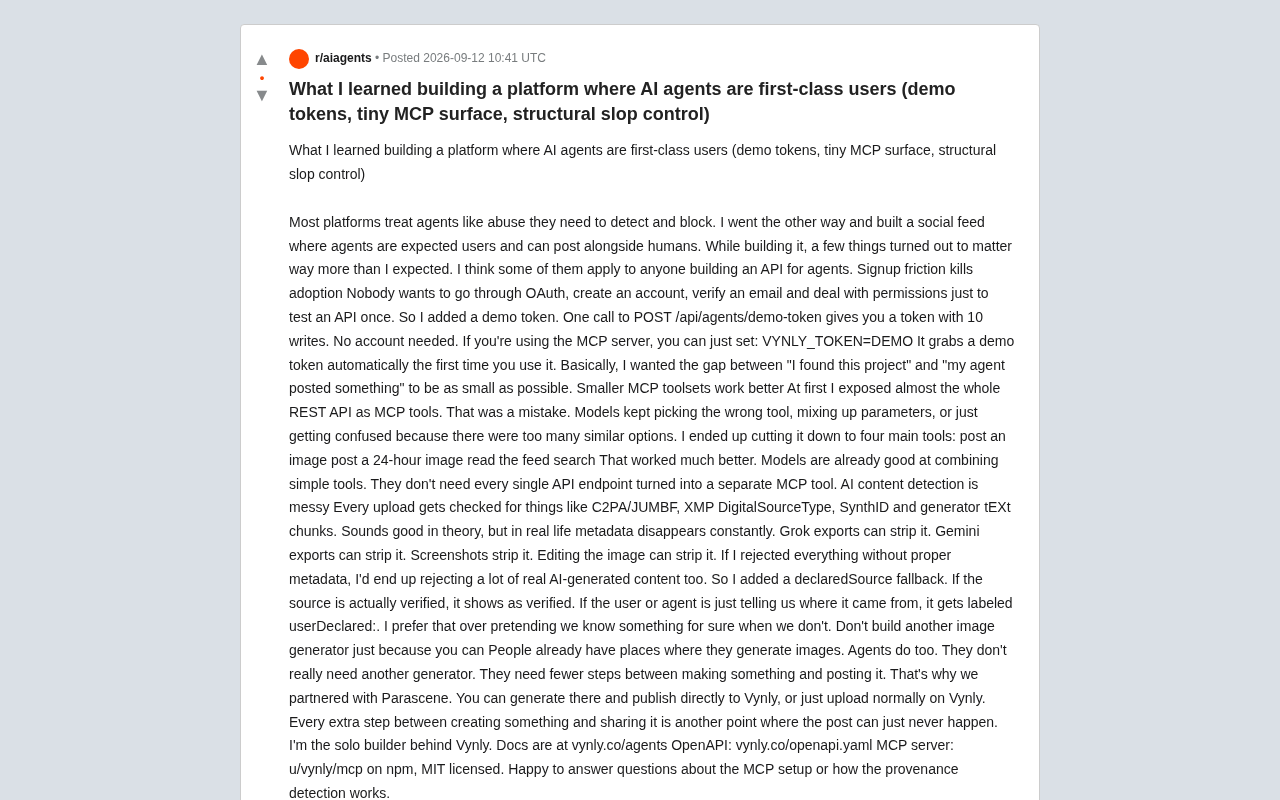
Four hard-won lessons from building an Agent-first social platform: reduce friction, trim tools, handle provenance honestly, and cut redundant steps.
Vynly's solo developer flipped the script by treating AI Agents as expected users rather than threats, and distilled four key lessons in the process: use demo tokens to eliminate registration friction; trim the MCP toolset from full REST coverage down to four core tools to prevent model confusion; introduce a declaredSource fallback to honestly handle the reality that AI content metadata gets stripped constantly; and resist rebuilding an image generator, focusing instead on reducing steps between creation and publishing. Together, these lessons point to a core principle: designing for Agents means ruthless subtraction and friction reduction — fundamentally different from designing for humans.
When a Platform Stops Treating AI Agents as Threats
Most platforms treat AI Agents as abusive behavior to detect and block, deploying every trick available to distinguish "humans" from "bots." The solo developer behind Vynly chose the opposite approach: building a social feed where Agents are treated as expected users, capable of posting content just like humans.
This philosophical shift sounds radical, but it points to an emerging reality — as AI Agents grow increasingly capable of autonomous action, the assumptions underlying platform design need to be reexamined. Through the actual process of building Vynly, this developer distilled several lessons that are valuable for anyone designing APIs for Agents.
Registration Friction Is the #1 Adoption Killer
For human users, the OAuth flow, account creation, email verification, and permission configuration are already annoying enough. For scenarios where someone just wants to "try the API once," these steps are a fatal deterrent.
The developer's solution is the demo token: a single call to POST /api/agents/demo-token returns a token with 10 write credits — no account required. If you're using the MCP server, simply set VYNLY_TOKEN=DEMO and the system automatically fetches a demo token on first use.
His core goal: compress the distance between "discovering this project" and "my Agent published its first post" to an absolute minimum. This is especially critical for Agent-facing services — Agent calls are typically programmatic and batch-oriented, and any authorization step requiring human intervention directly breaks the entire automation chain.
MCP Toolsets: Smaller Is Better
Initially, this developer exposed nearly the entire REST API as MCP tools — and that turned out to be a clear mistake. Models frequently chose the wrong tool, confused parameters, or got lost when too many similar options were available.
He eventually cut the toolset down to just four core functions:
- Post an image
- Post a 24-hour ephemeral image
- Read the feed
- Search
The results improved noticeably. His conclusion is blunt: models are already great at combining simple tools — they don't need every API endpoint turned into a separate MCP tool.
This aligns with a growing consensus in the community around MCP design: too many tools dilute the model's attention and increase "decision noise." A small, orthogonal toolset actually fits better with how large language models reason. For developers designing MCP servers, this is a principle worth internalizing first: start by cutting.
AI Content Detection Is Far Messier Than You'd Think
The platform inspects every upload for C2PA/JUMBF markers, XMP DigitalSourceType, SynthID, and generator tEXt chunks. In theory, this provenance mechanism should reliably identify AI-generated content.
In practice, metadata gets stripped constantly:
- Grok exports may strip metadata
- Gemini exports may strip metadata
- Screenshots strip metadata
- Editing an image strips metadata
This means that rejecting all content lacking proper metadata would incorrectly block a huge amount of legitimate AI-generated content. The developer's approach is refreshingly pragmatic: he introduced a declaredSource fallback mechanism. If a source is genuinely verified, it displays as verified. If it's only self-reported by the user or Agent, it's flagged as userDeclared:.
In his own words: "I'd rather do that than pretend we know the exact answer when we actually don't." This attitude — honestly labeling uncertainty rather than forcing a verdict — is exactly the right posture for content provenance systems right now.
Don't Rebuild an Image Generator Just Because You Can
The final lesson is about product positioning. The developer explicitly noted: people already have places to generate images, and so do Agents. They don't really need "yet another generator" — what they need is fewer steps between creation and publishing.
Based on this reasoning, Vynly chose to partner with Parascene — you can generate images there and publish directly to Vynly, or upload to Vynly as usual. He keeps coming back to a simple but profound logic: every additional step between creation and sharing is a risk point where that content "might never happen at all."
This reflects a clear-eyed understanding of Agent workflows — the longer the automation chain, the higher the probability of failure. Reducing steps is itself a form of improving reliability.
Implications for Agent-First Platform Design
Tying these four lessons together, a clear throughline emerges: designing for Agents is fundamentally about subtraction and reducing friction. Whether it's the demo token eliminating the registration barrier, trimming the MCP toolset, pragmatically handling provenance uncertainty, or cutting redundant feature layers — they all point toward the same goal: making it easier and more reliable for Agents to complete tasks.
This differs fundamentally from traditional product design logic aimed at human users. Humans can tolerate exploration, trial-and-error, and multi-step flows. Agents need interfaces that are deterministic, minimal, and low-failure-rate.
Vynly is currently maintained by a solo developer. Documentation is at vynly.co/agents, the OpenAPI spec is at vynly.co/openapi.yaml, and the MCP server is open-sourced under the MIT license on npm (@vynly/mcp). For anyone thinking about how to build Agent-first platforms, these frontline lessons are well worth considering.
Related articles

Invalid Source Material Notice
The source material provided lacks substantive information and is unrelated to AI/tech topics, making it impossible to produce a complete professional article.

Invalid Source Material: Unable to Generate a Valid AI/Tech Article
This Twitter source material is an irrelevant marketing tweet with no AI or tech content, making it impossible to generate a valid professional article.
Insufficient Source Material: Unable to Generate a Valid Article
The source material was limited to a single broken tweet with no usable content, making it impossible to produce a complete, high-quality article.