Treg: An AI Agent Tool Aggregation Platform — An Open-Source Solution with 2,600+ APIs at Zero Markup

Treg unifies 2,600+ APIs for AI Agents under one token with zero markup, positioning itself as the OpenRouter for tools.
Treg is an open-source platform that aggregates over 2,600 APIs into a single endpoint with zero markup, targeting the tool fragmentation problem facing AI Agent developers. By offering search-by-task functionality and pay-per-call billing, it mirrors what OpenRouter does for LLMs but for tool APIs. Its open-source nature provides trust and auditability, while its zero-markup model aims to build network effects before monetizing through enterprise features.
When AI Agents Need Tools, They Don't Care About Vendors
As AI Agents move from concept to production, a practical problem emerges: what Agents truly need isn't a specific vendor's product, but the best tool to get the job done. Whether it's performing SEO analysis, scraping social media data, generating sales leads, or running ads, an Agent's need fundamentally boils down to "using the most suitable API to solve the current task."
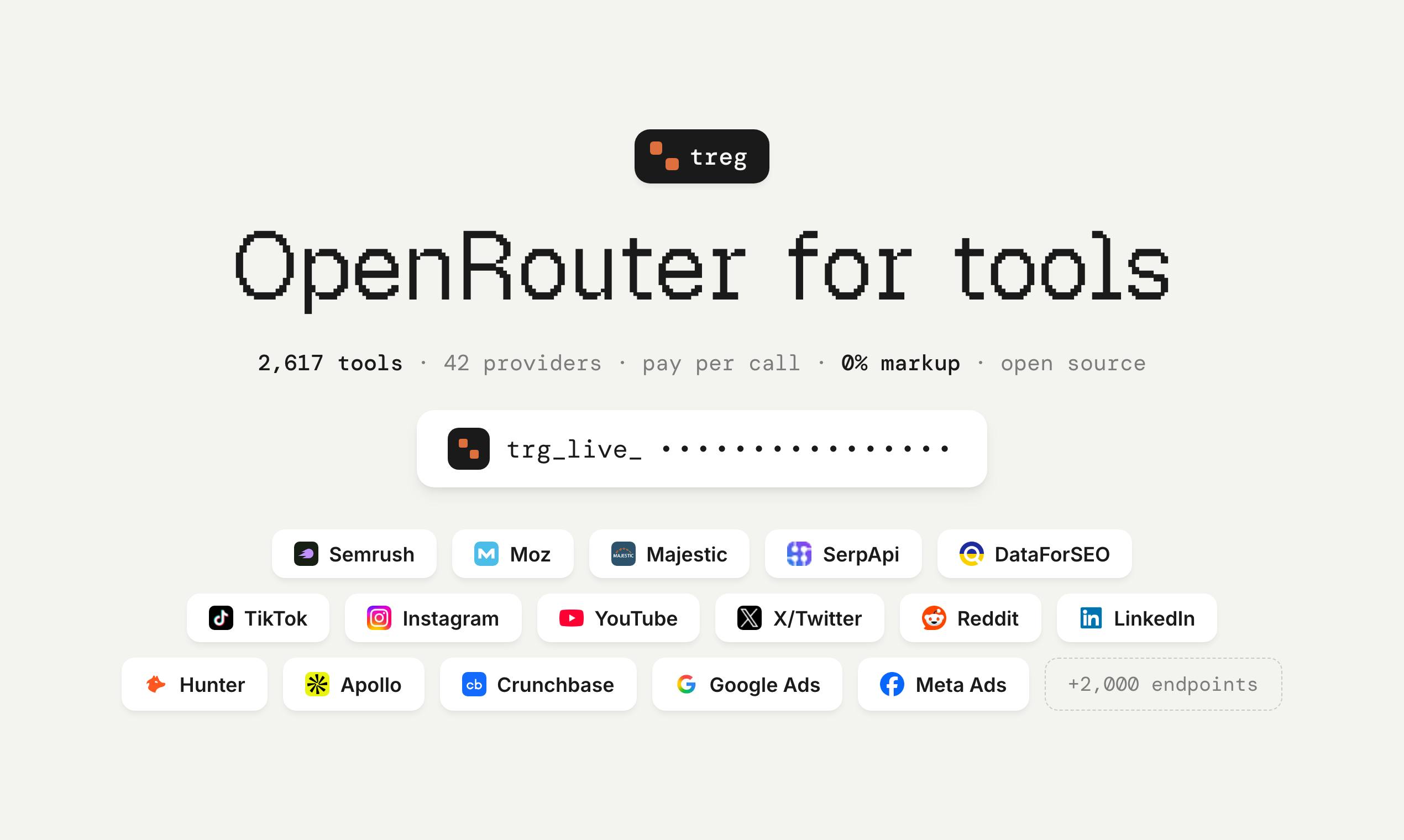
A recently launched open-source project on Product Hunt, Treg, targets precisely this pain point. Its positioning is crystal clear — "OpenRouter for tools" — consolidating over 2,600 APIs under a single URL and a single Token, with a promise of 0% markup. After launch, the project received 99 upvotes, ranking 8th on its launch day.
The reference to OpenRouter here is deliberate. OpenRouter is a widely recognized piece of infrastructure in the AI developer community. It aggregates models from dozens of LLM providers — OpenAI, Anthropic, Google, Meta, and more — behind a single standardized API endpoint. Developers only need to integrate once to freely switch between different models, without separately managing each provider's keys, billing, and interface differences. OpenRouter abstracts away the heterogeneity of underlying model providers through a unified request format and response structure, while offering value-added features like price comparison and automatic routing. The success of this model proves the enormous value of an "aggregation middleware layer" in a technology ecosystem — when the number of providers explodes, developers need an abstraction layer to reduce cognitive and engineering burden. Treg aims to replicate this proven model in the tool API space.
What AI Agent Development Pain Points Does Treg Solve?
The Fragmented API Integration Dilemma
Any developer who has built an Agent or automation system knows the drill: integrating a single external tool typically means going through an entire process — registering an account, obtaining an API Key, reading documentation, handling different authentication methods, adapting to various response formats, and managing separate billing. When you need to integrate dozens or even hundreds of tools, this fragmentation complexity grows exponentially.
This fragmentation pain is well-supported by industry data. In the modern SaaS ecosystem, vendors differ enormously in authentication mechanisms (OAuth 2.0, API Key, JWT, HMAC signatures, etc.), data formats (JSON, XML, GraphQL), pagination methods, rate limiting strategies, and error code systems. According to Postman's 2023 State of the API Report, enterprises use an average of over 20 APIs, and API integration and maintenance consume approximately 30% of developers' working time. For AI Agents, this problem is even more severe — Agents need to dynamically select and invoke tools at runtime, unlike traditional applications that can integrate and debug one by one during development. This transforms a unified API layer from a "nice-to-have efficiency boost" into "critical infrastructure for Agents to function properly."
Treg's core value lies in abstracting a unified API access layer. Developers need only a single URL and a single Token to access 2,600+ tools spanning categories like SEO, social media, sales leads, advertising, and data scraping. This is exactly analogous to what OpenRouter does in the large model space — OpenRouter unifies numerous LLM providers behind one API, and Treg unifies numerous tool APIs.
Search by Task, Pay per Call
Treg's design logic aligns perfectly with how AI Agents work. It supports search by task, allowing Agents or developers to find suitable tools based on the task they need to accomplish, rather than the other way around of choosing a vendor first. When selecting tools, the platform clearly displays each API's price, request parameters, and response format, ensuring transparency and predictability.
More critically is the billing model: pay per call, with zero markup from the platform. Pay-per-call is an extension of cloud computing's "on-demand pricing" philosophy into the API economy, forming a stark contrast to traditional monthly subscriptions or prepaid credits. For AI Agent applications, tool invocation volume is inherently highly unpredictable — an Agent might intensively call SEO tools for one task and not need them at all for the next. Traditional subscription models lead to either significant idle waste or sudden overage charges. Pay-per-call precisely aligns costs with actual value output, making it particularly well-suited for Agents' "task-driven, dynamically-selected tools" usage pattern. With zero markup, this means the platform exists purely as transparent infrastructure, extracting no profit from the transactions themselves — users pay only the API's actual cost. For cost-sensitive Agent applications with volatile call volumes, this on-demand billing model is extremely attractive.
Can the Zero-Markup Business Model Sustain Itself?
0% markup is one of Treg's most eye-catching selling points, but it naturally raises a question: how can the platform sustain operations?
Aggregation platforms typically have several monetization paths: charging callers a markup, taking commissions from tool providers, offering value-added enterprise services, or adopting a subscription model. Treg chose the aggressive "zero markup" strategy, which in the short term dramatically lowers the usage threshold and psychological friction for developers, helping rapidly accumulate users and call volume. For long-term monetization, the path likely leads to enterprise subscriptions, premium features, or provider-side partnership models.
From an ecosystem perspective, zero markup is a classic "build network effects first, figure out monetization later" play. When enough Agents call tools through Treg and enough tools reach developers through Treg, the aggregation layer itself becomes a moat.
Open Source Brings Trust Dividends to API Aggregation Platforms
Another important attribute of Treg is that it's open source, with the project categorized under GitHub, Developer Tools, API, and Artificial Intelligence.
For a middleware platform sitting between users and tool providers — one that holds Tokens and call data — open source means greater transparency and auditability. Developers can inspect the code themselves, understand how data flows, and even self-host deployments when necessary, avoiding the risk of vendor lock-in.
Vendor lock-in is one of the most scrutinized risks in enterprise technology decisions, referring to the situation where once users deeply depend on a vendor's proprietary interfaces or ecosystem, migration costs become prohibitively high. In the API aggregation layer scenario, this risk is particularly pronounced — if Treg were closed-source, users would not only need to trust it not to misuse data in transit but also bear the passive position when the platform changes pricing strategies or terms of service. Open source fundamentally alleviates this concern through code transparency: users can audit data flow logic, verify whether hidden data collection exists, and fork the code for self-deployment if necessary. In the AI infrastructure space, successful cases like Hugging Face, vLLM, and LangChain have all demonstrated the effectiveness of an "open-source first" strategy for winning developer trust and accelerating community adoption.
It's worth noting that one of the project's makers, Unclecode, is well-known in the developer community for open-source projects, which adds further credibility to Treg's technical trustworthiness.
Treg's Position in AI Agent Infrastructure
The Tool Aggregation Layer Is Becoming a New Battleground
Over the past year, the AI Agent technology stack has been rapidly forming distinct layers. The current stack is taking shape with a clear layered structure: at the bottom is the Foundation Model Layer, including GPT-4, Claude, Gemini, and other large models providing reasoning capabilities; the second layer is the Orchestration Layer, including Agent frameworks like LangChain, CrewAI, and AutoGen, responsible for task decomposition, multi-step reasoning, and tool-calling flow control; the third layer is the Memory Layer, managing conversation history, long-term knowledge, and working state; the fourth layer is the Tool & Action Layer — the interfaces through which Agents actually interact with the external world. Treg is entering precisely at the aggregation and routing of this fourth layer, playing a role similar to DNS in the early internet — routing an Agent's intent ("I need to do SEO analysis") to the most suitable concrete tool implementation.
As standards like Anthropic's MCP (Model Context Protocol) gain broader adoption, the way Agents call external tools is becoming standardized. MCP is an open protocol released by Anthropic in late 2024, designed to standardize interactions between AI models and external tools and data sources. It defines a unified message format specifying standardized approaches for tool description, parameter passing, result return, and error handling. MCP is analogous to what USB-C did for hardware interfaces — as long as different tools expose their interfaces following the MCP specification, any MCP-compatible Agent can call them in a plug-and-play manner. MCP is driving the Agent tool ecosystem's transition from "every integration is custom engineering" to "standardized protocol-driven plug-and-play." If aggregation platforms like Treg can deeply integrate with standard protocols like MCP, they will further reduce the cost of Agents connecting to massive tool libraries, becoming an indispensable "tool router" layer in the Agent ecosystem.
Opportunities and Challenges in the OpenRouter Analogy
OpenRouter succeeded largely because LLM providers are relatively concentrated and highly standardized. The world of tool APIs, however, is far more fragmented and heterogeneous — behind 2,600+ tools lie 2,600 different interfaces, authentication methods, and data formats. For Treg to truly achieve "one Token to call everything," it must complete massive amounts of adaptation and maintenance work behind the scenes. This is both its technical moat and its greatest engineering challenge.
Final Thoughts
Treg has seized a real and increasingly urgent need in the AI Agent era — enabling Agents to access massive tool libraries in a unified, transparent, and cost-effective way. The positioning as "OpenRouter for tools" is precise, and the combination of zero markup with open source is highly attractive in the early stage.
Of course, whether it can deliver on its promises, whether it can sustain high-quality integrations in a vast and heterogeneous API ecosystem, and how it will navigate a long-term commercialization path all remain to be proven over time. But one thing is certain: as Agent applications explode, tool aggregation platforms like Treg represent a track well worth watching.
Related articles

JobRunner MCP Server: AI Agents Can Now Fix Failed Java Jobs
JobRunner launches an open-source MCP server enabling AI agents to view cluster status, diagnose failures, and recover Java jobs—incident response from any cloud coding environment or existing agent.

MLAI Digital Launches 9 Security Agents: MCP Server Safeguards the Full Lifecycle of Agentic AI
MLAI Digital launches Security MCP Server with nine built-in specialized security agents covering vulnerability discovery, attack simulation, prompt injection detection, API and infrastructure assessment, and accelerated remediation—embedding security validation across the full Agentic AI lifecycle from development to production.

Running Isaac Lab on H100 GPUs: Exploring Better Approaches
Exploring optimization methods for running Isaac Lab on NVIDIA H100 GPUs, including MIG configuration, mixed precision, TensorRT acceleration, and community experience to improve robotics simulation and reinforcement learning efficiency.