Tressfecta: Using Technology to Lighten the Load on Braiding Stylists

Tressfecta uses assistive tools to reduce braiders' physical strain and will appear at TechCrunch Disrupt.
Braiders have long faced occupational strain to their wrists, shoulders, neck, and lower back, while braiding tools have seen almost no intelligent improvement for decades. The Tressfecta team is targeting this gap, positioning itself as an assistive tool rather than an automatic braiding robot. It aims to reduce the physical burden of repetitive labor while preserving the stylist's full control over the style, and will showcase its product at TechCrunch Disrupt. If successful, it could change the pricing model of braiding services and practitioners' career longevity.
Braiding—especially intricate styles like dreadlocks and cornrows—is both an art and a physical grind for stylists. Long hours on their feet, repetitive hand movements, and precise tension control put many practitioners at risk of occupational strain. A team called Tressfecta is trying to change that with technology.
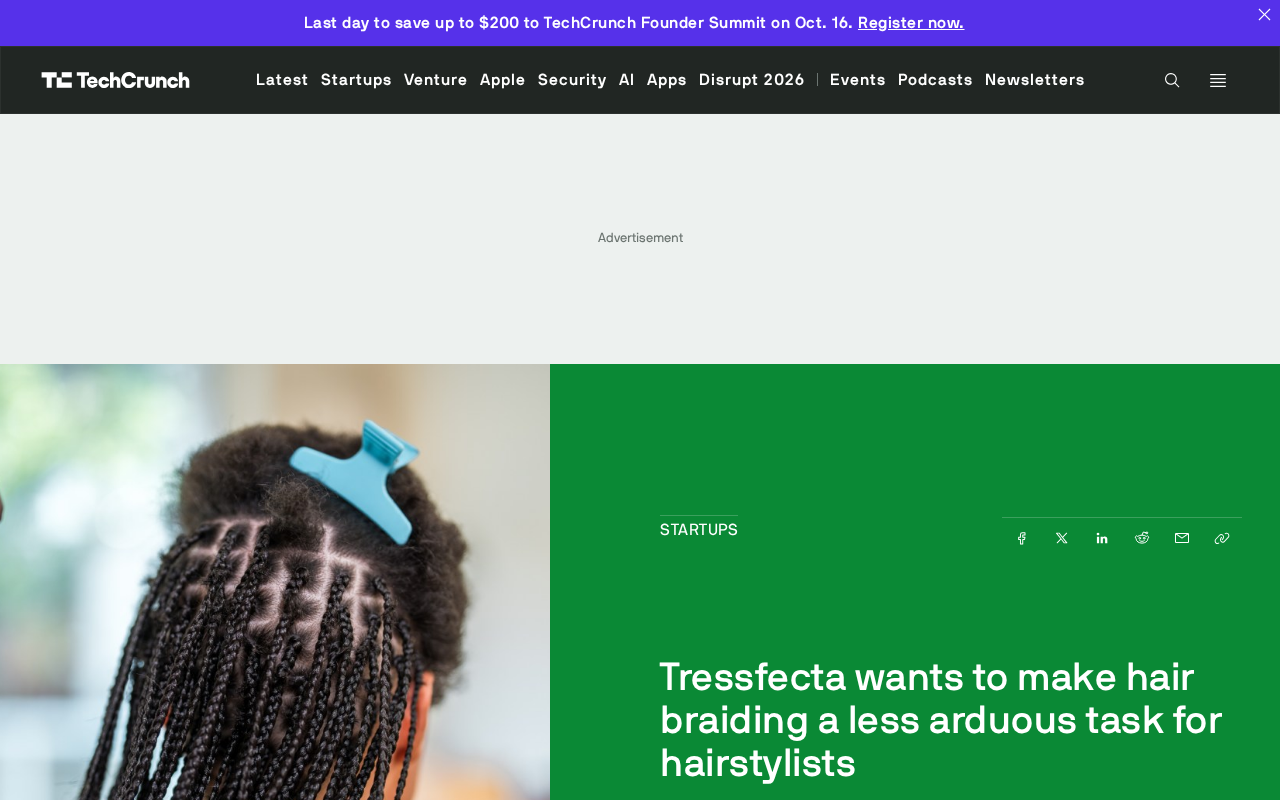
The Hidden Pain Points of the Braiding Industry
A braiding session often takes hours, requiring stylists to keep their arms raised and their fingers performing delicate maneuvers throughout. According to industry feedback, fatigue and injuries to the wrists, shoulders, neck, and lower back are quite common among braiders. Traditional tools—combs, clips, rubber bands—have seen virtually no intelligent improvement. Tressfecta's entry point is precisely this long-neglected link: not replacing the stylist's creativity, but reducing the physical toll of repetitive labor.
Repetitive strain injury (RSI) is the core medical backdrop to braiders' occupational health problems. These injuries stem from prolonged repetition of the same motion, leading to chronic inflammation of tendons, nerves, and muscles, with common manifestations including carpal tunnel syndrome, tenosynovitis, and rotator cuff injuries. During braiding, stylists' fingers must continuously perform fine grasping, pulling, and wrapping motions, the wrist remains in prolonged dorsiflexion or ulnar deviation, and the shoulder maintains an abducted, elevated position—postures that compress the median nerve and tendon sheaths. According to U.S. Bureau of Labor Statistics data, the incidence of musculoskeletal disorders among beauty and cosmetology workers is significantly higher than the average across all industries. Traditionally, such problems could only be alleviated by adjusting work pace, using wrist braces, or undergoing physical therapy, while interventions at the tool level have been almost nonexistent. Tressfecta is attempting to start with tool design to reduce the load of repetitive hand movements, which aligns with the occupational medicine principle that "engineering controls take priority over personal protective equipment."
Tressfecta's Approach
Based on available information, Tressfecta positions itself as an assistive tool rather than an automatic braiding robot. It aims to make the braiding process less strenuous and more efficient while preserving the stylist's full control over the style. Although specific technical details have not yet been disclosed, the team's choice to appear at TechCrunch Disrupt indicates that its product has reached a demonstrable stage. TechCrunch Disrupt has long been an important stage for early-stage startups to gain attention and funding, and Tressfecta's participation signals that it is seeking industry validation and resource support.
TechCrunch Disrupt is one of the most influential annual conferences in the tech startup world, featuring the Startup Battlefield competition, where many well-known companies such as Dropbox, Mint, and Cloudflare made their public debuts. For early-stage startups, appearing on the Disrupt stage means not only media exposure but also a key opportunity to showcase products to venture capitalists and industry partners and validate market demand. Tressfecta's choice to appear here indicates that its product has at least a demonstrable prototype and that the team hopes to leverage this platform to attract seed or Series A funding. By industry convention, hardware projects participating in Disrupt typically launch small-batch trials or pre-sales within months, so Tressfecta's subsequent developments are worth watching.
Why This Matters
Technological innovation in the hair industry has long been concentrated in coloring, perming, and care products, while braiding tools have barely moved beyond designs from decades ago. Tressfecta's emergence represents a trend: entrepreneurs are beginning to pay attention to service scenarios that rely on manual craftsmanship but involve clear physical wear and tear. If the product can genuinely reduce the burden on stylists, it could change the pricing model of braiding services and the career longevity of practitioners.
Tressfecta is still at an early stage, with actual effectiveness, pricing, and launch timing all unclear. But its showcase at TechCrunch Disrupt at least gives the world a glimpse of the possibility of smart braiding tools. For braiders who work hours every day, any improvement that can reduce hand pressure is worth looking forward to.
The uneven technological innovation in the hair industry has deep-seated reasons. Hair coloring, perming, and care products belong to the chemical and consumer goods sectors, with short R&D cycles, scalable production, and high gross margins, thus attracting sustained investment from giants like L'Oréal and Procter & Gamble. Braiding tools, however, are durable consumer goods with a fragmented market, low per-unit value, price-sensitive users, and braiding styles that are highly dependent on individual touch and difficult to standardize—leaving large companies with little incentive to invest in R&D. Moreover, braiding carries deep cultural significance in the Black community, and tool design needs to accommodate different hair textures (such as curly, coarse, and fine) and styling needs (such as dreadlocks, cornrows, and twists), further raising the bar for product development. If Tressfecta can validate demand in this niche scenario, it could attract more entrepreneurs to the blue ocean market of "craftsmanship + assistive tools."
One-line Summary
Tressfecta uses assistive tools to reduce braiders' physical strain and will appear at TechCrunch Disrupt.
Paragraph Summary
Braiders have long faced occupational strain to their wrists, shoulders, neck, and lower back, while braiding tools have seen almost no intelligent improvement for decades. The Tressfecta team is targeting this gap, positioning itself as an assistive tool rather than an automatic braiding robot, aiming to reduce the physical burden of repetitive labor while preserving the stylist's full control over the style. The team will showcase its product at TechCrunch Disrupt, seeking industry validation and resource support. If the product can genuinely relieve hand pressure, it could change the pricing model of braiding services and the career longevity of practitioners. The product is still at an early stage, with effectiveness, pricing, and launch timing all unclear, but its direction represents the extension of technological innovation into craftsmanship-based service scenarios.
Related articles

Chain of Thought Isn't Just for AI: How Humans Can Use CoT to Improve Thinking Quality
Chain of Thought isn't just a prompt trick for large models. Starting from a Hacker News discussion, this article analyzes why CoT works for human thinking too, breaks down actionable ways to transfer it, and highlights the key differences between human CoT and machine CoT.
Cloudflare Teams Up with OpenAI: Closi…
Cloudflare Teams Up with OpenAI: Closing the Loop from Vulnerability Discovery to Defense with AI
Cloudflare uses OpenAI Daybreak to investigate security vulnerabilities and generate reviewable remediation plans, while developers use Codex to boost coding efficiency and quality.

Orca Multi-Agent Orchestration in Practice: A Guide to Parallel Collaboration with Claude and Codex
Orca is Stable AI's free open-source agent workbench supporting 34 agents like Claude Code and Codex in parallel. Learn its Git worktree isolation, multi-model orchestration, and mobile management.