Tricentis vs Cursor: Which Should Privacy-First Teams Choose?

Tricentis and Cursor represent enterprise testing vs. AI coding — privacy-sensitive teams should define their core problem before choosing.
Based on ~6 months of evaluation, the article argues Tricentis and Cursor aren't same-dimension competitors: the former is an enterprise testing and quality engineering platform, the latter an AI code editor for everyday development, so comparing feature lists is a flawed premise. For privacy-sensitive teams, selection can't be about efficiency alone — they must examine data retention policies, model provider arrangements, access controls, and enterprise security options, involve the security team, and confirm data processing locations and deployment compliance. The leaning: choose Tricentis for enterprise testing and controlled delivery; consider Cursor if the team needs AI-assisted coding and security controls measure up. The final verdict: the two solve different problems, and the winner is the one that meets security requirements without sacrificing necessary workflows.
Introduction: This Isn't a Head-to-Head Comparison
When a team deals with sensitive source code, customer data, or regulated systems, the criteria for choosing an AI coding tool go beyond "how much efficiency does it add?" According to a conclusion reached by a YouTube channel after roughly six months of evaluation, Tricentis and Cursor represent two completely different paths in 2026 — putting them side by side in a feature-count comparison table is itself a flawed premise.
This analysis builds on that video's hands-on findings and the fundamental differences in how the two products are positioned, to lay out the decision logic for privacy-sensitive teams.

Tricentis: An Enterprise Foundation for Testing and Quality Engineering
Tricentis is best known in the enterprise software testing and quality engineering space, including AI-driven testing capabilities. For organizations that need reliable testing, traceability, and structured quality processes, its enterprise DNA is a genuine advantage.
To be clear, Tricentis is not a direct competitor to general-purpose AI code editors like Cursor. If your core need is "write code faster with AI," its tool portfolio may not precisely hit that target. In addition, selection requires carefully evaluating the specific Tricentis product line, deployment model, and licensing arrangement you plan to adopt — these variables directly affect whether it fits your compliance framework.
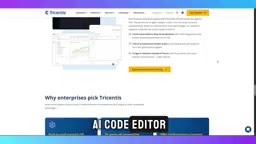
Quality Engineering differs from traditional "software testing" in that it moves quality assurance earlier from the testing phase at the end of development and threads it through the entire delivery pipeline, covering requirements traceability, automated testing, quality gates in continuous integration, and post-release monitoring feedback. Tricentis's product portfolio is built around this philosophy, emphasizing the reusability of test assets, integration with CI/CD toolchains, and audit traceability support for regulated industries (such as finance, healthcare, and automotive). Such platforms typically offer private deployment or dedicated cloud options, allowing enterprises to keep sensitive test data and source code within their own infrastructure — an important reason it gets considered in privacy-sensitive scenarios. Understanding this positioning makes it clear why it doesn't belong in the same competitive dimension as general-purpose AI code editors.
Cursor: An AI Code Editor for Everyday Development
Cursor is positioned as an AI-driven code editor that helps developers understand codebases, generate code, and make changes across multiple files. It's quite handy in everyday development, debugging, and refactoring scenarios, which is why it has a good reputation among developers.
However, privacy-sensitive teams can't just focus on editor features. One point the video repeatedly emphasizes: you must understand its current data retention policy, model provider arrangements, access control mechanisms, and enterprise-grade security options. Don't assume that "using an AI editor automatically keeps source code private" — that assumption itself is dangerous.
Data retention policies and model provider arrangements are two key dimensions for assessing the privacy risk of AI coding tools. Data retention policy defines how long the service provider stores your code, prompts, and interaction logs, in what form, and whether they're used for model training; most commercial AI editors offer zero-retention or short-retention options, but these usually require an enterprise edition or specific configuration to enable. Model provider arrangements involve which large model the request ultimately gets routed to (possibly OpenAI, Anthropic, or a self-hosted model), as well as that provider's own data processing terms. For regulated industries, you also need to confirm whether regionalized deployment is supported (e.g., data doesn't leave the country), whether a data processing agreement (DPA) can be signed, and whether compliance certifications such as SOC 2 and ISO 27001 are provided. These details often don't show up in feature comparison tables, yet they directly determine whether a tool can pass your organization's security review.
How Should Privacy-Sensitive Teams Choose?
The video's leaning is clear:
- Teams that prioritize enterprise testing, quality assurance, and controlled software delivery are better suited to Tricentis.
- Teams whose developers need AI-assisted coding can consider Cursor — provided its security and privacy controls meet your organization's compliance requirements.
The pre-selection checklist the video lays out is quite specific: bring your security team in; find out where data is processed; confirm whether prompts or code will be retained; understand what admins can control; and verify whether the available deployment options satisfy your compliance obligations. There's also one easily overlooked practical tip — run the tool against your real workflows, and don't make decisions based solely on a feature list.
Conclusion: Different Questions, Different Answers
The video author's final verdict is restrained: these two tools solve different problems. Tricentis is stronger in enterprise software quality and testing, while Cursor more directly serves AI-assisted coding. For privacy-sensitive teams, the winner isn't the one with more checkmarks on the feature table — it's the one that genuinely meets your security requirements without sacrificing necessary workflows.
In other words, define your core problem first, then decide on the tool.
One-line Summary
Tricentis and Cursor represent two paths — enterprise testing and AI coding — and privacy-sensitive teams should define their core problem before choosing.
Paragraph Summary
Based on roughly six months of evaluation, the article argues that Tricentis and Cursor are not competitors in the same dimension: the former is an enterprise testing and quality engineering platform, the latter an AI code editor for everyday development, and comparing feature lists is itself a flawed premise. For privacy-sensitive teams, selection can't be about efficiency alone — they must examine data retention policies, model provider arrangements, access controls, and enterprise security options, bring in the security team, and confirm data processing locations and deployment compliance. The article's leaning: choose Tricentis for enterprise testing and controlled delivery; consider Cursor if the team needs AI-assisted coding and its security controls measure up. The final verdict is that the two solve different problems, and the winner is the one that meets security requirements without sacrificing necessary workflows.
Related articles

RePlan-VLA: Progress-Aware Replanning Breakthrough for Long-Horizon Robotic Manipulation
The RePlan-VLA framework converts VLA models' short-horizon capabilities into reliable long-horizon execution through progress-aware adaptive replanning, improving success rates by 21.9% and 10.4% on RoboCasa365 and CALVIN, and validating real-world deployment on a Franka Research 3 robot.

Geometric Bridge Flow Matching: A New Breakthrough in Blind Rigid Motion Correction
Geometric bridge flow matching enables blind rigid motion correction in head CBCT, achieving 37.1 dB PSNR and 0.27 mm RPE on simulated data in ~9.1 minutes, outperforming existing methods.

Google Releases Gemini 4 Hydrogen: 2.5x Faster Without Sacrificing Intelligence
Google releases the lightweight Gemini 4 Hydrogen: 2.5x faster task completion, AA Intelligence Index of 54 beating its flagship sibling, 7.3s single-step on Agent Arena faster than Claude and GPT rivals, four thinking levels with pay-as-you-need pricing, now available across AI Studio and more.