Truck-Sized NASA Telescope to Fall to Earth After Orbit-Raising Attempt Fails

NASA's Swift telescope failed to raise its orbit nearly 22 years after launch and is about to reenter the atmosphere, drawing attention to space asset retirement management.
NASA's Swift gamma-ray burst observatory is about to reenter Earth's atmosphere nearly 22 years after launch, after attempts to push it back into a higher orbit failed. NASA expects reentry around 3:30 AM Eastern Time with an error window of plus or minus 11 hours, due to factors such as atmospheric density, spacecraft attitude, and solar activity. Swift is truck-sized, and some components may not completely burn up during reentry, but the probability of risk to the ground is extremely low. This event marks the end of a mission lasting more than two decades, highlights the lack of effective life-extension measures for aging spacecraft, and draws further attention to the retirement management of low-orbit space assets and space sustainability.
Orbit-Raising Failure: Swift Telescope Nears Reentry
According to an RSS source, nearly 22 years after launch, NASA's Swift observatory is expected to fall back to Earth on Wednesday. Previous efforts to push it into a higher orbit have failed. NASA announced that the aging space telescope is expected to reenter Earth's atmosphere around 3:30 AM Eastern Time, with an error window of approximately 11 hours.
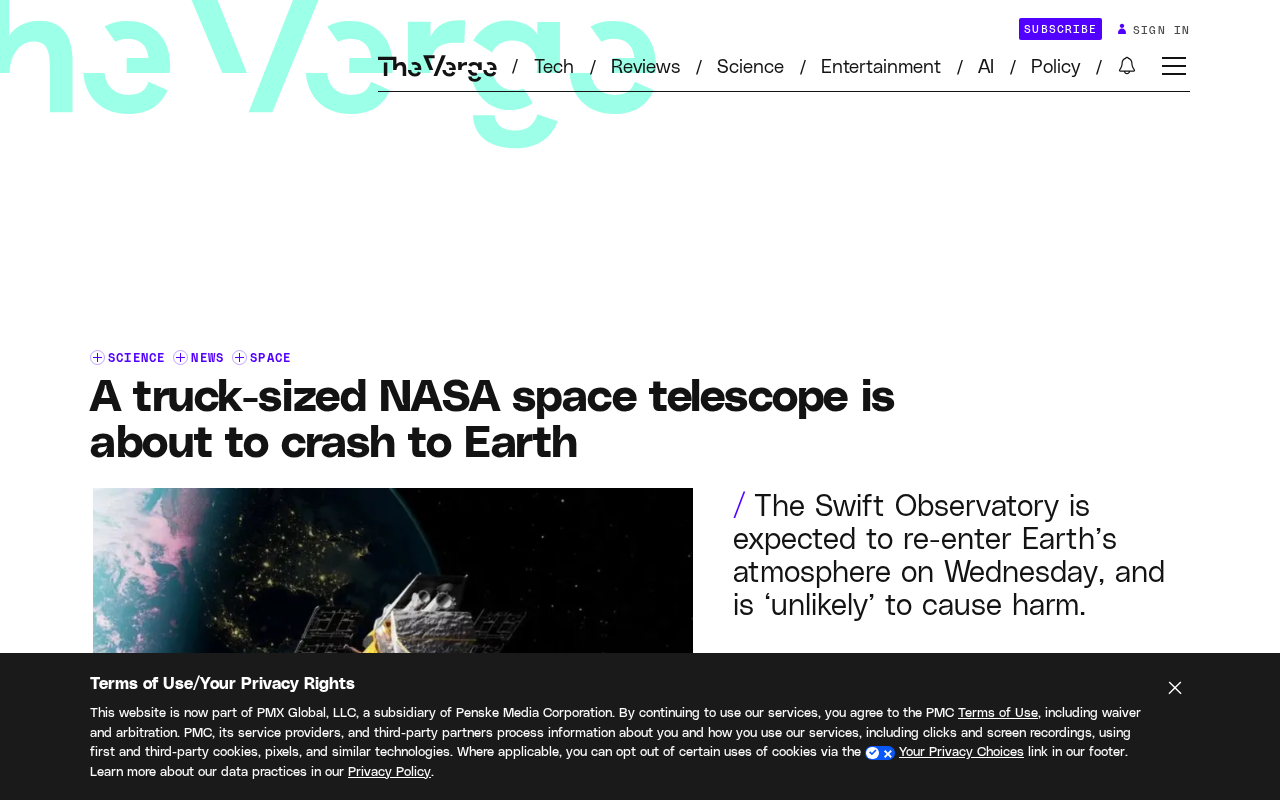
This news marks the approaching end of an astronomical observation mission spanning more than two decades. Since its launch, Swift has long been tasked with monitoring gamma-ray bursts and other transient phenomena. Its reentry is not only the finale of a spacecraft but also draws attention to the retirement management of low-Earth-orbit space assets.
The Swift Observatory is a multi-wavelength space observatory launched by NASA in 2004, officially named the Neil Gehrels Swift Observatory. Its primary science goal is to detect and rapidly localize gamma-ray bursts (GRBs), and to use its rapid slewing capability to conduct X-ray, ultraviolet, and optical afterglow observations within seconds to minutes of a burst. It carries three core instruments: the wide-field gamma-ray burst monitor BAT, the X-ray telescope XRT, and the ultraviolet/optical telescope UVOT. Swift's unique value lies in its "rapid response"—it can automatically adjust its attitude to point at a target within tens of seconds of detecting a gamma-ray burst. This capability made it a central platform in gamma-ray burst research in the early 21st century, greatly advancing the study of extreme astrophysical processes such as stellar collapse and neutron star mergers.
Reentry Time Window and Uncertainty
NASA gives the reentry time as approximately 3:30 AM Eastern Time, with a margin of plus or minus 11 hours. This uncertainty stems from the combined effects of atmospheric density, spacecraft attitude, solar activity, and other factors, and is common for a spacecraft that has lost orbital control capability.
As a detail, the truck-sized dimensions mean that some components of Swift may not completely burn up during reentry, potentially posing some risk to the ground, though the overall probability is extremely low.
Orbital decay and reentry: Low Earth orbit (LEO) spacecraft, even in an unpowered state, continuously lose orbital energy due to tenuous atmospheric drag, gradually lowering their orbital altitude until they finally reenter the atmosphere. The rate of orbital decay depends mainly on the spacecraft's area-to-mass ratio (the ratio of frontal area to mass) and the local atmospheric density at its altitude, and atmospheric density itself is strongly modulated by solar activity (especially atmospheric expansion caused by heating from solar ultraviolet and X-ray radiation). Therefore, reentry time prediction errors are typically several hours to more than ten hours; the closer to the reentry moment, the higher the prediction accuracy. For a spacecraft that has lost orbital and attitude control capability, it cannot change its reentry trajectory by adjusting attitude or firing engines, and can only passively wait for atmospheric drag to drag it into the denser atmosphere.
Failed Orbit-Raising Attempt
The report clearly states that previous attempts to push Swift back into a higher orbit were unsuccessful. This means the telescope can no longer maintain a stable long-term orbit and can only follow orbital decay until reentry. For a space telescope that has served for nearly 22 years, propellant depletion or system aging is often the direct cause of such an outcome.
This failure also highlights the real dilemma of the lack of effective life-extension measures for aging spacecraft at the end of their lives.
Propellant depletion and the "passive reentry" dilemma: Most LEO science satellites are designed with only enough propellant to maintain orbit and attitude control for a few years, far from sufficient to support more than two decades of life-extension needs. When propellant is exhausted, the spacecraft loses the ability to actively raise its orbit or perform controlled deorbit, and can only rely on residual atmospheric drag for natural decay. For a platform like Swift, with a mass of about 1.5 tons and the size of a truck, pushing it from a decaying orbit back to a stable orbit would require consuming a large amount of propellant and performing complex orbital maneuvers, and such operations are often difficult to carry out at the end of a mission due to system aging and fuel exhaustion. This reflects the reality of "no life-extension means" commonly faced by aging spacecraft at the end of their lives—neither fuel to raise orbit nor power for controlled deorbit, leaving only passive acceptance of reentry.
Implications for Space Sustainability
Swift's reentry is not an isolated event. As the number of spacecraft deployed in low Earth orbit continues to increase, the disposal of retired spacecraft is becoming an increasingly prominent issue. Technical solutions such as active deorbit, controlled reentry, and orbital tugs are being incorporated into design considerations for more missions.
Swift's case reminds the industry that the end-of-life disposal path should be considered at the very beginning of mission design, rather than passively accepting a reentry outcome only after an orbit-raising attempt fails.
Space sustainability and active deorbit: With the large-scale deployment of low-orbit constellations (such as Starlink, OneWeb, etc.), the number of LEO spacecraft has increased sharply, and the disposal of retired spacecraft has become a core issue in space traffic management. The Inter-Agency Space Debris Coordination Committee (IADC) and the United Nations Committee on the Peaceful Uses of Outer Space (COPUOS) have long advocated the "25-year rule"—requiring LEO spacecraft to deorbit within 25 years after the end of their mission. In recent years, stricter guidelines have tended to favor deorbit within 5 years. Implementation methods include: active deorbit using residual propellant, passive decay via atmospheric drag, accelerated decay using deployable drag sails, or capture and removal by orbital tugs (such as ESA's ClearSpace-1 mission). Swift's case shows that end-of-life disposal should be incorporated into system design at the early stage of mission design, rather than passively accepting reentry after an orbit-raising failure.
Conclusion
A space telescope that has worked for more than two decades is about to return to Earth's atmosphere. Its reentry is both a natural end to a mission and a real-world footnote to the issue of space traffic management. Information on the subsequent reentry trajectory and landing area still requires further updates from NASA.
One-line Summary
NASA's Swift telescope failed to raise its orbit nearly 22 years after launch and is about to reenter the atmosphere, drawing attention to the retirement management of space assets.
Paragraph Summary
NASA's Swift gamma-ray burst observatory is about to reenter Earth's atmosphere nearly 22 years after launch, after previous attempts to push it back into a higher orbit failed. NASA expects reentry around 3:30 AM Eastern Time, with an error window of plus or minus 11 hours, an uncertainty stemming from factors such as atmospheric density, spacecraft attitude, and solar activity. Swift is truck-sized, and some components may not completely burn up during reentry, but the probability of risk to the ground is extremely low. This event marks the end of an astronomical observation mission spanning more than two decades and also highlights the real dilemma of the lack of effective life-extension measures for aging spacecraft at the end of their lives, drawing further industry attention to the retirement management of low-orbit space assets and space sustainability.
Related articles
 Tech Frontiers
MuJoCo: An Analysis of DeepMind's Open-Source General-Purpose Physics Simulator
An in-depth analysis of Google DeepMind's open-source physics simulator MuJoCo: high-performance C++ kernel, MJCF modeling format, contact solving principles, MJX GPU acceleration, and robot reinforcement learning use cases.
 Tech Frontiers
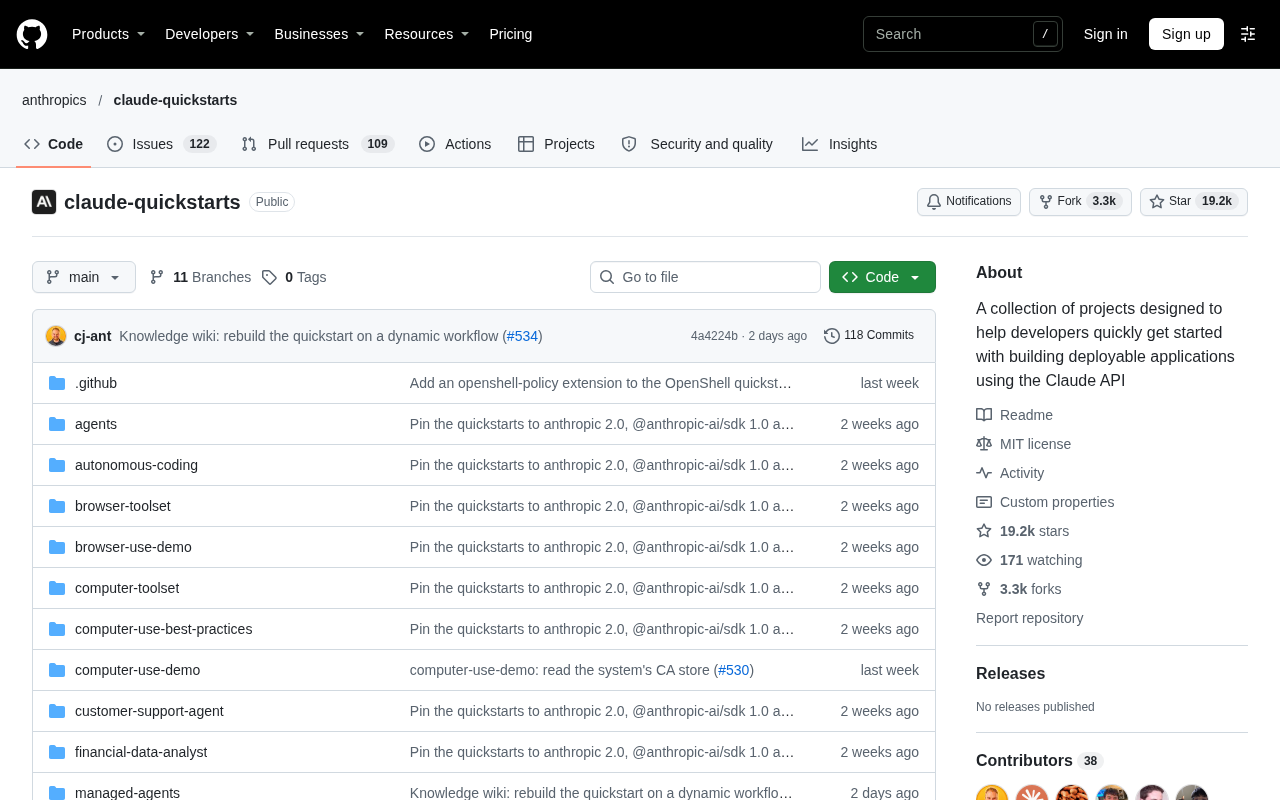
Claude API Quick Start: The Official Quickstarts Project Collection
Anthropic's official claude-quickstarts project collection helps developers quickly build deployable apps with the Claude API. Nearly 20k stars, Python-based, great for beginners and prototyping.
 Tech Frontiers
AI Agents Connecting Directly to APIs: Which Calls Can Be Safely Allowed?
AI agents can call any API, but the real challenge is deciding which calls can be safely allowed. This article analyzes allowance decisions from three dimensions—intent matching, least privilege, and controllable impact—and argues that the control layer should sit outside the agent, combined with audit traceability to build a trustworthy API call governance mechanism.