Trump Backs Jensen Huang's Return to Nvidia: No Evidence of Wrongdoing

Trump backs Jensen Huang's return to Nvidia while calling for the export control investigation to continue.
Trump publicly supported Jensen Huang's return to Nvidia, citing the Attorney General's opinion that no personal wrongdoing was found, but also urged Nvidia to continue advancing the export control investigation. This statement directly links corporate personnel changes with national security review and conveys a "separation of individual and company" regulatory logic: a finding of no wrongdoing for the individual does not equal a relaxation of regulation for the company. As a major global AI chip supplier, Nvidia faces dual pressure on compliance transparency and supply chain uncertainty, and AI companies relying on its chips may also be affected. The scope and conclusions of the investigation have not yet been disclosed.
Event Core: Presidential Endorsement and "No-Fault" Determination
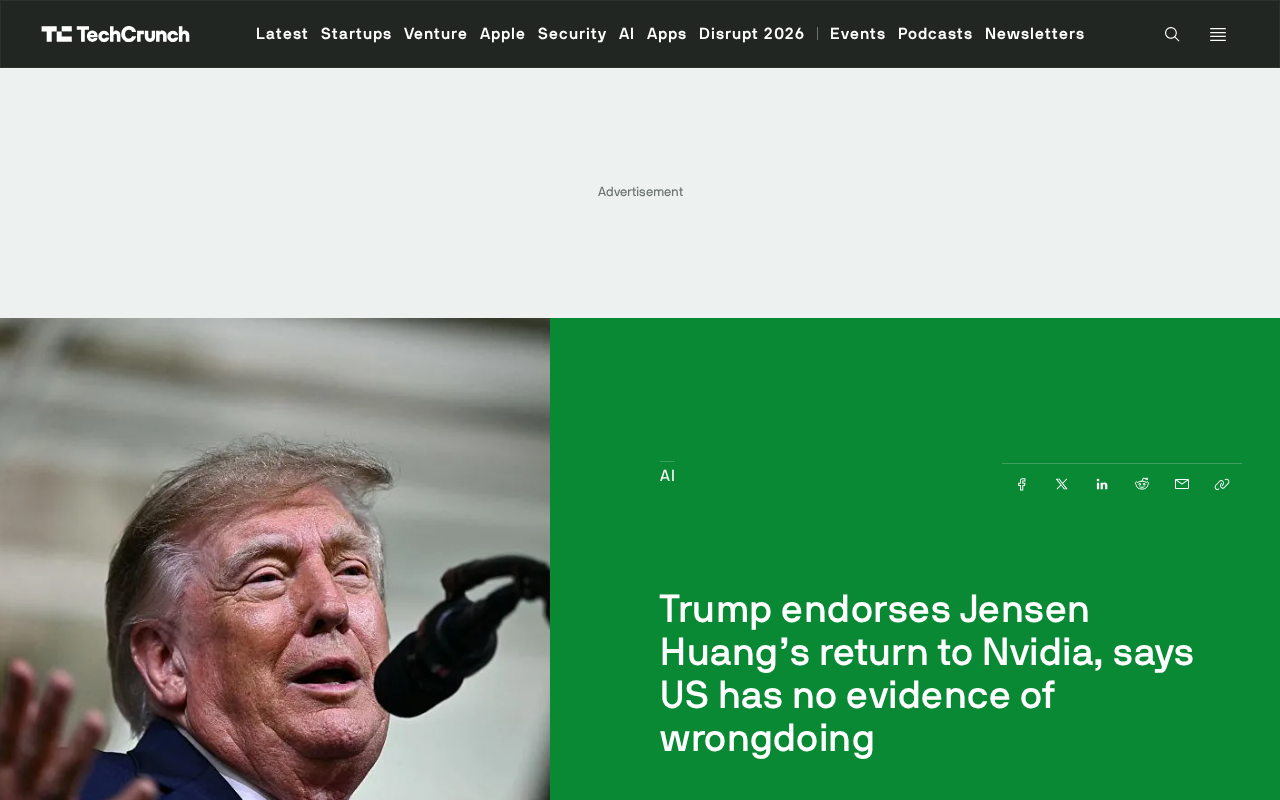
According to RSS sources, U.S. President Trump publicly supported Nvidia CEO Jensen Huang's return to the company, stating that the U.S. side has found no evidence of any wrongdoing by Huang. In his statement, Trump cited the opinion of the U.S. Attorney General to defend Huang's return, while urging Nvidia to continue advancing its export control-related investigation.
This statement directly links corporate personnel changes with national security review, and further makes explicit Nvidia's compliance pressure on export control issues.
Why the Export Control Investigation Has Become the Focus
Nvidia's export control issue is not an isolated incident. As a major global supplier of AI chips, its product flows are strictly constrained by U.S. export policy. By raising "Huang's return" and "continuing the investigation" together, Trump actually conveys two signals:
- A finding of no wrongdoing for the individual does not equal a relaxation of regulation for the company;
- The pace of the export control investigation will not be interrupted by personnel changes.
This "separation of individual and company" regulatory logic is uncommon among tech giants, and it also puts Nvidia's compliance team in a more complex position.
Export Control is a licensing and restriction system implemented by the United States through the Export Control Reform Act (ECRA) and the Export Administration Regulations (EAR) enforced by the Bureau of Industry and Security (BIS) of the Department of Commerce for sensitive technologies. Its core mechanism is the "presumption of denial" principle: exports of controlled items (such as high-performance GPUs and AI accelerator chips) to specific countries or entities require prior license application, and export without a license is a violation. Nvidia's A100/H100 and other chips were placed on the control list due to computing power thresholds, and exports to China require case-by-case review; the subsequently launched H800/A800 and other "downgraded versions" were also designed to fit the control thresholds. Violating the EAR may trigger civil penalties, criminal prosecution, and even supply chain cutoffs. Therefore, the "export control investigation" is not an ordinary compliance review, but directly relates to whether Nvidia can maintain sales channels in one of its largest overseas markets, and is also a core tool for the United States to intervene in the semiconductor industry under the name of national security.
The "separation of individual and company" regulatory logic deserves separate explanation: in U.S. regulatory practice, criminal or administrative accountability for individual executives and compliance investigations of corporate entities are usually two independent tracks. A finding that an individual has "no wrongdoing" only means that individual liability is not pursued; it does not exempt the company from civil or administrative liability for systemic violations. This distinction is reflected in both the Foreign Corrupt Practices Act (FCPA) and export control enforcement—the Department of Justice may drop charges against an individual, while BIS may still impose huge fines on the company or attach compliance monitors. For Nvidia, this means that Huang's return and presidential endorsement cannot replace corporate-level compliance remediation, and the compliance team still needs to independently respond to BIS investigation procedures.
Impact on the AI Chip Industry
From an industry perspective, this event signals continued regulatory attention to AI chip exports. If Nvidia wants to maintain its business rhythm during the investigation, it needs to invest more resources in compliance transparency. For AI companies that rely on Nvidia chips, supply chain uncertainty may rise further.
Currently, publicly available information only involves the presidential statement and the investigation requirement; the specific scope and conclusions of the investigation have not yet been disclosed, and subsequent developments deserve continued attention.
Supply chain uncertainty has an amplifying effect in the AI chip field: Nvidia GPUs are key computing resources for training large models, and cloud providers and AI startups usually lock in production capacity months in advance. Once an export control investigation leads to delays in license approvals or bans on certain models, downstream companies will face higher computing costs, longer delivery cycles, and may even be forced to turn to domestic替代 chips or the second-hand market. This "single-point dependence" quickly transmits Nvidia's compliance risk into risk across the entire AI industry chain, and is also one of the reasons the industry is closely watching this event.
One-line Summary
Trump supports Jensen Huang's return to Nvidia while requiring the export control investigation to continue.
Paragraph Summary
Trump publicly supported Jensen Huang's return to Nvidia, citing the Attorney General's opinion that no personal wrongdoing was found, but at the same time urged Nvidia to continue advancing the export control investigation. This statement directly links corporate personnel changes with national security review and conveys a "separation of individual and company" regulatory logic: a finding of no wrongdoing for the individual does not equal a relaxation of regulation for the company. As a major global supplier of AI chips, Nvidia faces dual pressure on compliance transparency and supply chain uncertainty, and AI companies relying on its chips may also be affected. The scope and conclusions of the investigation have not yet been disclosed.
Related articles

From 0 to 1: Vibe Coding an AI Knowledge Base — A Practical Retrospective and Tech Stack Breakdown
A retrospective on building the AI knowledge base OilBook from scratch with Vibe Coding: Next.js+Neon stack, Oil Dev Skill workflow, Stripe paywall security, interview-style writing, AI-flavor control, and Vercel deployment.

GLM-5.4 Hands-On: Native Vision Meets a New Vibe Coding Workflow
Hands-on with Zhipu GLM-5.4: native vision tested across a 3D product demo, pure-code video generation, and remote-control Vibe Coding, compared with GPT-6.2 and Gemini Neon.

AI and Humans Claim to Prove the Riemann Hypothesis: Machine-Verified, Yet Nobody Can Understand It
Anthropic mathematician and AI Claude claim to prove the Riemann Hypothesis with 17 million lines of Lean code, machine-verified but unreadable by humans. This article analyzes the event, the zero proportion record from 41.6% to 67.2%, and the gap between machine verification and human understanding.