Trump Halts Televised Execution: The Story Behind a Controversial Decision

Trump halts Hasan execution livestream, overturning the defense secretary's statement and highlighting the political and ethical complexity of the death penalty.
Trump announced on Truth Social the cancellation of the livestream of Fort Hood shooter Nidal Hasan's execution, overturning Defense Secretary Hegseth's earlier high-profile statement. Hasan's 2009 shooting killed 13 and wounded over 30, and his case has been tied up in appeals for years. Livestreaming an execution faces multiple legal and ethical obstacles in the U.S., victims' families largely oppose it, and conservatives are divided. The reversal shows the White House's sensitivity to public opinion and possible coordination issues between the Pentagon and the White House. The death penalty issue is highly politicized in the U.S. and remains a convergence point of politics, media, and public sentiment.
From High-Profile Announcement to Emergency Halt
U.S. President Donald Trump announced on Truth Social that he was canceling plans to livestream the execution of Nidal Hasan, the perpetrator of the Fort Hood shooting. This decision overturned a high-profile statement previously made by Defense Secretary Pete Hegseth.
Not long before, Hegseth had publicly stated that Hasan's execution would be livestreamed online, claiming that "letting the whole world see it" would have a powerful deterrent effect. However, in his latest post, Trump changed his tone, saying that after careful consideration, he had decided not to proceed with the livestream.
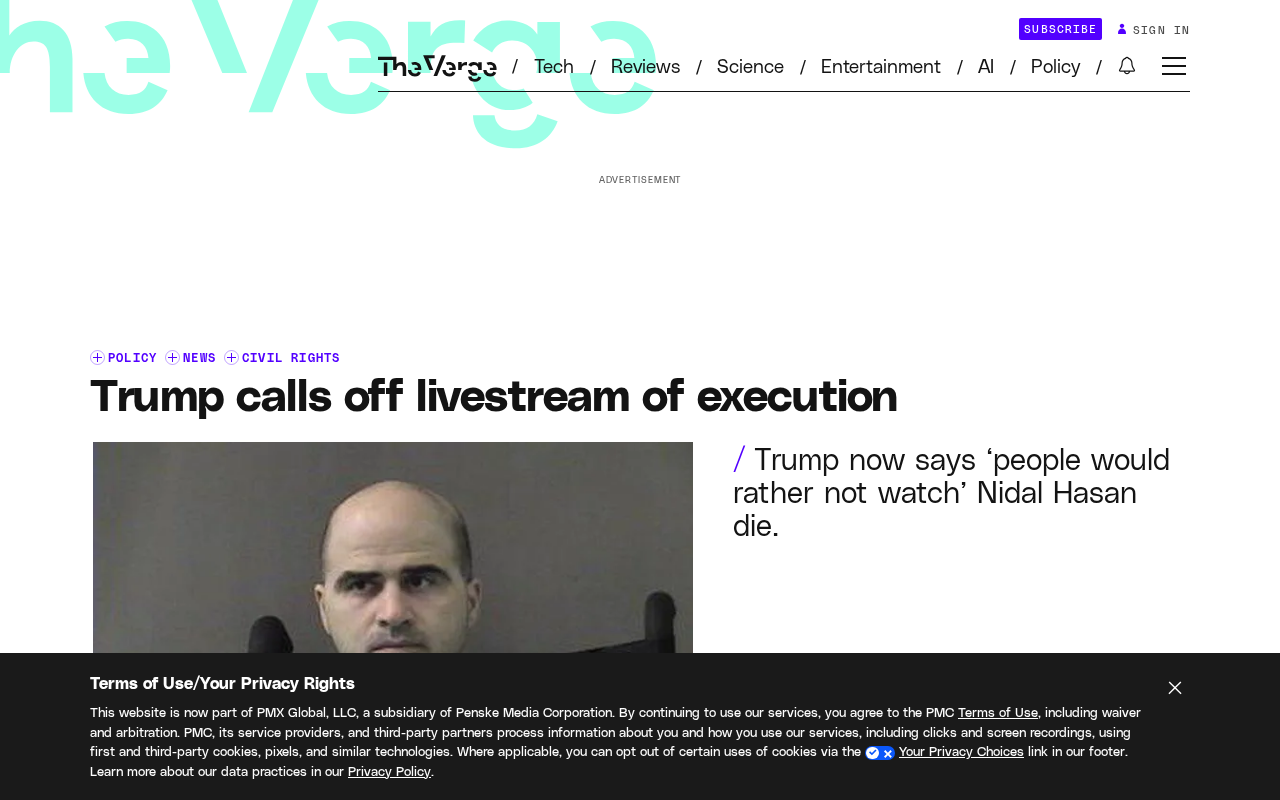
The reversal came suddenly. From announcement to halt, the entire process spanned only a few days, yet it had already sparked widespread discussion about transparency in executions, media ethics, and political motives.
Why the Hasan Case Draws So Much Attention
Nidal Hasan was a U.S. Army psychiatrist who opened fire at the Fort Hood military base in Texas in 2009, killing 13 people and wounding more than 30 others. It was one of the worst internal attacks in the history of U.S. military bases.
Hasan was sentenced to death by a military court, but the case subsequently became mired in years of appeals and legal proceedings. His execution itself carries enormous symbolic significance—it is both an extension of counterterrorism issues and touches on sensitive topics involving internal military security and extremist infiltration.
Because of this, any change in how the execution is carried out would be subject to heightened scrutiny. The idea of livestreaming an execution is extremely rare in the United States and around the world.
Key Background on the Nidal Hasan Case
On November 5, 2009, Hasan opened fire at the Soldier Readiness Center at Fort Hood, killing 13 people and wounding 32 others. Before the attack, he had exchanged emails with Anwar al-Awlaki, a Yemeni-American radical cleric who was subsequently designated a terrorist by the United States and killed in a drone strike. What makes this case particularly unusual is that Hasan himself was a military psychiatrist responsible for providing psychological counseling to soldiers before and after deployment, which placed enormous pressure on the military regarding internal security screening and extremism prevention.
In 2013, a military court convicted Hasan of 13 counts of premeditated murder and 32 counts of attempted murder, and sentenced him to death. The case then entered automatic appeal proceedings, which have now lasted more than a decade. Death penalty cases in the U.S. military justice system have extremely long appeal cycles, and the military has not carried out an execution since 1961. The Hasan case has therefore become a rare sample for observing how the U.S. military death penalty system actually operates.
Legal and Ethical Controversies Over Livestreaming an Execution
The livestream plan initially proposed by Trump and Hegseth faced multiple obstacles within the United States.
On the legal front, U.S. federal law and the military justice system have strict confidentiality rules regarding the execution process. Victims' families also tend to oppose public executions.
On the ethical front, livestreaming an execution could invite criticism of "state violence as spectacle" and could even be used against the movement to abolish the death penalty. Supporters argue that public executions can enhance transparency and prevent backroom dealings.
Trump mentioned on Truth Social that "letting the world see" Hasan's fate might have a deterrent effect. But he also acknowledged that doing so could bring unnecessary complications.
Transparency Rules for U.S. Executions
Federal executions in the United States are carried out under the Federal Death Penalty Protocol, which provides that the execution process should take place within a designated prison and be witnessed only by a small number of individuals, including representatives of victims' families, media journalists, and officials. Federal law explicitly prohibits filming or recording the execution process, and although state regulations vary, none allow television broadcasts. The military justice system is even more closed, with executions typically carried out in military prisons and not open to the public.
The attitude of victims' families often has a key influence in such cases. Among the survivors and families of the Fort Hood shooting, many worried that a public livestream would cause renewed psychological trauma and give the perpetrator public attention he does not deserve. Historically, the last public execution in the United States took place in 1936, after which the media and the public gradually accepted the principle that executions should be carried out in a closed setting.
Political Calculations and Public Reaction
From a political perspective, the death penalty issue has long been highly polarized in the United States. During both his campaigns and his presidency, Trump repeatedly emphasized "law and order" and supported expanding the scope of the death penalty. Hegseth's statement was seen as an echo of that position.
However, the proposal to livestream an execution did not necessarily enjoy unanimous support even among conservatives. Some Republicans worried that it could be portrayed by opponents as a "barbaric spectacle" and damage America's international image.
At the same time, left-wing and civil rights organizations strongly condemned the plan, arguing that it turned state punishment into an entertainment spectacle and trampled on the dignity of the rule of law.
Trump's eventual decision to halt the livestream may well have been a choice made after weighing these pros and cons.
What the Reversal Signals
This reversal conveys at least two messages.
First, the Trump administration remains highly attuned to public opinion even on extremely sensitive judicial execution issues. Although livestreaming an execution might appeal to some hardline voters, once it spins out of control, the cost could far exceed the benefit.
Second, the fact that the defense secretary's public statement was overturned by the president shows that the White House and the Pentagon are not monolithic on major decisions. This kind of public policy swing may also be interpreted by outsiders as a sign that internal coordination is not smooth enough.
For those who follow the interaction between U.S. judiciary and politics, the latest developments in the Hasan case remind us that the death penalty is never just a legal issue—it has always been a point of intersection for politics, media, and public emotion.
One-line Summary
Trump halts the planned livestream of Hasan's execution, overturning the defense secretary's statement and highlighting the political and ethical complexity of the death penalty issue.
Paragraph Summary
Trump announced on Truth Social that he was canceling the livestream of the execution of Fort Hood shooter Nidal Hasan, overturning Defense Secretary Hegseth's earlier high-profile statement. Hasan's 2009 shooting killed 13 people and wounded more than 30, and after being sentenced to death, his case became mired in years of appeals. Livestreaming an execution faces multiple legal and ethical obstacles in the United States, victims' families largely oppose it, and conservatives themselves are divided. The reversal shows the White House's sensitivity to public reaction and possible coordination problems between the Defense Department and the White House. The death penalty issue is highly politicized in the United States and has always been a point of intersection for politics, media, and public emotion.
Related articles

Chain of Thought Isn't Just for AI: How Humans Can Use CoT to Improve Thinking Quality
Chain of Thought isn't just a prompt trick for large models. Starting from a Hacker News discussion, this article analyzes why CoT works for human thinking too, breaks down actionable ways to transfer it, and highlights the key differences between human CoT and machine CoT.
Cloudflare Teams Up with OpenAI: Closi…
Cloudflare Teams Up with OpenAI: Closing the Loop from Vulnerability Discovery to Defense with AI
Cloudflare uses OpenAI Daybreak to investigate security vulnerabilities and generate reviewable remediation plans, while developers use Codex to boost coding efficiency and quality.

Orca Multi-Agent Orchestration in Practice: A Guide to Parallel Collaboration with Claude and Codex
Orca is Stable AI's free open-source agent workbench supporting 34 agents like Claude Code and Codex in parallel. Learn its Git worktree isolation, multi-model orchestration, and mobile management.