Trump on Jensen Huang's Departure: Returning to Nvidia 'Certainly Isn't a Bad Idea'
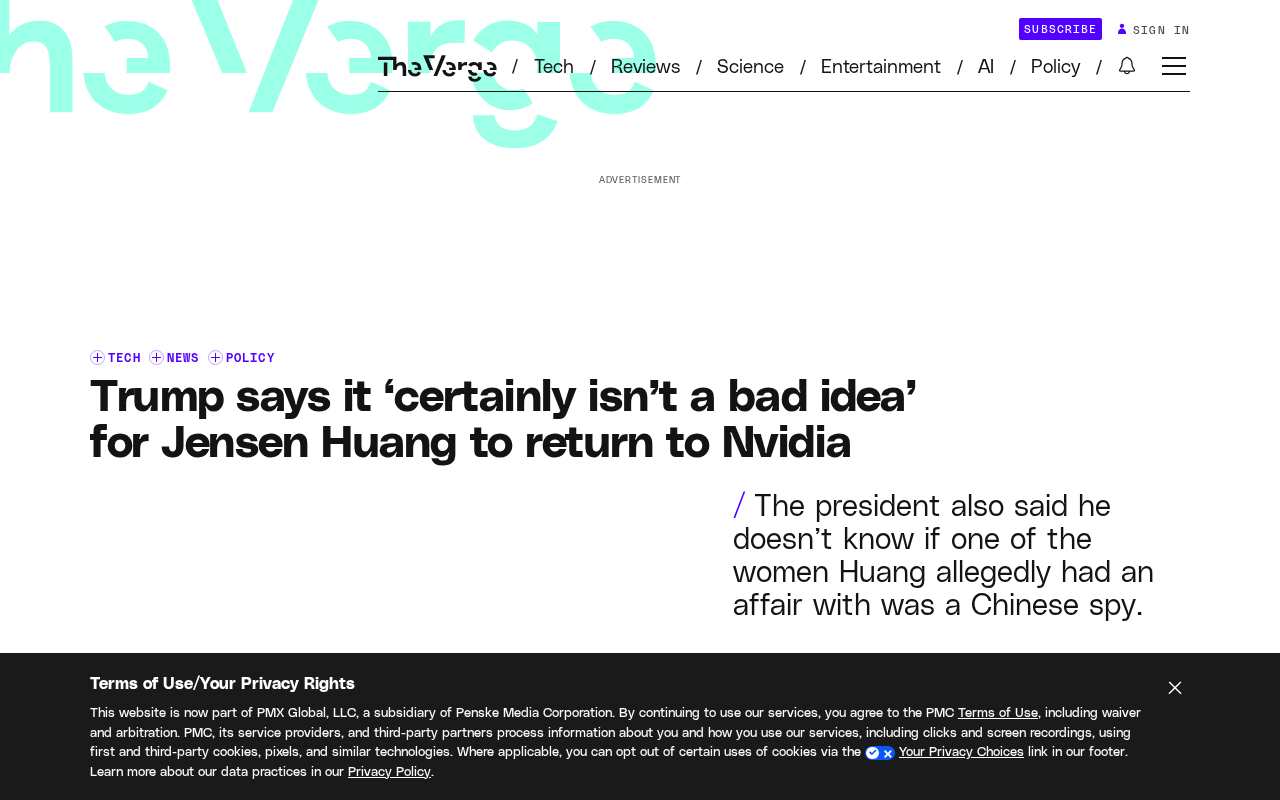
Jensen Huang's resignation rumor prompts Trump's remarks and shakes the AI chip industry, but the information comes from a single RSS source.
A single RSS source reports that Nvidia CEO Jensen Huang resigned last week amid rumors of an affair with a woman who may be a spy. Trump said Monday that Huang's return to Nvidia "certainly isn't a bad idea" and that he was unsure whether the woman was a spy. The article analyzes the potential impact on Nvidia and the AI chip landscape, noting that Huang's leadership is deeply tied to the company's market dominance and that the event reflects the geopolitical sensitivity of tech leaders. It stresses that all information lacks multi-source verification.
Background: Jensen Huang's Resignation Sparks Shockwaves
According to an RSS source report, Nvidia CEO Jensen Huang resigned last week, a development that quickly set off a chain reaction across the tech and political worlds. As the iconic figure in the global AI chip industry, Huang's departure is not just about the fate of one company—it has implications for the entire semiconductor and artificial intelligence industry.
The report stated that Huang was allegedly involved in an affair with a woman, and whether that woman is actually a spy has become one of the focal points of public discussion. Although the details have not been made public, the rumor has already added a geopolitical dimension to the story.
The tight bond between Huang and Nvidia is key background for understanding the impact of this event. Huang co-founded Nvidia in 1993 and has long served as president and CEO, making him one of the longest-tenured founder-CEOs in Silicon Valley. Under his leadership, Nvidia transformed from a graphics chip maker into the undisputed leader in AI computing, with its GPU products (such as the A100 and H100 series) becoming the core hardware for training AI workloads like large language models. Huang is known for his signature leather jacket and his public influence as a kind of "godfather of AI," and his personal brand is closely tied to the company's market value. As a result, his sudden resignation amounts to more than just a management change for investors—it means significant uncertainty about strategic continuity and market confidence.
Trump's Remarks: Returning "Certainly Isn't a Bad Idea"
On Monday, Trump told reporters that he would welcome Huang's return to Nvidia, saying, "Let Jensen Huang go back—a lot of people are asking about Jensen Huang, they think..." Trump also added that he was not sure whether the woman who had an affair with Huang was really a spy.
This statement comes from a single report by an RSS source and has not yet been cross-verified by other independent channels. Trump's wording appeared open yet cautious—he neither explicitly supported nor ruled out Huang's return, but the phrase "certainly isn't a bad idea" hints at some degree of approval.
Industry Impact: The Variable Fate of Nvidia and the AI Chip Landscape
Huang's resignation and possible return come at a time when global AI chip competition is white-hot. Nvidia's dominance in the GPU market is deeply intertwined with Huang's personal leadership, and his departure or return directly affects investor confidence and the company's strategic continuity.
From an industry analysis perspective, if Huang returns, it could stabilize market expectations; if he remains absent, Nvidia's long-term roadmap and customer relationships may face adjustments. There is currently no further information from Nvidia officially or from other authoritative channels, and the direction of events remains uncertain.
Nvidia's position in the AI chip market deserves further explanation. According to data from industry research firms, Nvidia's share of the global data center GPU market has long remained above 80%, and its CUDA software ecosystem constitutes an extremely high migration barrier, making it difficult for customers to easily switch to AMD, Intel, or in-house chips. This dual moat of "hardware plus software" is closely tied to Huang's personal leadership style—he drove the company's strategic pivot from gaming graphics cards to AI computing and personally pushed for cooperation with TSMC on advanced process technology. If leadership changes, the market's focus will include whether the next-generation GPU roadmap (such as successors to the Blackwell architecture) will be delayed, whether major customers (Microsoft, Google, Meta, etc.) will adjust their procurement strategies, and whether competitors can seize the opportunity to grab share. These variables give Huang's departure or return industry spillover effects beyond any single company.
The Intertwining of Politics and Business
Trump's intervention pushes the event beyond the commercial sphere. Although the spy rumor has not been confirmed, it reflects the sensitivity of tech leaders in a complex geopolitical environment. As a Chinese American CEO, Huang's personal conduct is being placed under a political magnifying glass—this is not an isolated case in the U.S. tech world.
It should be noted that the above analysis is based on limited information from a single RSS source. The specific reasons for Huang's resignation, the truth of the spy rumor, and the full context of Trump's remarks all require corroboration from more independent sources. Readers should treat the claims currently circulating with caution.
The geopolitical sensitivity of Chinese American tech leaders has its institutional background. In recent years, the U.S. government has continued to tighten export controls on semiconductor technology, and Nvidia has repeatedly been at the center of policy disputes due to its sales of AI chips to the Chinese market. At the same time, the U.S. Congress and intelligence agencies have become stricter in scrutinizing tech figures with commercial or ethnic ties to China. Although rumors involving "spy" allegations often lack public evidence, they are enough to damage personal reputations and company stock prices. As a Chinese American CEO, Huang's personal conduct being interpreted politically is not an isolated phenomenon—several Chinese American scientists and entrepreneurs have faced similar scrutiny before. This background helps explain why an unverified romantic rumor quickly became linked to national security topics.
One-line Summary
Rumors of Jensen Huang's resignation trigger Trump's remarks and shockwaves in the AI chip industry, but the information comes from only a single RSS source.
Paragraph Summary
Based on a single RSS source, the article reports that Nvidia CEO Jensen Huang resigned last week and was rumored to have had an affair with a woman who may be a spy. Trump commented on Monday that having Huang return to Nvidia "certainly isn't a bad idea," and said he was not sure whether the woman was a spy. The article analyzes the potential impact on Nvidia and the AI chip landscape: Huang's personal leadership is deeply tied to the company's market dominance, and his departure or return affects investor confidence and strategic continuity. It also notes that the event has gone beyond the commercial sphere, reflecting the sensitivity of tech leaders in a geopolitical environment. The article concludes by emphasizing that all information lacks multi-source cross-verification and that readers should treat it with caution.
Related articles
AI Agents Invent Mysterious Language Humans Can No Longer Understand
AI agents invent secret language with mysterious codes like o3 t12 in trading scenarios, baffling humans. Video reveals emergent communication phenomenon, raising questions about AI transparency and regulation.

Google Play's New Permission Policies: Local Network, Contact Management, and the AppFunctions API
Google Play updates permission policies: local network access requires a Play Console declaration, occasional contact management must use system Intents, and the new AppFunctions API sets data protection and endpoint security requirements for AI agent experiences.

Check Point Teams Up with OpenAI Daybreak: Vulnerability Research Compressed from Hours to Minutes
Check Point uses OpenAI's Daybreak model to compress vulnerability research from hours to minutes and jointly develops autonomous cybersecurity with OpenAI, covering process automation, intent-driven architecture, and industry implications of tool democratization.