Trump's 'Super Intelligence' Executive Order Unexpectedly Sparks Rush on Slovenia's .si Domain

Trump's 'super intelligence' order unexpectedly sparked a domain rush on Slovenia's .si, revealing AI-driven market speculation.
After President Trump signed an executive order on "super intelligence," Slovenia's .si ccTLD saw a rare spike in registration demand. Driven by domain hacking logic — where .si enables creative combinations like "supersi" or "intelligensi" — the trend attracted both entrepreneurs and speculators, echoing how .io was adopted by tech startups and .ai was embraced by the AI industry. Slovenia could earn significant registration revenue, much like Anguilla's windfall from .ai. This niche story reveals how top-level policy signals ripple unexpectedly through domain markets, showing AI concepts have crossed from technical discourse into commercial speculation.
A Domain Registration Frenzy Triggered by One Executive Order
Slovenia's country-code top-level domain .si has seen an unprecedented surge in registration demand. The cause is surprisingly unexpected — not driven by Slovenian businesses or local internet service providers, but by a U.S. presidential executive order signed by Donald Trump concerning "super intelligence."
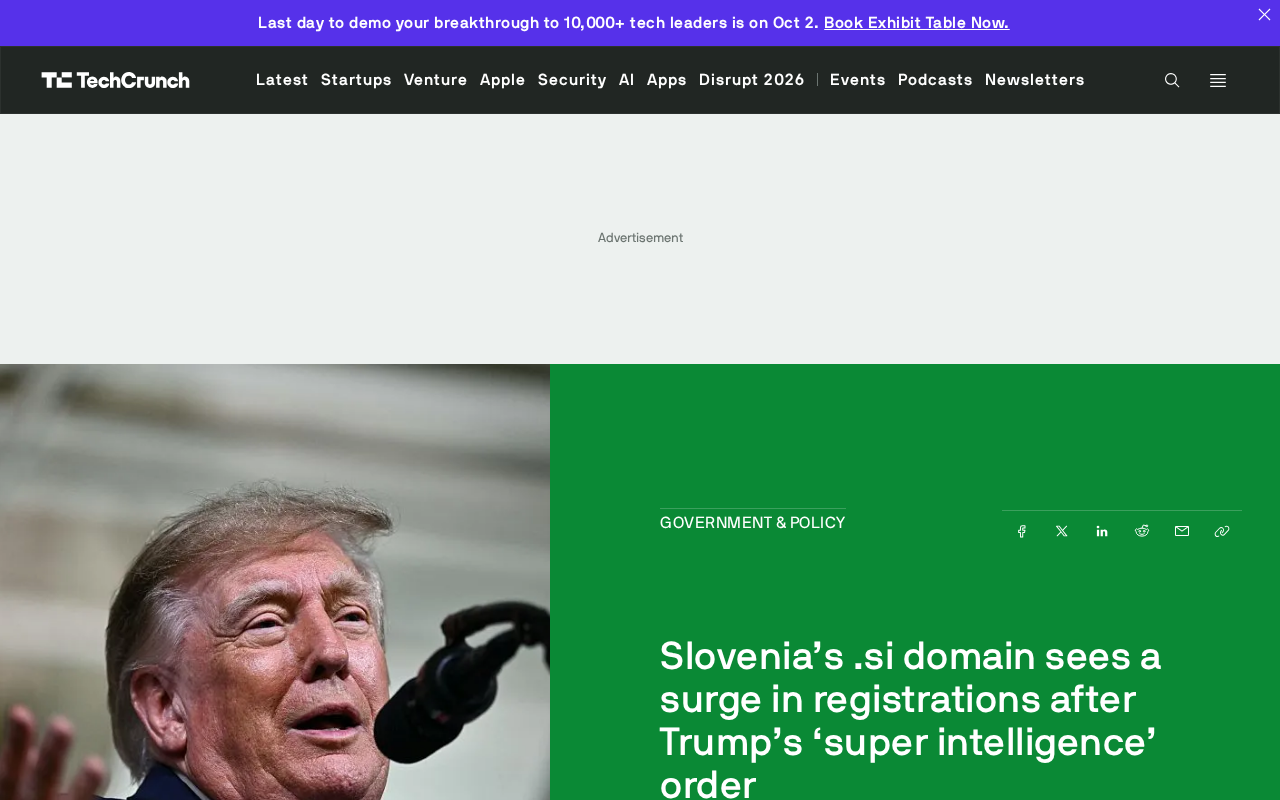
This phenomenon reflects a fascinating logic embedded in internet culture: when a tech concept captures the public spotlight, domain names associated with it tend to get snapped up quickly. As Slovenia's country-code top-level domain (ccTLD), ".si" can be creatively combined with English words to form constructs like "supersi" or "intelligensi" — or serve as a phonetic stand-in for the acronym "Super Intelligence." That's made it an unexpected hot commodity among domain speculators and brand builders riding the AI wave.
The Resurgence of Domain Hacking
Using country-code top-level domains to spell out complete English words or phrases is a long-standing internet practice known as "domain hacking." Classic examples include .io (British Indian Ocean Territory, widely adopted by tech startups as shorthand for "input/output") and .ai (Anguilla, embraced by the entire AI industry). The rise of .si follows the same logic.
When "super intelligence" entered mainstream discourse via the executive order, sharp-eyed registrants quickly recognized the potential value of .si domains in related naming contexts and rushed to register them. This kind of demand surge tends to be speculative in nature — registrants may be entrepreneurs looking to reserve brand identities for future AI projects, or domain investors hoping to buy low and sell high.
Domain Hacking is a creative naming technique that incorporates a top-level domain suffix into the spelling of a word, making the entire domain read as a complete word or phrase. Early classic examples include del.icio.us (leveraging the .us suffix) and last.fm (using the Federated States of Micronesia's .fm domain). This naming approach gained popularity during the Web 2.0 era alongside the demand for short domains, and saw renewed interest in the mobile internet age as brands sought greater recognition. The market value of domain hacks is far from static — it depends heavily on public awareness and association with specific words. .io became the default choice for tech startups partly because "I/O" (Input/Output) is deeply embedded in programmer culture; .ai's explosion in popularity was driven entirely by the AI industry's narrative momentum. It's worth noting that using another country's ccTLD for commercial purposes carries certain legal risks: registration policies are set by each country independently, and managing authorities can change the rules at any time — meaning brand assets built on a foreign ccTLD lack stable international legal protection.
How a Small Nation Can Ride the AI Dividend
For a small country like Slovenia, an unexpected surge in demand for its national domain could generate substantial registration revenue. Anguilla's experience of earning licensing fees from the .ai domain — far exceeding the scale of its own national economy during the AI boom — sets a precedent that Slovenia's domain authority may now find itself replicating with a windfall of its own.
However, this kind of dividend typically comes with uncertainty. Domain crazes depend largely on whether the underlying concept maintains its momentum. If "super intelligence" turns out to be only a short-term policy talking point, demand for related registrations may quickly fade. Conversely, if super intelligence becomes a sustained industrial and policy theme, the value of .si domains could find more durable support.
Anguilla is a British Overseas Territory in the Caribbean with a population of only around 18,000 and a very limited GDP. Yet since 2023, its country-code top-level domain .ai is estimated to have generated tens of millions of dollars in annual revenue — a significant contribution to the island's public finances. The Anguillian government maintains a relatively open registration policy for .ai domains, allowing global users to register them at annual fees of roughly $50–$100 per domain, effectively creating a unique "digital resource export" model. This case has sparked widespread industry discussion about the monetization potential of small-nation ccTLDs — Tuvalu's .tv and Montserrat's .ms have similarly gained commercial value on the same logic. Slovenia's .si domain is managed by ARNES (the Academic and Research Network of Slovenia). Whether its registration policies and pricing strategy can fully capitalize on the business opportunity created by this sudden demand surge remains to be seen.
The Chain Reaction Between Policy Signals and Market Response
What appears to be a niche news story actually reveals how policy signals can trigger chain reactions throughout the digital economy. A top-level executive order doesn't just affect regulatory frameworks and industrial investment direction — it ripples in unexpected ways through the domain market, brand naming, and the allocation of internet infrastructure resources.
For observers following the AI industry, the .si registration rush is a telling gauge of market sentiment. It demonstrates that the concept of "super intelligence" has already permeated beyond technical discourse into commercial speculation — and that the market is betting real money on the future value of this narrative.
Conclusion
Given the limited public information currently available, the specific scale, duration, and key players behind this .si registration wave have yet to be fully disclosed. But it once again confirms a familiar pattern: in the AI era, even national domain suffixes can become contested targets for capital and attention.
Related articles

Workbuddy for Absolute Beginners: How a Desktop AI Agent Fits Into Real Workflows
A beginner's guide to the Workbuddy desktop AI agent: installation, claiming credits, file management, and building automated workflows—compared with CodeX for fit and cost, helping professionals shift from AI question-askers to AI managers.

OpenAI's New Agent Stack: Computer Use, Decisions API, and Ultra-Fast Workflows
OpenAI Dev Day unveiled a new agent stack: Computer Use outperforms humans, Decisions API delivers ultra-low-latency classification via Luna, Agents API opens the same Computer Use capabilities, and GPT-6.1 Sol costs only one-seventh of Astra. Core updates, benchmark data, and developer insights.

Liang Wenfeng Open-Sources DeepInfo Inference Framework, Takes On U.S. Ban
DeepSeek open-sources its DeepInfo inference framework after its models, featuring GPU/CPU cross-pipelining, small-model prediction with large-model verification, and full Huawei Ascend and NVIDIA chip support—facing the U.S. federal ban head-on. This article analyzes its significance for AI deployment and open-source strategy.