Trump Sets $25M Whistleblower Bounty, Right-Wing YouTuber Gets $10K

Trump administration rewards conservative YouTuber and sets $25M whistleblower bounty, sparking debate over political motives and verification.
The Trump administration announced a $10,000 award to conservative YouTuber Nick Shirley and launched a $25 million fraud whistleblower bounty program, announced jointly by Vice President JD Vance. The trigger was Shirley's December 2025 viral video alleging fraud at Minnesota daycare centers. The article examines the bounty mechanism, controversy, and impact on the content creator ecosystem: critics question the program's selectivity, as the accused parties are of a specific ethnic background; the public reporting plus cash incentive model carries risks of false reports and malicious competition; the event may incentivize more creators to shift toward leak-style content production, undermining verification mechanisms. The program's implementing agency, legal basis, and duration remain unclear.
The Core: From Viral Video to Federal Bounty
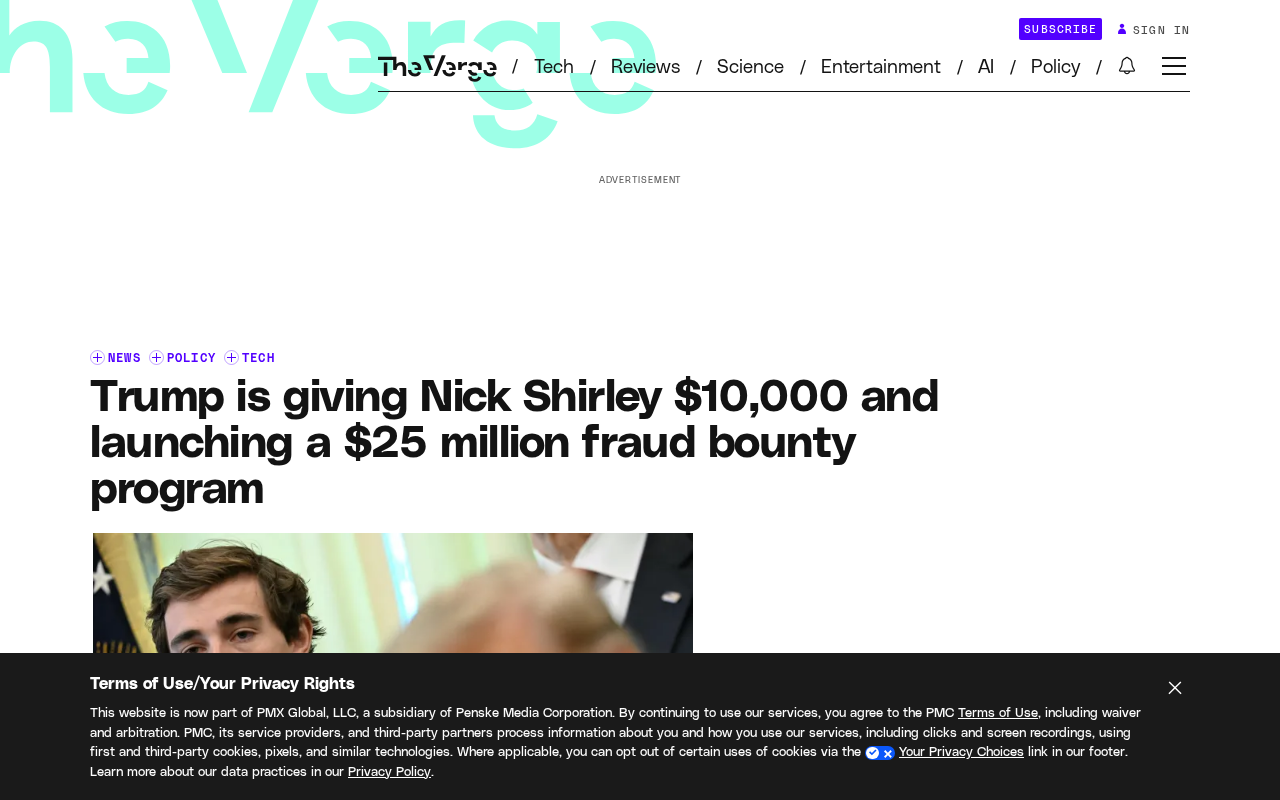
The Trump administration recently announced a high-profile move: awarding $10,000 to conservative YouTuber Nick Shirley and launching a $25 million fraud whistleblower bounty program. According to the original report, Vice President JD Vance announced the news alongside Trump.
The immediate trigger was a viral video Shirley published in December 2025. The video alleged fraud at daycare centers in Minnesota operated by a particular group. It spread rapidly through right-wing social media circles and eventually entered the federal policy spotlight.
From a dissemination standpoint, this is a textbook "influencer content → public sentiment → policy response" loop. But it's worth asking: is a single video that hasn't been independently verified enough to justify a federal-level bounty program?
How the Bounty Works: Distributing $25 Million
Based on available information, the $25 million pool is open to the public to encourage fraud reporting. Specific allocation rules, reporting thresholds, and verification procedures have not been detailed in the original material.
This "public reporting + cash incentive" model is not new. The IRS Whistleblower Program has operated for years, offering a percentage of recovered tax revenue as a reward. But applying similar logic to the broader category of "fraud," with direct leadership from the executive branch, raises questions about boundaries and abuse risks.
The $10,000 Shirley received is closer in nature to a "content contribution reward" than a whistleblower bounty. This framing blurs the line between media content and law enforcement leads.
The IRS Whistleblower Program was established under Section 7623 of the Internal Revenue Code. After a major revision in 2006, it allowed whistleblowers to receive 15% to 30% of recovered tax revenue (including penalties and interest) as a reward, provided the information is substantive and the case recovery exceeds $2 million. The program is independently reviewed by the IRS Whistleblower Office, with internal review and appeal mechanisms, and whistleblower identities are protected by law. By contrast, fraud bounty pools directly led by the executive branch typically lack the same degree of procedural constraints: reward percentages, verification standards, and appeal channels are often at the discretion of the administrative agency, and are not subject to the judicial review of the "Qui tam" litigation process under the False Claims Act. This institutional difference is the key reference point for assessing the risks of the $25 million program—cash incentives without independent review and cap constraints are more likely to invite speculative reporting.
The Controversy: Political Motives and Information Verification
Critics point out that the program's selectivity is obvious: the rewarded influencer has clear political leanings, and the accused parties belong to a specific ethnic group. The truncated phrase "members of […]" in the original report hints at the ethnic targeting of the allegations.
Questions also arise at the verification level. Was Shirley's video fact-checked? Have Minnesota local law enforcement agencies opened investigations into daycare fraud? These key questions have no answers in the source material.
From a policy design perspective, a $25 million pool is substantial, but there is no accompanying mechanism to prevent false accusations. Historically, the biggest risk of public reporting programs is precisely false reports and malicious competition.
Typical forms of false claims in public reporting programs include: "speculative reports" that fabricate or exaggerate facts to obtain rewards, malicious complaints by competitors seeking to damage business rivals, and discriminatory allegations rooted in ethnic bias. While the Qui tam provisions of the U.S. False Claims Act allow individuals to sue on behalf of the government, they require whistleblowers to possess "original evidence independent of publicly available information" and set "first-to-file" rules and seal-period review to filter out complaints lacking substance. Without such thresholds, reporting volume surges while the proportion of valid leads plummets, consuming significant law enforcement resources. Moreover, concentrated reporting targeting specific ethnic groups may also trigger "retaliatory enforcement" controversies under civil rights law, exposing administrative agencies to constitutional challenges under the Equal Protection Clause.
Impact on the Content Creator Ecosystem
This event sends a signal to content creators: investigative videos with political impact may yield direct financial returns. This could incentivize more creators to shift toward "leak-style" content production rather than traditional verified reporting.
For AI and tech content creators, the relevance lies in this: platform algorithms amplify viral content, and the executive branch is directly rewarding specific creators—together, these are reshaping the incentive structure of information production. When "whistleblowing" can be monetized, the gatekeeping mechanisms for content authenticity will face greater pressure.
It remains unclear which agency will implement the bounty program, its legal basis, and how long it will last. Further developments warrant continued attention.
Platform algorithms' amplification of "viral content" typically weights engagement rates (likes, comments, shares) and completion rates as core factors. Controversial, emotional content naturally has higher engagement rates and therefore receives more recommendation exposure. This incentive structure gives "publish first, verify later" leak-style content an advantage in the attention economy, while traditional verified reporting is disadvantaged by longer production cycles and lower engagement rates. When the executive branch further directly subsidizes specific types of leak-style content with cash rewards, it effectively adds a layer of fiscal incentive on top of platform algorithm incentives, creating a double amplification effect. Academics call this phenomenon "incentive misalignment": content producers' revenue functions become decoupled from information accuracy and instead tied to political impact and reporting volume.
One-line Summary
The Trump administration rewarded a conservative YouTuber and set up a $25 million whistleblower bounty, sparking controversy over political motives and verification mechanisms.
Paragraph Summary
The Trump administration announced a $10,000 award to conservative YouTuber Nick Shirley and launched a $25 million fraud whistleblower bounty program, announced jointly by Vice President JD Vance. The trigger was Shirley's December 2025 viral video alleging fraud at Minnesota daycare centers. The article examines the bounty mechanism, controversy, and impact on the content creator ecosystem: critics question the program's selectivity, as the accused parties are of a specific ethnic background; the public reporting plus cash incentive model carries risks of false reports and malicious competition; the event may incentivize more creators to shift toward leak-style content production, undermining verification mechanisms. The article also notes that the program's implementing agency, legal basis, and duration remain unclear.
Related articles

Workbuddy for Absolute Beginners: How a Desktop AI Agent Fits Into Real Workflows
A beginner's guide to the Workbuddy desktop AI agent: installation, claiming credits, file management, and building automated workflows—compared with CodeX for fit and cost, helping professionals shift from AI question-askers to AI managers.

OpenAI's New Agent Stack: Computer Use, Decisions API, and Ultra-Fast Workflows
OpenAI Dev Day unveiled a new agent stack: Computer Use outperforms humans, Decisions API delivers ultra-low-latency classification via Luna, Agents API opens the same Computer Use capabilities, and GPT-6.1 Sol costs only one-seventh of Astra. Core updates, benchmark data, and developer insights.

Liang Wenfeng Open-Sources DeepInfo Inference Framework, Takes On U.S. Ban
DeepSeek open-sources its DeepInfo inference framework after its models, featuring GPU/CPU cross-pipelining, small-model prediction with large-model verification, and full Huawei Ascend and NVIDIA chip support—facing the U.S. federal ban head-on. This article analyzes its significance for AI deployment and open-source strategy.