Truth or Fiction? How the AI Community Fact-Checks Unverified Claims on Reddit

A Reddit post sparks an AI community truth debate, exposing how screenshot evidence fails in the era of gradual rollouts.
A Reddit user claimed their post was shared by an official account, only to face collective skepticism in the comments. Community responses fell into three patterns: outright dismissal based on product release logic, demands for video proof, and cross-language calls for evidence. The article argues that gradual rollout practices create information asymmetry that makes genuine early-access screenshots indistinguishable from fakes, while the low barrier to image editing renders single screenshots nearly worthless as evidence. The author advises users to evaluate release logic, weigh evidence tiers, and wait for official confirmation.
When One Post Sparks a Community-Wide Debate
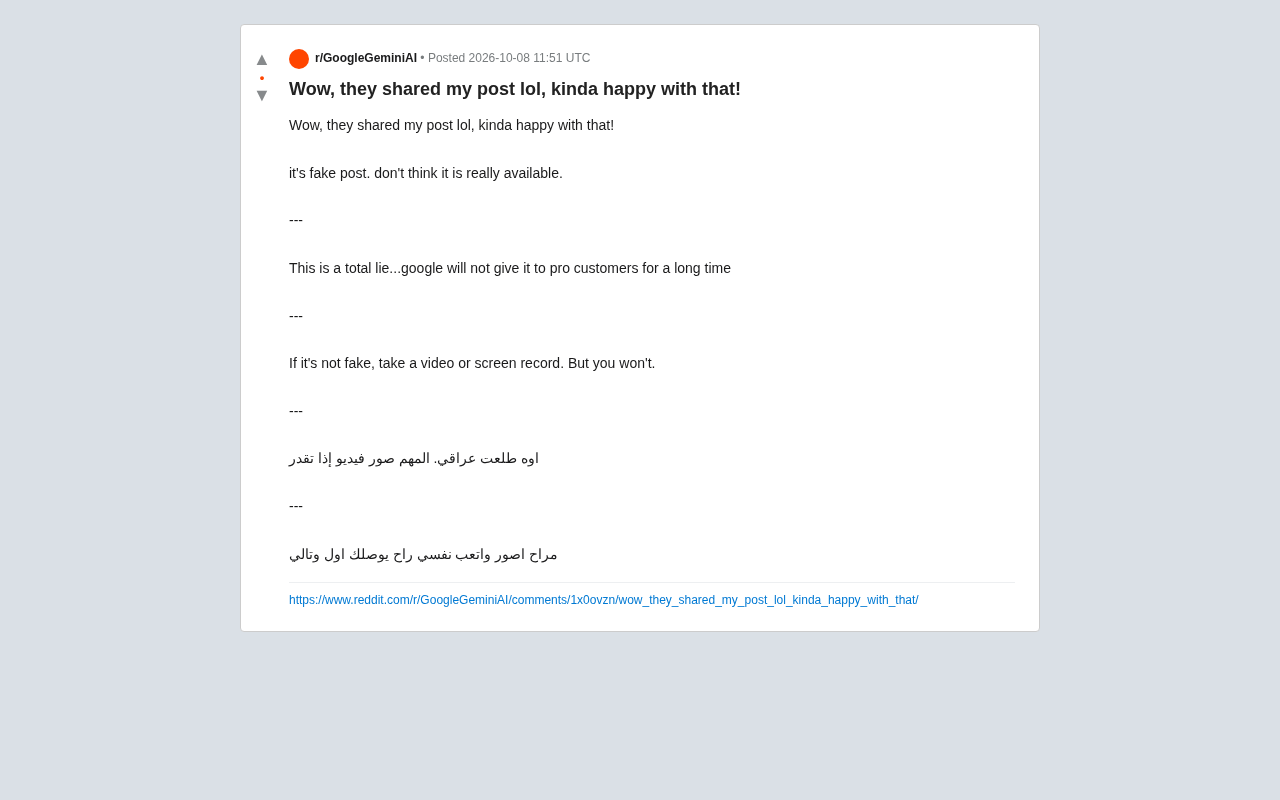
A Reddit user posted claiming their content had been shared by an official account, with a tone of barely concealed delight: "Wow, they shared my post lol, kinda happy with that!" The comments section, however, was far less enthusiastic. A wave of skepticism followed, turning what looked like a routine share into a full-blown discussion about authenticity.
Scenes like this play out in the AI community almost daily. As major companies accelerate their product release cycles, a flood of "closed beta screenshots" and "early access" leaks has made it increasingly hard to separate fact from fiction. Using this post as a lens, let's look at how online communities spontaneously fact-check unverified claims.
Three Typical Reactions in the Skeptics' Corner
The comments section reveals several common postures communities adopt when verifying information.
Outright Dismissal
Some commenters were blunt: "it's fake post. don't think it is really available." Others went further with specific reasoning: "This is a total lie...google will not give it to pro customers for a long time."
This reaction draws on an existing mental model of how companies roll out products. When the timing of a claimed "perk" or "feature" doesn't align with known release patterns, the community instinctively raises its guard. Notably, judgments grounded in "release logic" like this tend to be far more persuasive than purely emotional dismissals.
Demanding Hard Evidence
Another faction laid out a clear standard for verification: "If it's not fake, take a video or screen record. But you won't."
This is the most classic debunking logic in online communities — screenshots can be faked, but a continuous screen recording raises the bar for fabrication considerably. Demanding "video proof" is essentially using the cost of evidence production as a filter for truth. The kicker, "But you won't," carries an implicit prediction that the original poster won't be able to back up their claim.
The core advantage of screen recording as a verification tool lies in its temporal continuity. A single screenshot presents only static pixels — any image editor can alter UI text, icons, or feature labels within minutes. A full walkthrough video, by contrast, requires the forger to either build a convincing interactive fake interface or perform frame-by-frame post-production, sending the effort required up exponentially. A consensus has formed through long community practice: video doesn't prove everything, but the absence of video is nearly equivalent to forfeiting your right to self-verify. This is why "But you won't" lands so hard — it's not mere mockery. It logically anticipates the poster backing down when faced with a high-cost burden of proof, effectively turning the absence of evidence into a suspicious signal in itself.
Cross-Language Pushback
The comments section also saw exchanges in Arabic, which similarly centered on the theme of "prove it by recording a video" — to which the original poster responded that they wouldn't bother recording. This cross-language dynamic shows that regardless of cultural background, demanding proof is a universal instinct when communities encounter dubious claims.
Why AI Rumors Are Especially Prone to Controversy
This post itself contains limited information, but it reflects a structural problem in how information spreads in the AI space.
On one hand, AI products update frequently and gradual rollouts are the norm, meaning different users, regions, and subscription tiers may see entirely different interfaces and features. This built-in "information asymmetry" creates fertile ground for rumors and misunderstandings — a "new feature" one person sees may simply not exist for another.
On the other hand, the credibility of screenshots as evidence is declining. The barrier to editing images is vanishingly low, and with the widespread availability of AI-generated imagery, a single screenshot can barely serve as proof that a feature actually exists. This is precisely why commenters reflexively demanded video recordings.
Gradual rollout is a common product launch strategy in the tech industry: new features aren't released to all users simultaneously, but are first pushed to a small subset of users to gather feedback and confirm stability before expanding coverage. AI companies like Google and OpenAI routinely use this mechanism, defining the first wave of users by region, account tier (e.g., free vs. Pro), or random sampling. This means that at any given moment, some users genuinely can see a new feature while the vast majority have no idea it exists. It's precisely this deliberately engineered "experience gap" that makes screenshots from real early users visually indistinguishable from fabricated ones — and prevents skeptics from concluding a feature doesn't exist just because they haven't seen it. Both sides end up stuck in an evidentiary deadlock.
How Ordinary Users Should Approach These Leaks
When it comes to "early access" AI content on social platforms, staying rational matters far more than either breathless excitement or reflexive dismissal.
- Check the release logic: Does the timing and target audience for this feature or benefit align with the company's typical behavior?
- Consider the evidence tier: Text < Screenshot < Screen recording < Official announcement — the harder something is to fake, the more credible it is.
- Wait for official confirmation: Genuine feature launches are almost always accompanied by official communications. Rather than chasing rumors, it pays to wait for authoritative sources.
This post ultimately left the truth unresolved, but it offers a small window into how community self-correction mechanisms work. In an environment where truth is hard to verify, the collective skepticism of community members and their insistence on proof form a genuine line of defense against misinformation.
Conclusion
A simple claim — "they shared my post" — sparked a debate that looks at first glance like routine internet bickering, but is really a microcosm of the information verification challenges of the AI era. When leaks are flying everywhere, a request as simple as "show us the video" may be the most effective filter we have. For content consumers, building the habit of "demand evidence, check the logic, wait for official word" is the key to staying clear-headed amid the noise.
Related articles

Workbuddy for Absolute Beginners: How a Desktop AI Agent Fits Into Real Workflows
A beginner's guide to the Workbuddy desktop AI agent: installation, claiming credits, file management, and building automated workflows—compared with CodeX for fit and cost, helping professionals shift from AI question-askers to AI managers.

OpenAI's New Agent Stack: Computer Use, Decisions API, and Ultra-Fast Workflows
OpenAI Dev Day unveiled a new agent stack: Computer Use outperforms humans, Decisions API delivers ultra-low-latency classification via Luna, Agents API opens the same Computer Use capabilities, and GPT-6.1 Sol costs only one-seventh of Astra. Core updates, benchmark data, and developer insights.

Liang Wenfeng Open-Sources DeepInfo Inference Framework, Takes On U.S. Ban
DeepSeek open-sources its DeepInfo inference framework after its models, featuring GPU/CPU cross-pipelining, small-model prediction with large-model verification, and full Huawei Ascend and NVIDIA chip support—facing the U.S. federal ban head-on. This article analyzes its significance for AI deployment and open-source strategy.