TS+Zod Full-Stack in Practice: From Type Safety to openclaw Agents

TypeScript+Zod forms a closed loop from type unification to runtime validation at the AI application layer, a practical entry ticket for AI full-stack.
The article, based on a Bilibili creator's sharing, argues that TypeScript combined with Zod is becoming the core technology combination for enterprise-grade AI applications. The core logic is: large model outputs are non-deterministic while enterprise applications require standardization; TypeScript unifies application-layer code and Zod constrains model output structure, forming a closed loop from development standards to runtime validation. It introduces Zod's parse runtime validation, describe injecting prompt semantics, coerce type-lenient conversion, and refine business rule validation, and demonstrates via Ollama-deployed Qwen3, LangChain agents, and Zod schema as response_format that both text and multimodal inputs can output structured JSON. It also reviews the TS AI framework ecosystem including LangChain.js, RAGFlow.ts, and Mastra, while noting that the "million-yuan salary" narrative has marketing elements and the real value lies in mastering the engineering capability of standardizing LLM output.
In the field of AI development, the ecosystem competition between Python and TypeScript has never ceased, but an underappreciated fact is that the frontend tech stack is showing astonishing explosive power at the AI application layer. A Bilibili creator pointed out unequivocally in a recent sharing session that the combination of TypeScript and Zod is becoming a core competitive advantage for building enterprise-grade AI applications, with an ecosystem richness that even surpasses Java.
Why TS+Zod Is the Entry Ticket for AI Full-Stack
There is a fundamental contradiction in AI development: the output of large models is inherently non-deterministic, while enterprise applications demand high standardization. The creator repeatedly emphasized in the video that TypeScript solves the problem of code unification at the application layer, while Zod solves the problem of structural constraints at the model output layer. Together, they form a complete closed loop from development standards to runtime validation.
From market feedback, this technology choice is not an isolated case. Several AI engineering channels on YouTube have also discussed similar views: when building LLM applications, TypeScript's type system can significantly reduce communication costs for multi-team collaboration, and Zod as a schema definition standard has been adopted by OpenAI's official SDK—which itself is an industry bellwether.
Zod: The Bridge from Compile Time to Runtime
The value of traditional TypeScript lies in compile-time checking, but data in AI applications is often generated only at runtime. In the demonstration, the creator defined a user agreement schema, and when the input data changed from {name: '合一', age: 18} to age: '18', Zod's parse method immediately throws an error. This runtime protection is crucial for handling unreliable data returned by large models.
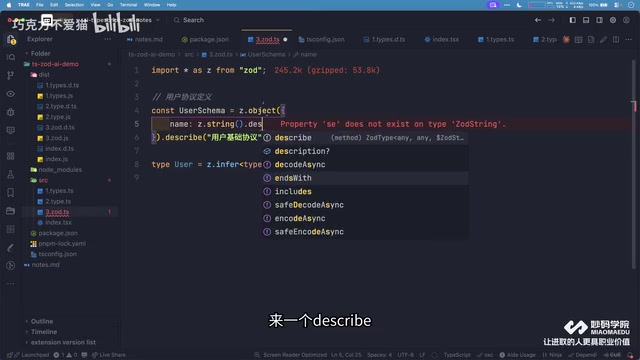
More importantly, Zod's describe method can inject field semantics into the prompt given to the large model—in the demo, after the creator changed the age field description from "user age" to "the user's age this year," the model automatically calculated "18 next year" as 17 for output. This approach of schema-driven prompt engineering is more controllable than hand-written prompts.
The relationship between Zod and JSON Schema: Zod is a TypeScript-first schema declaration and validation library. It is not directly equivalent to JSON Schema, but tools like zod-to-json-schema can convert Zod schemas into JSON Schema. Function calling/structured output interfaces from vendors such as OpenAI generally use JSON Schema under the hood to describe the expected output format, so Zod actually serves as a "developer-friendly authoring layer" that is ultimately serialized into a standard schema submitted to the model. Understanding this conversion relationship helps troubleshoot "why the model doesn't output according to the schema"—the problem often lies in whether the converted JSON Schema is precise enough, not in Zod itself.
Practical Path: From Zero Initialization to Agent Output
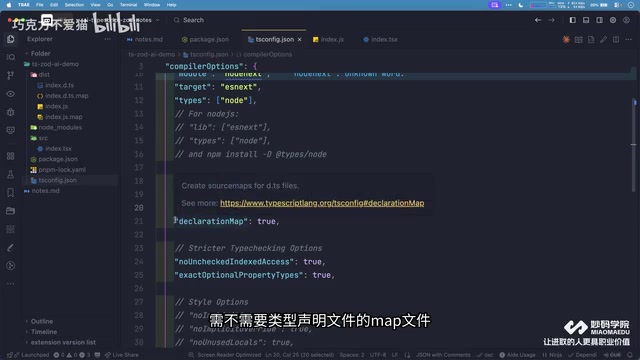
The video demonstrated the complete project setup process, and its rigor is worth learning from: when installing TypeScript, the creator specifically specified version 5.9.3 and explained why one should check the tsc symlink under the node_modules/.bin directory—"when learning, you should understand the call chain of every step clearly, rather than copying commands."
Key Decisions in Engineering Configuration
In the tsconfig configuration section, the creator gave clear recommendations for the frontend/backend boundary: for frontend applications, set module to esnext and moduleResolution to bundler; for Node.js projects, keep the CommonJS specification. This differentiated configuration directly affects whether AI applications can smoothly integrate with modern build tools like Vite.
The meaning of module and moduleResolution: module determines which module syntax the compiled code uses (e.g., esnext outputs native import/export, commonjs outputs require), while moduleResolution determines how TypeScript resolves import paths. The two must match the runtime environment: modern bundlers like Vite are based on ESM, so frontend projects typically use esnext + bundler; while many Node.js services and some AI SDKs are still distributed as CommonJS, and mixing them causes errors such as "module not found" or "cannot use import in CommonJS." This is also a common pitfall in AI full-stack projects—frontend and backend tsconfig files in the same repository often need to be maintained separately.
The Practical Value of Type Utilities
The video demonstrated the clever use of Omit and Pick in AI scenarios. For example, if the User type contains name and age, but creating a lightweight user object only requires name, Omit<User, 'age'> can derive a new type. This kind of type operation is especially common when building RAG systems—document chunks, vectors, and metadata often need to derive different forms from base types.
Structured Output: The Watershed of Agent Development
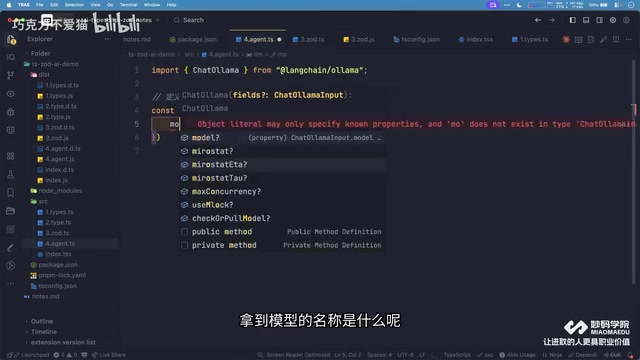
The most impressive demo appeared in the agent section. The creator first deployed the Qwen3 model locally with Ollama (0.6B parameter version), then created an agent through LangChain and passed in the userSchema defined by Zod as response_format. When the input was "Hello, let me introduce myself first. I'm Heyi, 18 years old this year," the model directly returned structured JSON: {name: '合一', age: 18}.
Even more impressive was the multimodal test: passing an image with the same content to the Qwen3-VL model, the agent still output standardized results. According to confirmation by the creator and some viewers in the comments, this verified that Zod schema can constrain output format across modalities.
Lenient Mode and Custom Validation
Zod's coerce feature is highly recommended in AI scenarios. When the model outputs age: '18' as a string, z.coerce.number() automatically converts it to a number, avoiding process interruptions caused by type mismatches. The refine method is used to handle business rules—for example, in a time interval schema, the start time must be earlier than the end time.
The cost of coerce and the role of refine: z.coerce.number() essentially performs Number() conversion on the input before validation, so it converts '18' to 18, but it also converts an empty string to 0 and true to 1. While leniently handling model output, it may mask data quality issues. In practice, a safer approach is to use coerce only on fields where it is known that the model may return string numbers, and keep strict validation on other fields. refine is used to express cross-field or business rules that cannot be covered by the schema structure. It returns a boolean and can include custom error messages, but by default it does not short-circuit subsequent validations; for complex scenarios, superRefine can be used for finer control over error paths.
Ecosystem Overview: The Overlooked TypeScript AI Frameworks
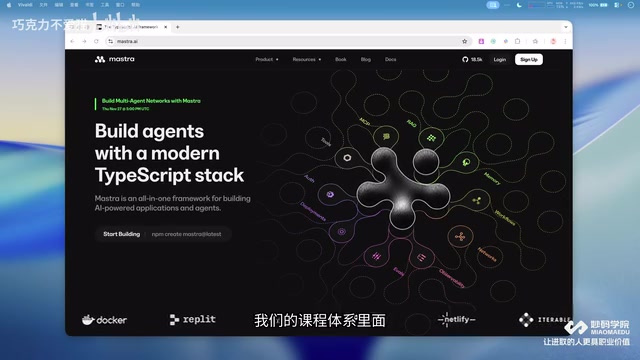
The creator listed multiple frameworks in the frontend AI ecosystem, information that is rarely systematically organized in most Chinese technical communities:
- LangChain.js / LangGraph.js: Mainstream choices for agent orchestration
- RAGFlow.ts: A dedicated framework for RAG engineering
- Mastra: A TS framework focused on agent development
- LlamaIndex.ts: Data indexing and retrieval layer
A detail (citing the creator's personal judgment): he believes the TS ecosystem is more active than Java's Spring AI or LangChain4j at the AI application layer. Similar voices have appeared in Hacker News discussions, but no industry consensus has yet formed.
Trade-offs in the Learning Path
Faced with the vast knowledge system of TS, the creator defined four core modules: type definitions (basic/reference/custom), generics, function types, and fallback symbols (optional chaining and non-null assertion). This strategy of focusing on the big picture is indeed effective for developers with existing JavaScript experience to build usable knowledge within a week.
A Calm View of the "Million-Yuan Salary" Narrative
The "million-yuan salary architecture" in the video title is more of marketing rhetoric. From a technical substance perspective, TS+Zod does lower the barrier to AI application development, but the core of architectural capability still lies in abstracting business scenarios—for example, how to design MCP tool protocols and how to plan RAG retrieval strategies. The creator also admitted that underlying principles and engineering experience require long-term accumulation.
For developers, the more pragmatic takeaway is: after mastering Zod's structured output capabilities, you can quickly integrate the return results of any LLM into existing business systems. This "last mile" engineering capability has high practical value at the current stage of AI implementation.
One-line Summary
TypeScript+Zod forms a closed loop from type unification to runtime validation at the AI application layer, making it a practical entry ticket for AI full-stack.
Paragraph Summary
The article, based on a Bilibili creator's sharing, argues that TypeScript combined with Zod is becoming the core technology combination for enterprise-grade AI applications. The core logic is: large model outputs are non-deterministic, while enterprise applications require standardization. TypeScript is responsible for unifying application-layer code, and Zod is responsible for structural constraints on model output, forming a closed loop from development standards to runtime validation. The article introduces Zod's capabilities such as parse runtime validation, describe injecting prompt semantics, coerce type-lenient conversion, and refine business rule validation. Through a practical demonstration of deploying Qwen3 locally with Ollama, creating an agent with LangChain, and passing a Zod schema as response_format, it shows that both text and multimodal inputs can output structured JSON. The article also reviews the TS AI framework ecosystem including LangChain.js, RAGFlow.ts, and Mastra, while reminding that the "million-yuan salary" narrative contains marketing elements and that the real value lies in mastering the engineering capability of standardizing LLM output.
Related articles
world2vec: Building Mechanistic World Models with Latent Dynamics Learning
world2vec proposes a reward-free method for learning mechanistic world models via latent dynamics, faithfully reproducing systems over long horizons with at least an order of magnitude fewer parameters than DreamerV3, TD-MPC2, and LeWM, and achieving accurate system identification on 71 attractor benchmarks.

A New KL-DRO Paradigm: Adaptive Scenario Generation Around a Learned Density Model
KL-DRO research proposes centering the KL ball on a learned density model instead of the empirical distribution, with adaptive scenario generation guiding sampling toward the worst case. Experiments show lower cost under distribution shift when records are scarce and the model can extrapolate, with comparable in-distribution cost.

ODE Samplers for Discrete Diffusion Models: Exponential Residual Flows Accelerate Generation
Discrete diffusion models lack deterministic ODE sampling? This article introduces Exponential Residual Flows (ERFs), which introduce continuous residual variables per token to construct piecewise ODEs for deterministic sampling and support consistency distillation acceleration. Superior to prior methods on code and text generation tasks.