Tsinghua Postdoc on the Self-Study Path for AI Algorithm Engineers and Engineering Thinking
Tsinghua postdoc Wang Shuhao says the key to AI deployment is engineering ability, not mathematical theory, and offers a self-study path.
The article introduces a course on the self-study path for AI algorithm engineers taught by Wang Shuhao, a postdoctoral fellow at Tsinghua University's Institute for Interdisciplinary Information Sciences. Addressing the common pain point of "learning deep learning but failing to build AI systems," Wang combines his academic and industry experience at Tsinghua, Baidu, JD, and a pathology AI startup to point out a huge gap between academic and industry models: paper models are mostly single-center small-scale tests, while industry-grade models require multi-center validation, sensitivity close to 100%, fast inference, disaster recovery, and scalability. He therefore argues that AI is essentially computer science rather than mathematical theory, that programming ability is a prerequisite for entry, and that self-study should balance theoretical depth with engineering ability. He also explains the course's target audience and core methodology.
Why Can't You Build an AI System Even After Learning Deep Learning?
On Bilibili, a course on the self-study path for AI algorithm engineers taught by Wang Shuhao, a postdoctoral fellow at Tsinghua University's Institute for Interdisciplinary Information Sciences, has attracted widespread attention. Unlike the many tutorials on the market that pile up formulas, the core viewpoint of this course directly targets a common pain point: many people finish learning deep learning yet still cannot truly put AI into production.
At the beginning of the course, Wang Shuhao raises a sharp observation: many job seekers have only run introductory experiments like MNIST and consider their fundamentals solid, but as soon as they are asked deeper model questions or simple engineering questions, their shortcomings are immediately exposed. According to his sharing in the course, this phenomenon is quite common in AI recruitment and reflects a structural flaw in self-study paths: "emphasis on theory, neglect of engineering."
Speaker Background: From a Tsinghua Lab to the Industry Front Line
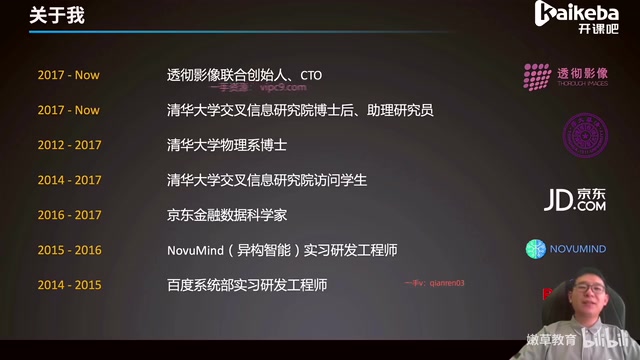
Wang Shuhao's resume itself is a growth path of an "academia + industry" double helix. He holds a PhD from Tsinghua University's Department of Physics and met the graduation requirements in the second year of his doctoral studies. Over the following three and a half years, he was successively a visiting student at Tsinghua University's Institute for Interdisciplinary Information Sciences and an intern R&D engineer in Baidu's Systems Department, participating in smart data center projects and using AI methods for power optimization. In 2015, at the invitation of Baidu scientist Wu Ren, he joined the Silicon Valley AI solutions company Ego Intelligence (Chinese name "Yige Intelligence"), headquartered in Santa Clara, close to Intel, Qualcomm, and Google.
After returning to China, he joined JD Finance (now JD Digital Technology) as a data scientist and for the first time applied recurrent neural networks to the field of fraud detection. The related code still runs at JD today and has been borrowed by many domestic and international e-commerce companies. After completing his PhD, he returned to Tsinghua's Institute for Interdisciplinary Information Sciences as a postdoctoral assistant researcher, focusing on medical artificial intelligence, and co-founded the pathology AI company "Tongche Imaging."
This experience spanning academia and industry constitutes the course's most unique value: what he teaches is not just knowledge, but a methodology validated by multiple successful projects.
Where Is the Gap Between Academic Models and Industry Models?
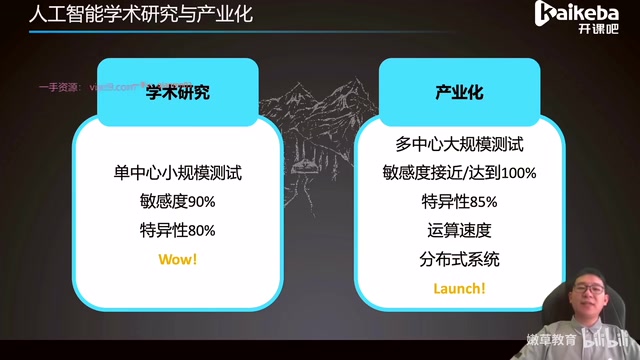
The most insightful part of the course is the comparative analysis of "paper models" and "industry models." Wang Shuhao points out that academic research is usually single-center and small-scale testing, with sensitivity perhaps only 90% and specificity less than 80%. Such a model is fine for publishing papers, but it is very dangerous for clinical practice—90% sensitivity means missing 10% of positive patients.
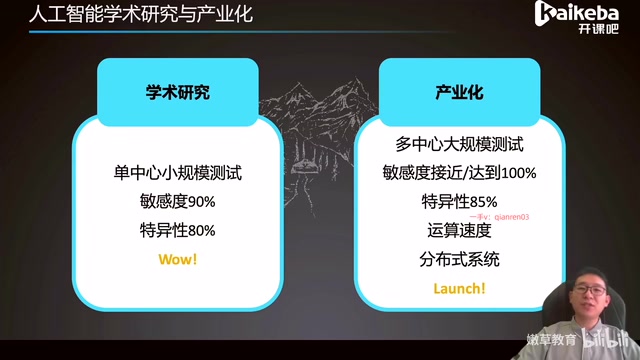
The requirements for industry-grade models are completely different: multi-center large-scale testing is needed, sensitivity must approach or even reach 100%, and specificity must also reach about 85%, avoiding missed diagnoses while controlling false positives. In addition, system-level requirements are equally demanding: computation speed must be fast enough, otherwise it is useless in real-time scenarios; the system must be robust and able to recover automatically after a node fails; and it must be scalable, so that when users grow from one million to two million, it can be smoothly supported simply by expanding servers.
These requirements point to one conclusion: the foundation of AI systems is not mathematical theory, but computer science. Wang Shuhao repeatedly emphasizes in the course that artificial intelligence is essentially a practical discipline and part of computer science. Mathematics is a tool, papers are references, but the real foundation lies in programming ability and engineering thinking.
Sensitivity and specificity are two core metrics for evaluating the performance of classification models (especially medical diagnosis models). Sensitivity, also called recall, refers to the proportion of actual positive samples correctly identified as positive, measuring the model's ability to "not miss diagnoses"; specificity refers to the proportion of actual negative samples correctly identified as negative, measuring the model's ability to "not misdiagnose." The two usually involve a trade-off: increasing sensitivity often comes at the cost of lowering specificity. In clinical scenarios, the cost of a missed diagnosis (false negative) is far higher than that of a misdiagnosis (false positive). Therefore, industry-grade models prioritize pushing sensitivity close to 100%, while trying to maintain specificity at around 85% through multi-center large-scale data training and threshold tuning, thereby balancing safety and usability.
Multi-center testing means validating a model on datasets from different hospitals, different devices, and different population distributions, rather than evaluating it only on small-scale data from a single institution. Single-center testing easily overestimates a model's generalization ability because of uniform data distribution, while multi-center testing can expose performance degradation under the heterogeneity of real-world data. It is an essential step for medical AI to move from papers to clinical practice.
The Right Path for Self-Studying AI: Equal Emphasis on Theoretical Depth and Engineering Ability
Based on the above judgment, the course identifies two dimensions that self-learners need to focus on.
Theoretical Level: Beyond "Knowing the Structure"
Learning a network cannot stop at the shallow level of knowing what it looks like. You need to understand its specific structure, how the number of parameters is calculated, how the code is implemented, and even be able to construct new network structures yourself. This requires a deep understanding of the network itself as well as a corresponding level of coding ability.
Practical Level: View AI Through an Engineering Lens
Do not study AI as mathematical theory. Wang Shuhao advises learners to move beyond the misconception that "getting a demo to run means you have learned it" and to understand all the knowledge required for a complete AI system: inference speed optimization, distributed architecture, disaster recovery design, scalability, and more. These contents are often ignored in traditional courses, yet they are key to industrial deployment.
He also particularly affirms the path of "building a solid programming foundation first, then learning artificial intelligence." Compared with directly tackling deep learning frameworks, learners with solid programming skills have obvious advantages in understanding model implementations and debugging engineering problems. This also explains why people with a computer science background often have stronger long-term potential in AI engineering positions.
Disaster recovery design and scalability are two key engineering capabilities for AI systems moving from the laboratory to production environments. Disaster recovery design means that when some nodes, services, or data centers fail, the system can still maintain service availability through mechanisms such as redundant deployment, failover, and automatic recovery, avoiding overall paralysis caused by a single point of failure. For real-time inference systems, one outage may mean business interruption and user loss. Scalability means that when the number of users or requests grows, the system can smoothly carry the load through horizontal expansion (adding server nodes) rather than re-architecting. Together with inference speed optimization and distributed architecture, these two capabilities form the engineering foundation of industry-grade AI systems, and they are also content that traditional deep learning courses almost never cover.
Who Is This Course For?
From the course positioning, it is suitable for three types of people: first, career changers with zero foundation who hope to systematically enter AI; the course's emphasis on programming first can help them avoid "castles in the air" style learning; second, students who have already studied deep learning but lack engineering experience; the course's discussion of industry model requirements can fill gaps in their understanding; third, candidates preparing to apply for AI algorithm positions; the typical problems Wang Shuhao encountered in recruitment are exactly the targets this course attempts to solve.
One attitude the instructor repeatedly conveys is: AI learning does not have to be stressful, but the right methodology must be established. His experience with multiple successful projects from 2014 to the present has been distilled into reusable ways of working, and this may be the biggest difference between this course and ordinary tutorials.
For those who truly want to become AI algorithm engineers, what matters more than "finishing learning a certain model" is building a complete cognitive framework from theory to systems and from papers to products. There is no shortcut on this path, but if the direction is right, every step counts.
Related articles

Prompt Engineering for Beginners: From Writing Prompts to Engineering Thinking
Starting from the essence and four functions of prompts, this article systematically explains the six-step process, four success criteria, learning value, and practical limitations of prompt engineering to help you build a complete understanding.

Anthropic Launches Nasdaq IPO: AI Giant's Listing and Risk Disclosures
Anthropic officially launches its Nasdaq IPO under ticker ANT, with market valuation expected to potentially exceed SpaceX's record. The prospectus devotes nearly 100 pages to AI risks, while first-half revenue grew over 14x but net losses widened sharply, reigniting the AI bubble debate.

Rust cURL Clone Uses 4,832 unsafe Blocks—Is the Memory Safety Myth Broken?
A Rust cURL clone uses 4,832 unsafe keywords, challenging Rust's memory safety narrative. We analyze what unsafe really means, compare Fil-C, and examine rewrite motives.