Tura: A New Approach to Saving 80% of Tokens for AI Agents
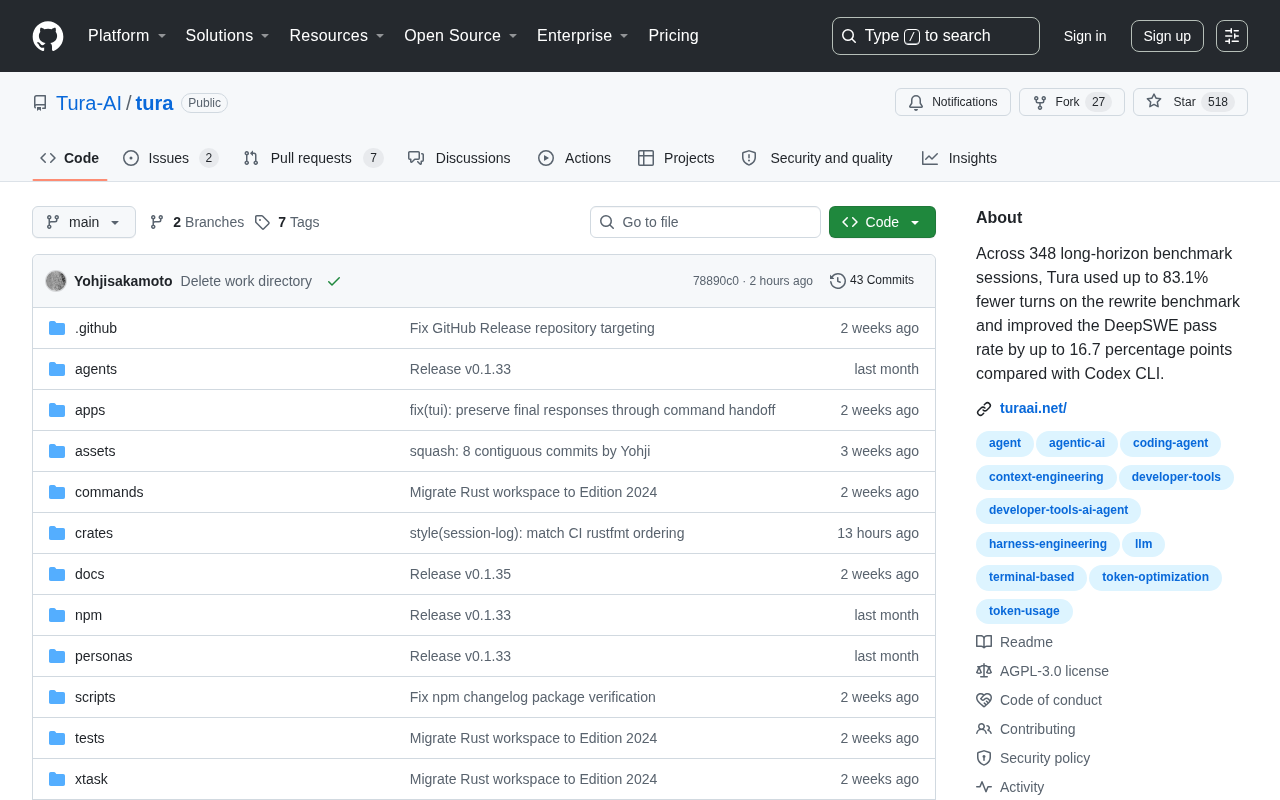
Tura framework claims to cut AI Agent token usage by 80% through smart context management and model cascading.
Tura is a new AI Agent framework that claims to reduce token consumption by 80% while improving output quality. It likely achieves this through intelligent context pruning, structured tool calling protocols, and model cascading. While the specific benchmarks remain unverified, the project represents an important industry shift from feature-driven to efficiency-driven Agent engineering.
The Token Cost Dilemma in the AI Agent Era
As AI Agents powered by Large Language Models (LLMs) become the dominant paradigm for building complex automated tasks, an increasingly prominent problem has emerged — token consumption costs. When an Agent needs to repeatedly call tools, retrieve context, and perform multi-round reasoning, every step continuously accumulates token overhead.
An AI Agent is an autonomous task execution system based on large language models that completes complex tasks through a "perceive-reason-act" loop. Unlike single-turn Q&A, Agents typically go through multiple steps: first understanding user intent, then formulating a plan, then repeatedly calling external tools (such as search engines, code executors, database queries, etc.), and finally synthesizing all intermediate results to generate the final output. In this process, each loop requires re-feeding the previous conversation history, tool return results, system instructions, and other information back into the model, causing token consumption to grow exponentially rather than linearly.
For developers and enterprises, this not only means high API costs but also brings a cascade of issues including increased latency and context window congestion.
Recently, a project called Tura appeared on Hacker News' Show HN section, claiming to help developers build Agents that "use 80% fewer tokens while delivering better results." This bold efficiency claim deserves an in-depth technical analysis.
Tura's Core Proposition: Better Results with Fewer Tokens
Tura's positioning is very clear: it's a framework for building AI Agents, with its core selling point being the unification of two seemingly contradictory goals — reducing token usage while improving task completion quality.
Typically, reducing tokens means compressing context and streamlining prompts, which often sacrifices the amount of information available to the model, thereby affecting output quality. Tura claims to break this trade-off, achieving "the best of both worlds."
Why Token Efficiency Is Critical for AI Agents
To understand Tura's value, we first need to recognize the cost structure of tokens in Agent systems:
- Economic cost: Major commercial models charge by token. A high-frequency Agent may consume millions of tokens per day, with considerable costs. Taking OpenAI GPT-4o as an example, its input token price is $2.5 per million tokens, and output is $10. A typical customer service Agent may consume 5,000-20,000 tokens when handling a single complex ticket, and an enterprise-level Agent system processing tens of thousands of requests daily can easily reach tens of thousands of dollars in monthly API costs. More critically, as Agents become more autonomous and task chains grow longer, token consumption inflates dramatically — a task involving 10 tool-calling steps may accumulate tens of thousands of tokens in context, because each step needs to carry forward prior information.
- Performance cost: Longer context means higher inference latency, directly impacting user experience.
- Attention dilution: Research shows that when context is too long, the model's "attention" to key information becomes dispersed, which may actually reduce output accuracy — this is the so-called "lost in the middle" phenomenon.
The "Lost in the Middle" phenomenon originates from a 2023 research paper published by Stanford University and other institutions titled Lost in the Middle: How Language Models Use Long Contexts. This study systematically revealed that when key information is placed in the middle of a long context, the model's retrieval and utilization accuracy drops significantly. Experiments showed that models pay the most attention to information at the beginning and end of the context, while exhibiting a notable "forgetting effect" for information in the middle. This means that simply piling on more context not only fails to improve performance but may actually reduce output quality due to information overload, providing strong theoretical support for context compression strategies.
From this perspective, Tura's claim that "reducing tokens actually improves results" isn't far-fetched but has solid technical logic behind it: concise, precise context is often more beneficial for model performance than verbose, noisy context.
Possible Technical Approaches Behind Tura's Token Optimization
While publicly available information is currently limited (the project is still in its early demonstration phase), combining mainstream technical trends in the AI Agent field, we can speculate on several possible paths Tura uses to achieve token optimization:
Intelligent Context Management and Dynamic Pruning
Traditional Agents often adopt a "full stacking" approach, cramming all historical conversations, tool outputs, and system prompts into the context. A more advanced approach is dynamic context pruning — retaining only information truly useful for the current decision, streamlining input through summarization, retrieval, or relevance ranking. This method can dramatically reduce token usage without losing critical information.
Dynamic context pruning involves multiple specific technical implementations. One is retrieval-augmented generation (RAG) based on semantic similarity, using vector databases to retrieve only the most relevant historical fragments for the current question. Another is Progressive Summarization, which generates compressed summaries of earlier conversation turns to replace original text. There's also importance scoring based on attention weights, which uses the model's own attention distribution to determine which context fragments are most critical for the current decision. Projects like MemGPT have already been exploring paging mechanisms similar to operating system virtual memory, dividing context into two layers — "working memory" and "archival memory" — loaded on demand, thereby achieving efficient management of large-scale information within limited context windows.
Structured Tool Calling Protocols
Much of the token waste in Agents comes from inefficient tool calling formats and redundant intermediate reasoning steps. Through more compact tool descriptions and more precise calling protocols, the token overhead per step can be significantly reduced. For example, replacing natural language tool parameter descriptions with structured JSON schemas can dramatically compress token usage.
Hierarchical Routing and Model Cascading
Breaking complex tasks into parts, using small models or rule engines to handle simple steps, and only calling large models for deep reasoning when necessary, is also a common strategy for reducing overall token consumption. This hierarchical routing mechanism ensures every token is spent where it matters most.
Model Cascading is a cost optimization strategy that has been widely validated in the industry, with its core idea being "don't use a sledgehammer to crack a nut." In practice, the system first uses a lightweight model (such as GPT-4o-mini or a locally deployed small model) to assess task complexity. Simple tasks are completed directly by the small model, and only when confidence falls below a threshold is the task escalated to a larger model. Google's Gemini series and Anthropic's Claude series both offer models of different scales to support this layered strategy. In Agent scenarios, simple steps like routing decisions and formatted output can be handled entirely by small models, while complex reasoning and creative generation tasks require calling flagship models, thereby reducing overall costs by 50%-70%.
How to Rationally Evaluate Tura's Efficiency Claims
It's worth noting that while quantified numbers like "80%" are attention-grabbing, as an early-stage project, its measurement baselines and applicable scenarios remain unclear. Such efficiency improvements are often highly dependent on specific task types, comparison baselines, and implementation details.
For developers interested in AI Agent token optimization tools, it's recommended to focus on the following points before actual adoption:
- What's the comparison baseline? Comparing against a naive implementation versus an already-optimized solution leads to vastly different conclusions.
- How is quality measured? "Better results" needs to be supported by clear evaluation metrics, such as task completion rate and accuracy.
- What's the scope of applicability? Is it only effective for specific task types, and how well does it generalize across scenarios?
Efficiency Optimization Trends in Agent Engineering
Regardless of Tura's ultimate real-world performance, the direction it represents is worth paying attention to — AI Agents are transitioning from "functional" to "performant and economical" in their engineering maturity stage.
The development of AI Agents has undergone rapid evolution from academic proof-of-concept to engineering deployment. The viral success of AutoGPT in 2023 marked the popularization of the Agent concept, but its token consumption was extremely high and task success rates were limited. Subsequently, frameworks like LangChain, CrewAI, and AutoGen emerged in succession, gradually solving Agent controllability and reliability issues. Since 2024, the industry focus has shifted from "can it complete tasks" to "can it complete tasks cost-effectively," with products like Devin and OpenAI Assistants API exploring more efficient Agent architectures. Tura's emergence sits precisely at this industry inflection point of transitioning from feature-driven to efficiency-driven development.
Early Agent development focused more on functional implementation, but as deployment scenarios mature, engineering metrics like token efficiency, cost control, and response speed are becoming increasingly critical. It's foreseeable that more tools and frameworks focused on Agent efficiency optimization will emerge in the future, helping developers build more powerful AI applications within limited cost budgets.
For teams currently building Agent systems, rather than blindly pursuing larger models and longer contexts, it's better to return to engineering fundamentals: achieving more efficient intelligent output through more elegant architectural design. This is perhaps the most valuable insight that projects like Tura bring to the entire AI Agent development industry.
Key Takeaways
Related articles

Felix Rieseberg Personal Homepage
Felix Rieseberg's personal homepage sparks attention on Hacker News. This article covers the Slack engineer's technical background, the rise and fall of nativefier, and the value of a developer homepage as a tech calling card.

@ai-sdk/vue 3.0.306 Patch Release Syncs with [email protected] Update
@ai-sdk/vue 3.0.306 released, synced with [email protected]. A routine patch release for the Vercel AI SDK ecosystem with no public API changes; the Vue adapter layer stays version-aligned with the core package.

Gemini 4 Argon API Launches: The Era of Million-Token Output Begins
Google launches Gemini 4 Argon with sparse MoE architecture, up to 1M output tokens, and a 68.90% Vals Index score, available across API, AI Studio, and the Gemini app.