Turbo-Flow: An Intelligent Development Environment Integrating 600+ AI Sub-Agents
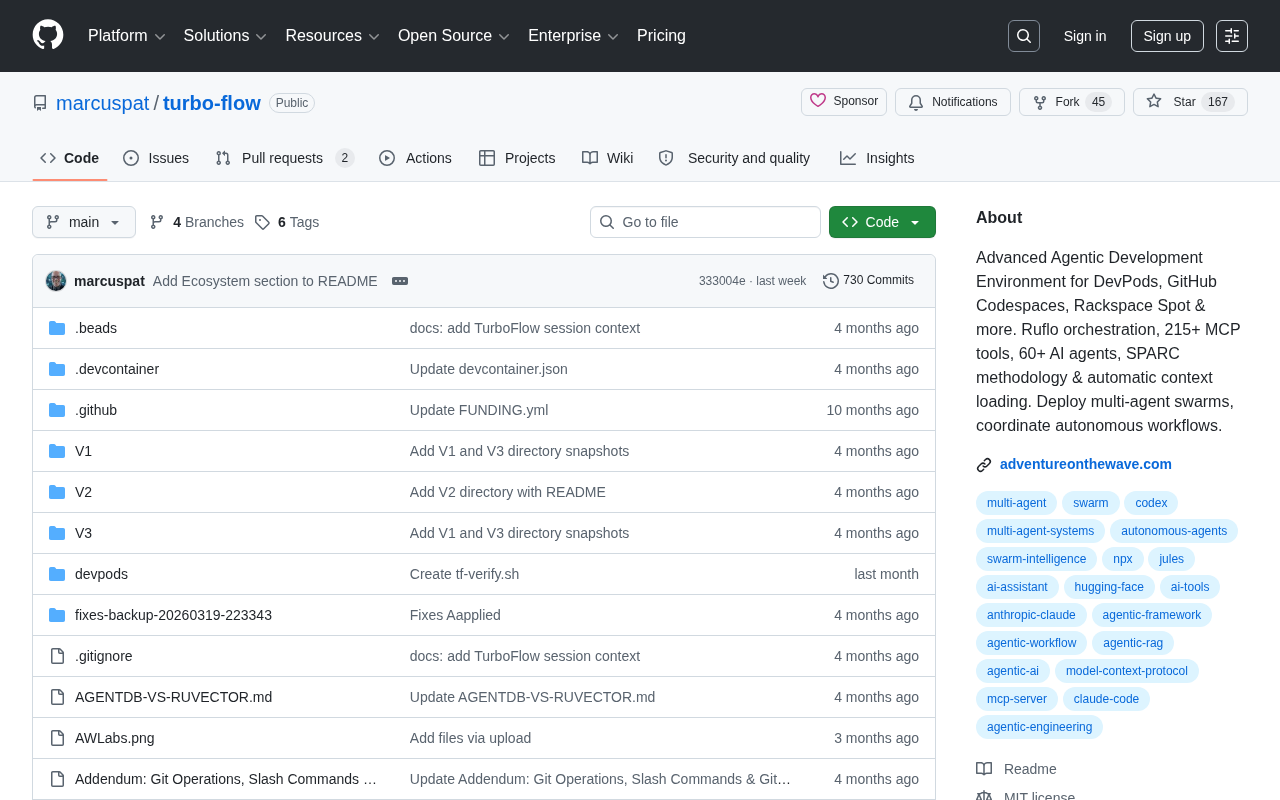
Open-source multi-agent dev environment with 600+ AI subagents, SPARC methodology, and multi-cloud deployment support.
turbo-flow is an open-source agentic development environment built on Shell scripts, featuring multi-agent swarm support with 600+ AI subagents, the Claude Flow orchestration framework, and SPARC methodology to automate the pipeline from requirements to implementation. It supports GitHub Codespaces, Google Cloud Shell, and Rackspace Spot Instances, with Spot support potentially slashing costs for large-scale agent workloads. Still early-stage at 162 Stars, it faces inherent multi-agent challenges like error propagation, cost unpredictability, and context consistency — making it a solid low-cost experiment rather than a production-ready solution.
A Development Environment Built for Multi-Agent Collaboration
As AI-assisted programming evolves from single assistants toward multi-agent collaboration, the open-source project turbo-flow (by marcuspat) offers a compelling approach worth exploring. Built around Shell scripts at its core, the project has earned 162 Stars and 45 Forks on GitHub, positioning itself as an "Advanced Agentic Development Environment."
Unlike traditional single-agent AI coding assistants, turbo-flow's core proposition lies in its support for multi-agent swarms. It claims to integrate over 600 AI subagents, combined with the Claude Flow framework and SPARC methodology, aiming to help developers deploy intelligent multi-agent collaboration systems and orchestrate autonomous workflows.
Cross-Platform Deployment Is the Standout Feature
turbo-flow offers remarkably broad compatibility across deployment environments. According to the project documentation, it supports Devpods, Rackspace Spot Instances, GitHub Codespaces, Google Cloud Shell, and more. This means developers aren't locked into a single cloud platform or local environment — they can choose their runtime based on cost and compute needs.
Support for Rackspace Spot Instances is particularly noteworthy. Spot instances are typically low-cost but can be reclaimed at any time, making them well-suited for interruptible batch workloads. Deploying multi-agent workflows on such instances could theoretically reduce the cost of running large-scale AI agent swarms significantly — a practical advantage for scenarios requiring long-running autonomous tasks.
Support for GitHub Codespaces and Google Cloud Shell also lowers the barrier to entry: developers can spin up a full agentic development environment in the browser without configuring a complex local setup.
600+ Subagents and the SPARC Methodology
The "600+ AI subagents" figure mentioned in the project description is its most eye-catching claim. Subagents typically refer to specialized AI units preconfigured with roles and prompts for specific tasks — such as code review, test generation, documentation writing, or architectural design. A large subagent library means developers can quickly invoke domain-specific agents for different tasks, rather than relying on a single general-purpose assistant to handle everything.
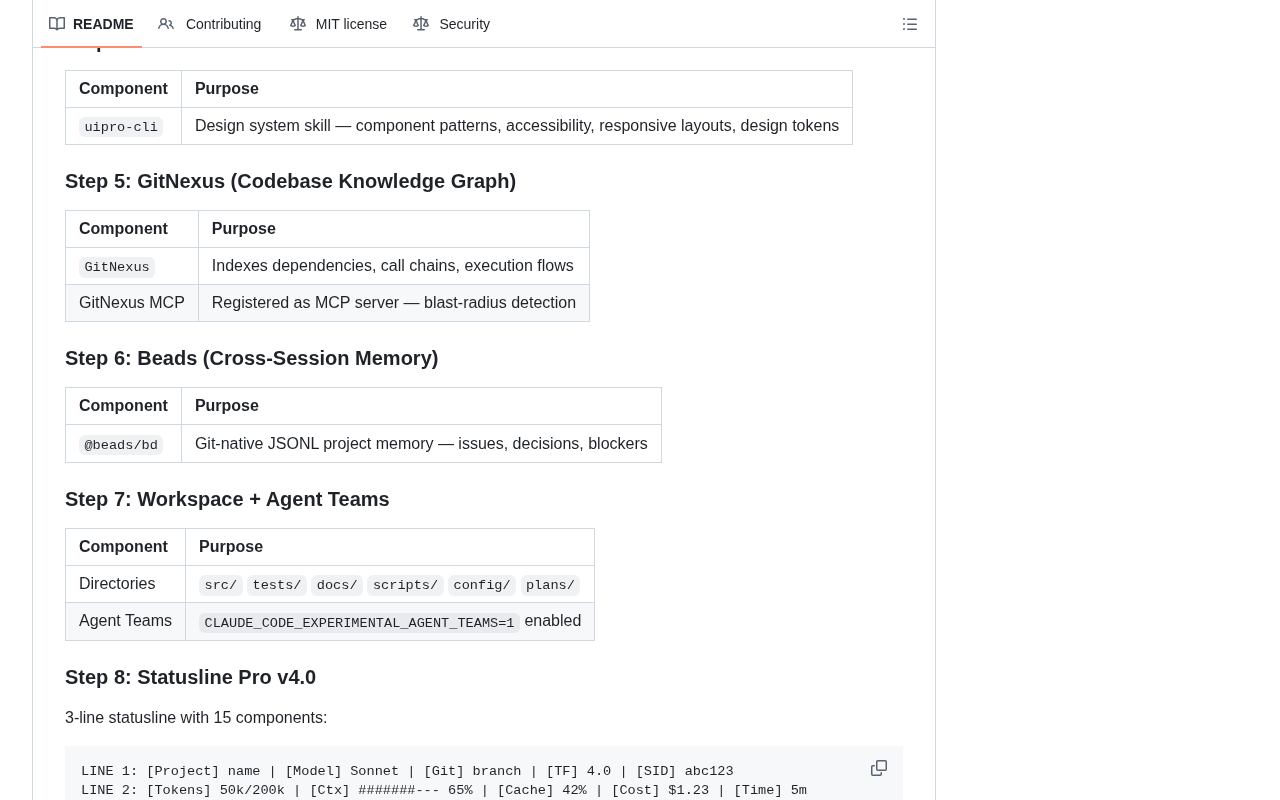
The SPARC methodology is a structured development process framework commonly used to define the stages of AI-driven development (Specification, Pseudocode, Architecture, Refinement, Completion, etc.). Combined with Claude Flow as an orchestration engine, turbo-flow attempts to connect "methodology + orchestration engine + agent library" into a single automated pipeline from requirements to implementation.
The project also mentions automatic context loading. In long-chain multi-agent workflows, the consistency and efficiency of context passing is often the deciding factor in output quality. If the automatic loading mechanism works effectively, it would meaningfully reduce the burden of manually managing context across agents.
Claude Flow is Anthropic's multi-agent orchestration framework that allows developers to define collaboration topologies across multiple Claude instances — including parallel execution, sequential dependencies, and result aggregation. Its core value lies in extending the capability boundary beyond a single conversation into cross-agent task decomposition and result synthesis, enabling complex tasks that exceed a single context window to be completed through "task sharding + agent specialization." By using Claude Flow as its scheduling engine, turbo-flow's 600+ subagents are not simply a collection of prompt templates — they are integrated into an orchestration system with genuine task-routing capabilities. That said, Claude Flow itself is still actively evolving, and its stability and API cost management remain critical variables for developers in real-world usage.
A Realistic Take: Forward-Thinking Concept, Still Needs Validation
It's worth being objective: turbo-flow is still in its early stages. With 162 Stars, it hasn't yet built significant community traction, and its Shell script-based implementation suggests the core logic leans more toward environment orchestration and workflow chaining than foundational framework innovation.
Numbers like "600+ subagents" are attention-grabbing, but their actual value depends on the quality, reliability, and collaborative stability of those agents. Multi-agent systems in practice commonly face challenges such as high coordination overhead, error accumulation, and unpredictable costs — raw agent count does not translate directly into productivity gains.
For teams looking to experiment with multi-agent development paradigms, turbo-flow offers a low-cost entry point — particularly thanks to its support for Spot instances and cloud-based shells, which dramatically lower the experimentation barrier. Before committing to production use, however, it's advisable to thoroughly validate stability and ROI in smaller-scale scenarios first.
The engineering challenges of Multi-Agent Systems (MAS) in practice are far more complex than conceptual descriptions suggest. First, there's the error propagation problem: when multiple agents execute in sequence, output deviations from upstream agents get amplified by downstream ones, causing final results to drift significantly from expectations — and debugging the chain is far more difficult than debugging a single model. Second is uncontrollable cost: every agent invocation incurs API fees, and a collaborative task involving 600 agents could in extreme cases cost dozens of times more than a single call, requiring strict budget controls. Additionally, context consistency is a persistent challenge — different agents may have diverging understandings of task context, and without an effective shared memory mechanism, collaboration quality degrades. These are not issues unique to turbo-flow; they represent systemic challenges that the entire multi-agent paradigm has yet to fully resolve.
Who Should Try It
If you're interested in AI orchestration methodologies like Claude Flow and SPARC, or you're exploring how multi-agent swarms can tackle complex development tasks, turbo-flow is a project worth cloning and experimenting with. It packages several cutting-edge concepts into a deployable environment, saving the effort of building from scratch. For teams seeking stable, mature toolchains, keeping an eye on its future iterations and community feedback is a reasonable approach.
Related articles
Altman: Taking OpenAI Public This Year Would Be 'Ill-Advised'
OpenAI CEO Sam Altman says going public this year would be 'ill-advised,' even as the company has confidentially filed IPO paperwork. Here's what it means for AI.
An Open Letter to Dario: If AI Safety Is Real, Open the Model Weights
Developer Jacob's open letter to Anthropic CEO Dario Amodei went viral on Hacker News, challenging the contradiction between AI safety rhetoric and closed-source models: if safety truly matters, why not open the weights?
Ludwig: Building Custom LLMs and Neural Networks with Declarative Low-Code Configuration
Ludwig is an open-source low-code ML framework that builds custom LLMs and neural networks via declarative YAML config — no boilerplate training code required.