Turn Your Phone Into a Thermal Camera: Thermal Master 8mm Macro Thermal Imager Review
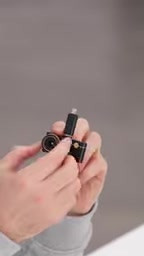
Thermal Master is a phone-attached thermal camera with 8mm macro focus, suited for electronics repair and home inspection.
Thermal Master is a thermal camera that connects to smartphones via Type-C, with a bundled Lightning adapter for compatibility with new and old iPhones and most Android devices. Its standout feature is the built-in rotating focus ring, enabling continuous focus from 8mm macro to distant subjects—clearly revealing the heat of individual PCB components while also handling large-scale outdoor scanning. Compact enough to fit in a pocket, it's ideal for home heat-loss detection, circuit hot-spot troubleshooting, and electronics repair.
A Plug-and-Play Thermal Imaging Solution
Thermal Master is a Type-C thermal imaging camera designed specifically for smartphones, and it ships with a Lightning adapter, making it compatible with both new and old iPhones as well as the vast majority of Android devices. The body features a built-in rotating focus ring that allows smooth focal adjustment, enabling continuous focus from 8mm macro all the way to distant subjects.
Its core value lies in letting ordinary people "see" heat distribution that is invisible to the naked eye. Plug it into your phone, download the app, and you can start thermal scanning—no extra power supply or complicated setup required.
The core principle of thermal imaging is to use an infrared sensor to detect the infrared radiation emitted by an object's surface and convert it into a visual temperature-distribution image. Any object above absolute zero radiates infrared, and the hotter it is, the stronger the radiation—so a thermal imager can "see" heat without any visible light. Unlike ordinary cameras, thermal sensors typically have lower resolution (commonly 160×120 to 256×192 pixels), so image detail is limited, but temperature information is precisely quantified per pixel. Phone-attached thermal modules generally draw power and transmit data via USB Type-C or Lightning, with power consumption usually under 1 watt, so no separate battery is needed. Temperature accuracy for such devices is typically around ±2°C, making them suitable for qualitative troubleshooting rather than precision measurement.
Macro and Distant Subjects, All in One Lens
The biggest differentiating selling point of this device is its 8mm macro capability. The rotating focus ring can focus on extremely close objects—such as a single component on a PCB—clearly revealing its heat generation.
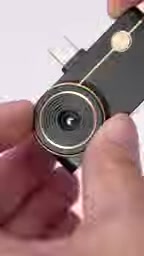
This means it can handle both large-scale outdoor scanning and close-range indoor inspection. For electronics repair technicians, pinpointing abnormal hot spots on a circuit board becomes intuitive and efficient; for ordinary users, it can also be used to check for heat loss at outlets, circuit breakers, window seals, and insulation layers.
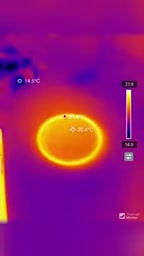
Focusing a thermal lens is similar to focusing a visible-light lens, but because infrared optical materials (commonly germanium) have a different refractive index, a manual rotating focus ring is the most common low-cost approach. 8mm macro focus means an object 8mm in front of the lens can be imaged clearly, which is especially critical for inspecting 0402 or 0603 surface-mount components on a PCB—these components are only about 1mm in size, and without close-up focusing, their heat would blur into a blob in the image. Typical applications of macro thermal imaging also include finding battery swelling, localized temperature rises caused by poor connector contact, and microscopic faults such as cold solder joints on chips. Note that in macro mode the field of view is extremely narrow, so you still need to switch to distant focus when scanning large areas.
An Inspection Tool in Your Pocket
Portability is another major advantage of Thermal Master. It is compact enough to slip easily into a pocket, adding almost no burden when used with a phone. The back of the body has ventilation holes to ensure stability during prolonged use.
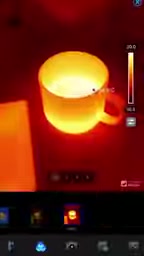
In practice, you can even use it to measure body temperature—in the video demo, readings were around 36.8 to 37 degrees. Although this is not its primary design purpose, it demonstrates the sensor's sensitivity.
Normal human body temperature is about 36.5 to 37.2°C. The accuracy of thermal readings when measuring body temperature is affected by ambient temperature, measurement distance, and skin emissivity. Human skin emissivity is about 0.98, close to an ideal blackbody, so thermal temperature measurement is relatively reliable; however, if measured in an air-conditioned room or right after entering indoors, surface temperature may read low. The 36.8 to 37 degree readings mentioned in the article indicate that the sensor's sensitivity in the normal temperature range is sufficient to distinguish temperature differences at the 0.1°C level—the basic capability needed to identify insulation defects in buildings or abnormal heating in circuits. That said, medical-grade temperature screening typically requires accuracy within ±0.3°C along with blackbody calibration, so consumer-grade thermal modules are better suited for qualitative reference.
Target Users and Buying Advice
Thermal Master has a clear positioning: home inspection, electrical maintenance, electronics repair, and any on-site work that requires quick thermal imaging. It comes with a two-year warranty and a 30-day free trial, and is available through official channels. For professionals who need a portable thermal imaging tool, this is a lightweight option worth considering.
One-line Summary
Thermal Master is a phone-attached thermal camera with 8mm macro focus, suited for electronics repair and home inspection.
Paragraph Summary
Thermal Master is a thermal camera that connects to smartphones via Type-C, with a bundled Lightning adapter for compatibility with new and old iPhones and most Android devices. Its standout feature is the built-in rotating focus ring, enabling continuous focus from 8mm macro to distant subjects—clearly revealing the heat of individual PCB components while also handling large-scale outdoor scanning. The device is compact enough to fit in a pocket, with rear ventilation holes for extended use. Use cases include home heat-loss detection, circuit hot-spot troubleshooting, and electronics repair; in the video demo it can even measure body temperature (readings around 36.8 to 37 degrees). It offers a two-year warranty and a 30-day free trial, positioned as a lightweight thermal imaging tool for professionals on the go.
Related articles

In the Age of AI Programming, Should You Still Write Code by Hand?
Do you still need to write code by hand now that AI programming tools are widespread? A YouTube creator gives a conditional answer: during learning you must type it yourself—friction forces real understanding.

A New App Built Exclusively for Women's Sports, With No Real-Money Gambling
A new app focused exclusively on women's sports launches, aiming to change how fans engage with women's sports and explicitly avoiding real-money gambling. This article analyzes its product logic, compliance considerations, and commercial prospects.

Verge Readers' Black Friday Favorite: Novel Tech Products Beat Discounts
The Verge observes Black Friday reader purchasing behavior: price still matters, but novel tech products are favored in holiday shopping. This article analyzes the trend's implications for tech manufacturers' holiday marketing.