Turning Quantum Measurement Noise into an Asset: Efficient Diffusion Model Generation

Turning quantum measurement noise into a randomness source for diffusion models, greatly reducing measurement costs for quantum neural networks.
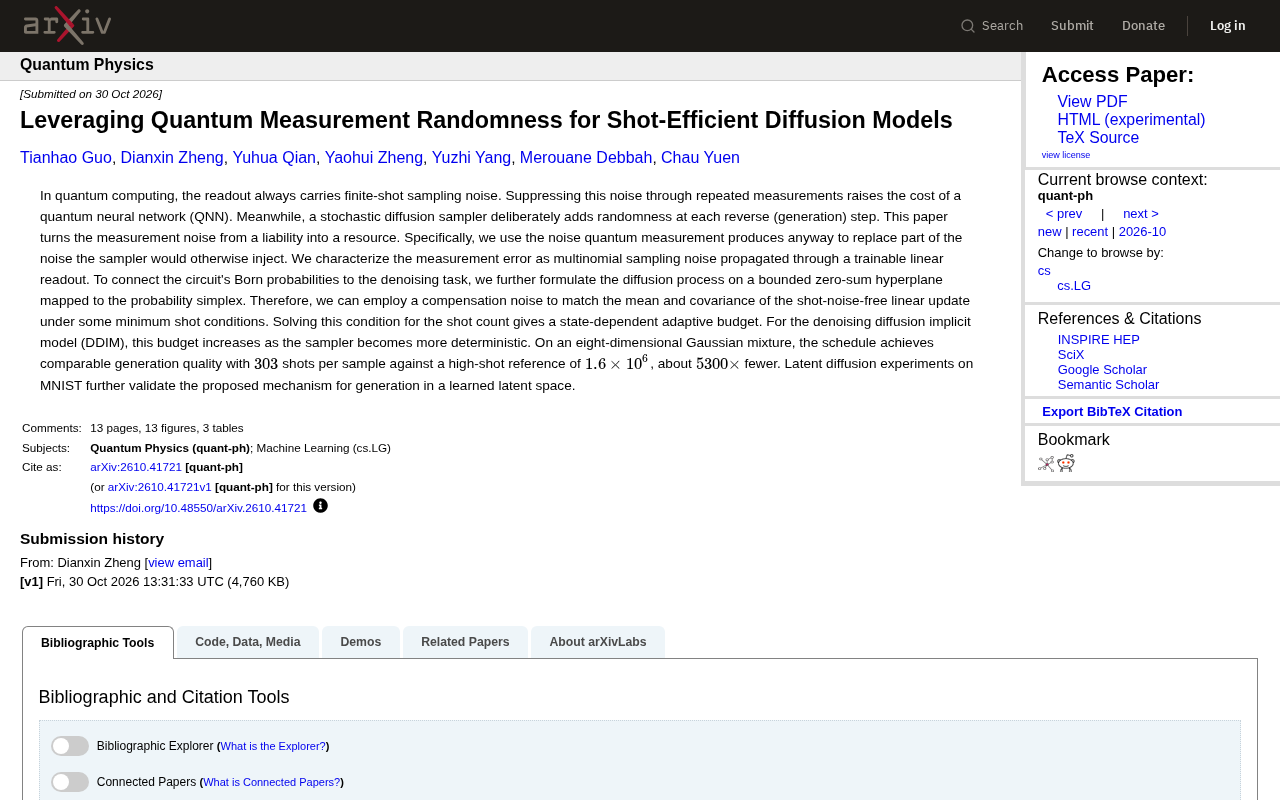
The paper proposes a reverse approach: instead of suppressing finite-shot measurement noise in quantum computing, it uses it as the source of randomness needed for diffusion model generation. The diffusion process is defined on a zero-sum hyperplane mapped to the probability simplex, directly linking the quantum circuit's Born probabilities to the denoising task. By matching the mean and covariance of the noise-free linear update via compensation noise, a state-dependent adaptive measurement budget is derived. In DDIM, the more deterministic the sampler, the higher the required budget. Experiments on an eight-dimensional Gaussian mixture require only 303 measurements per sample to match a 1.6×10^6 high-measurement reference—about 5300 times fewer—and MNIST latent diffusion experiments verify feasibility. This opens a new path for resource-constrained quantum generative models.
Measurement noise in quantum computing is typically seen as interference to be suppressed, but a recent paper flips this thinking: it turns the sampling noise from finite measurements into the source of randomness needed during diffusion model generation. This research not only reduces measurement costs for quantum neural networks (QNNs) but also offers a new perspective on noise scheduling for diffusion samplers.
A Paradigm Shift from "Noise" to "Resource"
In quantum computing, reading a quantum state always comes with finite sampling noise (shot noise). To obtain precise results, the traditional approach is to increase the number of measurements (shots), but this significantly raises the operating cost of quantum neural networks. On the other hand, diffusion models require injecting random noise at each step of the reverse generation process to ensure generation quality.
The core insight of this paper is that quantum measurement itself produces polynomial sampling noise, which can propagate through a trainable linear readout layer and affect the final output. Rather than expending effort to eliminate it, why not use it to replace part of the noise that the diffusion sampler would otherwise add? In this way, measurement noise goes from a "burden" to a "resource."
To realize this idea, the researchers redefine the diffusion process on a bounded zero-sum hyperplane that maps to the probability simplex. This allows the Born probabilities of the quantum circuit to be directly linked to the denoising task.
Shot noise is a fundamental phenomenon in quantum measurement. Unlike classical bits, which can be read losslessly, a quantum state collapses probabilistically to some eigenstate upon measurement. Therefore, to estimate the expectation value of an observable, one must repeatedly prepare and measure a large number of identical quantum states and then collect statistics. The more measurements (shots), the smaller the statistical error of the estimate, with the error decaying roughly as 1/√N. This fluctuation caused by finite sampling is shot noise. In quantum neural networks, each forward pass requires multiple measurements to obtain an output; if high precision is pursued, measurement costs skyrocket, becoming one of the main bottlenecks on near-term quantum hardware.
Probability simplex is the set of all vectors whose components are non-negative and sum to 1, with dimension n-1 (where n is the number of components). The Born probabilities obtained after measuring a quantum circuit naturally satisfy this constraint and can therefore be viewed as a point on the simplex. Diffusion models typically define forward noising and reverse denoising processes in a high-dimensional Euclidean space, but the generated probability distributions should also lie on the simplex. Restricting the diffusion process to a bounded zero-sum hyperplane and mapping it to the probability simplex ensures that the Born probabilities output by the quantum circuit correspond to the denoising task in the same geometric space, allowing quantum measurement results to participate directly in diffusion generation without additional normalization or projection steps.
Combining Adaptive Measurement Budgets with DDIM
The paper further proposes a compensation noise mechanism: under the condition of satisfying a minimum number of measurements, compensation noise is used to match the mean and covariance of the noise-free linear update. Solving this condition yields a state-dependent adaptive measurement budget.
Specifically for Denoising Diffusion Implicit Models (DDIM), this budget increases as the sampler becomes more deterministic. In other words, as the reverse process of DDIM approaches determinism, the required number of measurements is adjusted accordingly, thereby controlling costs while ensuring generation quality.
Experiments on an eight-dimensional Gaussian mixture dataset show that this scheduling strategy requires only 303 measurements per sample to achieve generation quality comparable to a high-measurement reference (1.6×10^6 measurements), a reduction of about 5300 times in the number of measurements. In addition, latent diffusion experiments on MNIST also verified the feasibility of this mechanism for generation in a learned latent space.
DDIM (Denoising Diffusion Implicit Models) is an accelerated sampling method for diffusion models. The reverse process of standard diffusion models is a stochastic Markov chain that injects new noise at each step; DDIM generalizes this to a non-Markovian, step-skipping deterministic or semi-deterministic process. When the stochasticity parameter of DDIM approaches zero, the reverse update becomes a fully deterministic linear transformation and no longer requires additional noise. In the setting of this paper, quantum measurement noise is used to replace the noise that the diffusion sampler would otherwise inject: the closer DDIM is to determinism, the less "free" noise is available, and to maintain the same mean and covariance as the noise-free linear update, more measurements are needed for compensation. Therefore, the adaptive measurement budget increases with increasing determinism.
Implications for Quantum Machine Learning and Generative Models
The significance of this work lies in breaking down the barrier between the two fields of quantum computing and generative models. For quantum machine learning, it offers an approach to reducing measurement overhead: by incorporating measurement noise into algorithm design rather than single-mindedly pursuing high-precision readout, the practical feasibility of quantum neural networks can be significantly improved.
For the diffusion model community, this research suggests that noise sources can be diversified—not limited to classical random number generators, quantum measurement noise can also serve the purpose and may even bring additional computational advantages. Of course, the current experimental scale is still small (eight-dimensional Gaussian mixture and MNIST), and whether it can be extended to more complex datasets and larger-scale quantum circuits remains to be further verified.
Overall, this research opens a new path for resource-constrained quantum generative models: treating noise as a partner rather than an enemy may enable more efficient generation tasks on near-term quantum hardware.
One-line Summary
Turning quantum measurement noise into a source of randomness for diffusion models, greatly reducing measurement costs for quantum neural networks.
Paragraph Summary
This paper proposes a reverse approach: instead of suppressing finite-shot measurement noise in quantum computing, it uses it as the source of randomness required for diffusion model generation. The researchers define the diffusion process on a zero-sum hyperplane mapped to the probability simplex, directly linking the Born probabilities of the quantum circuit to the denoising task, and by matching the mean and covariance of the noise-free linear update through compensation noise, they obtain a state-dependent adaptive measurement budget. In DDIM, the more deterministic the sampler, the higher the required measurement budget. Experiments on an eight-dimensional Gaussian mixture show that only 303 measurements per sample are needed to achieve the generation quality of a 1.6×10^6 high-measurement reference, reducing the number of measurements by about 5300 times; latent diffusion experiments on MNIST also verify feasibility. This work opens a new path for resource-constrained quantum generative models.
Related articles

AI Tools Quietly Altering Settings: Postman Silently Installs Plugin, Codex Sharing Option Auto-Resets
AI Daily reports: Postman silently installs a Mac plugin and self-approves startup hooks, logged as auto-existing upgrade; Hacker News developers say Codex data-sharing opt-out flips back. Plus Simon Willison's raw float weight experiment with QEN 3.8-27B.

AI Learns to Rewrite AI: MIT's "Weightspace Programming" Redraws the Path to Recursive Self-Improvement
MIT team proposes weightspace programming: GPT-6 Astra reads and edits AI model weights directly. Math scores jump several-fold, hand-written networks beat trained models. Eight experiments analyzed, plus Anthropic's same-day warning and the real boundaries of recursive self-improvement.

Running Qwen 3.8 on a Laptop to Read Raw Weights: 46 Minutes Per Answer
Simon Willison reproduced weight space programming with Qwen 3.8 27B on a laptop: a 17GB model file, 46 minutes per answer, 43,506 reasoning tokens, Pong over an hour, Freeway failed. Suited for interpretability researchers.