Turtle Beach Budget Alternative to SteelSeries Headset Review: Is Saving $50 Worth It?
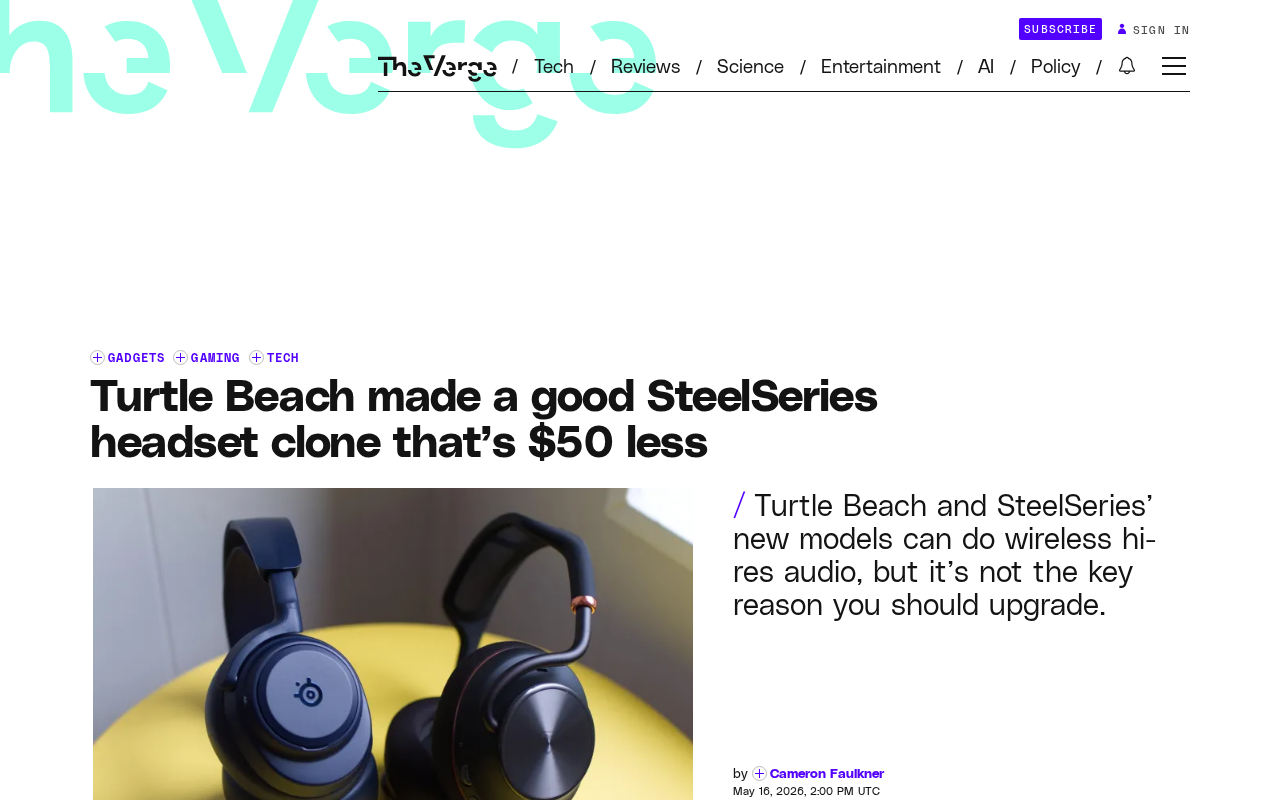
Turtle Beach launches a $50-cheaper rival to SteelSeries' flagship headset, sparking premium gaming audio price wars.
SteelSeries released the $399 flagship wireless gaming headset Nova Pro Omni featuring wireless Hi-Res audio and multi-platform compatibility. Turtle Beach quickly followed with a highly similar competitor at $50 less that earned positive professional reviews. This head-to-head clash between two veteran manufacturers is set to drive down prices in the premium gaming headset market, with future competition shifting toward software ecosystems and brand differentiation.
Turtle Beach Launches a Budget SteelSeries Alternative: Imitation or Innovation?
Turtle Beach recently released a wireless gaming headset that closely resembles SteelSeries' highly acclaimed Arctis Nova Pro Wireless in both design and features — but at a price that's a full $50 less. This move has sparked considerable discussion in the gaming peripherals community: when an established brand openly "pays tribute" to another's flagship product, how should consumers choose?
SteelSeries Arctis Nova Pro Omni: The Flagship Standard Evolves
What's New from Nova Pro Wireless to Nova Pro Omni
SteelSeries' Arctis Nova Pro Wireless, launched in 2022, was the benchmark for wireless gaming headsets, winning over countless gamers with its excellent sound quality, comfortable fit, and multi-platform compatibility. On May 5, 2025, its successor — the Nova Pro Omni — officially went on sale at $399.
The Nova Pro Omni continues the classic design of its predecessor while upgrading in several key areas:
- Wireless Hi-Res Audio: The most significant upgrade — users can now enjoy Hi-Res-level sound quality without a wired connection
- Connectivity and Latency Improvements: Enhanced multi-device switching, connection stability, and low-latency performance
- Refined Industrial Design: Retains the market-proven design elements from the previous generation
Why Wireless Hi-Res Audio Is a Critical Breakthrough
Wireless Hi-Res Audio is one of the most important technological breakthroughs in the gaming headset space in recent years. Traditionally, Hi-Res audio requires sampling rates of 96kHz/24bit or higher — far exceeding the CD-quality standard of 44.1kHz/16bit. However, bandwidth limitations of Bluetooth and 2.4GHz wireless transmission have long forced users to choose between "wireless freedom" and "high-fidelity sound." In recent years, the maturation of codecs like Qualcomm aptX Lossless and LDAC, along with proprietary low-latency wireless protocols developed by manufacturers, have made wireless Hi-Res audio transmission possible. SteelSeries achieving this on the Nova Pro Omni means gamers can get audio detail and dynamic range approaching wired headphones without plugging in — particularly significant for pinpointing footsteps in FPS games and enhancing immersion in rhythm games.
Multi-Platform Compatibility: Simpler Than It Looks, Harder Than You'd Think
Multi-platform compatibility is a core selling point of high-end wireless gaming headsets, but implementing it is far more complex than consumers might imagine. PlayStation, Xbox, Nintendo Switch, and PC each have different wireless audio protocols and certification requirements — for example, Xbox has long lacked support for standard Bluetooth audio, requiring connection via Xbox Wireless protocol or USB adapters; PlayStation has its own independent certification system for third-party wireless devices. For a headset to be compatible with all major platforms simultaneously, it typically needs multiple wireless modules (such as a dedicated 2.4GHz receiver plus Bluetooth) and a base station to manage switching between devices. The signature GameDAC base station of the Nova Pro series was designed precisely to solve this pain point — it serves not only as a wireless receiver but also integrates a DAC (digital-to-analog converter) and audio processing capabilities, enabling seamless switching between PC and consoles.
The $399 price tag is flagship-tier for high-end wireless gaming headsets, but considering the features it offers, it remains competitive among products in the same class.
Turtle Beach's Competitive Strategy: Lower Price, Similar Experience
A "Fast Follower" at $50 Less
Turtle Beach's competing headset bears obvious similarities to the SteelSeries Nova Pro Omni in appearance and core features, but the key differentiator is price — $50 cheaper. In the premium headset market, this price gap is enough to influence many consumers' purchasing decisions.
From a market strategy perspective, Turtle Beach's approach is far from uncommon in consumer electronics. The "Fast Follower" strategy is a standard playbook for mid-sized manufacturers: wait for the market leader to validate the product direction, then launch a similar product at a more competitive price. This strategy carries lower risk because market demand has already been thoroughly proven. Historically, Samsung's following of Apple in smartphones and AMD's competitive pricing against Intel's processor architectures are classic examples. This approach is typically legal — as long as it doesn't infringe on patents or trademarks, design "similarity" alone doesn't constitute infringement. However, it carries risks: the brand may be labeled an "imitator," which can be detrimental to building independent brand recognition and user loyalty in the long run.
A Veteran Manufacturer Not to Be Underestimated
It's worth noting that Turtle Beach is not some upstart newcomer — it's a veteran audio equipment manufacturer with over 45 years of history, starting with professional audio products back in 1975. Around 2005, Turtle Beach astutely pivoted to the gaming headset market and rapidly rose to prominence with console headset products during the Xbox 360 era, becoming the highest market-share gaming headset brand in North America at one point. In 2024, Turtle Beach's parent company completed its integration of ROCCAT, further expanding its product line in the PC peripherals space. This isn't a story of a "small brand challenging a big brand" — it's a head-to-head confrontation between two equally established peripheral manufacturers at the flagship price tier.
Review Performance: More Than Just a Cheap Knockoff
Notably, reviewers gave Turtle Beach's headset a "good" rating, indicating it's not simply a low-quality imitation. A "high-value alternative" endorsed by professional media means Turtle Beach has delivered in the following areas:
- Sound quality meets expectations for the price point
- Build quality and materials show no obvious cost-cutting
- Core features are well-implemented, ensuring a solid everyday experience
Turtle Beach vs SteelSeries: How Should Consumers Choose?
The Premium Gaming Headset Market Sees Price Pressure
This competitive landscape is genuinely good news for gamers. When a $399 flagship faces a strong $349 competitor, prices across the entire high-end wireless gaming headset market could be driven down.
For gamers on a budget who still want a high-quality audio experience, Turtle Beach offers an option worth serious consideration. While the $50 savings isn't a fortune, choosing the more economical option when the experience is comparable is simply smart consumerism.
2025 Wireless Gaming Headset Buying Guide
- If you want the ultimate experience and brand assurance: The SteelSeries Nova Pro Omni remains the safer choice. As the original designer, SteelSeries typically puts more polish into product details, and firmware updates and after-sales support tend to be more reliable
- If you're a pragmatist focused on value: Turtle Beach's alternative is worth serious consideration — especially when core feature differences are minimal, the savings can be put toward other peripherals
- If you're undecided and waiting: Consider holding off until more in-depth professional comparison reviews are available — real-world sound quality differences and long-term usage experience take time to verify
What's Next for the Gaming Peripherals Industry: What Comes After Homogenization?
Competition in the gaming peripherals market is entering a new phase. As product designs become increasingly homogenized, brand premium, after-sales service quality, and software ecosystem integration will become the key differentiators.
Software Ecosystem: The Invisible Competitive Moat
Modern gaming peripheral competition has extended from pure hardware to software ecosystems. SteelSeries' GG software platform (formerly SteelSeries Engine) offers EQ adjustment, spatial audio configuration, ANC (active noise cancellation) level tuning, firmware OTA updates, and more — with the ability to manage keyboards, mice, and other products in a unified interface. The depth of this software ecosystem directly impacts the long-term user experience — a headset's sound quality at launch is just the starting point. Subsequent firmware updates that optimize latency, improve microphone algorithms, and add features (like ChatMix chat-to-game audio ratio adjustment) are what create ongoing value. For Turtle Beach, the maturity and update frequency of its Swarm II software platform will be a critical factor in determining the product's long-term reputation — and a hidden battlefield for closing or widening the gap with SteelSeries.
SteelSeries needs to continue leading in feature innovation, while Turtle Beach must prove it can do more than imitate — that it can create differentiated value on top of a similar foundation.
Regardless of who ultimately wins, the price rationalization and continuous feature evolution driven by healthy competition will ultimately benefit gamers themselves.
Key Takeaways
- SteelSeries launches the $399 flagship Nova Pro Omni headset with wireless Hi-Res audio support
- Turtle Beach releases a highly similar competitor at $50 less, receiving positive reviews
- Intensifying competition in the premium gaming headset market will benefit consumers through price pressure
- As product homogenization trends continue, brand premium and ecosystem integration become key differentiators
Related articles
 Product Reviews
The Programmer's Desk Setup Guide: Building a Workspace That Feels Like Home
Discover how programmers build productive, comfortable workspaces. From multi-monitor setups to ergonomic design, explore the desk philosophy that drives focus and flow.
 Product Reviews
Qoder vs Cursor Real-World Comparison: Which $20/Month AI IDE Is Better?
Hands-on comparison of Qoder vs Cursor AI IDEs: Agent autonomy, human interaction count, and architecture decisions. Qoder needed only 2 interactions vs Cursor's 8.
 Product Reviews
Cursor Cloud Agent Demo: Eliminating Bottlenecks Across the Entire Software Development Lifecycle
Deep analysis of Cursor's Cloud Agent demo showing how cloud VMs, automated test artifacts, and a full-chain control plane systematically eliminate human bottlenecks across the software development lifecycle.